Why do astronomers still prioritize observing G-type stars, even if K-dwarfs show better potential?
Answer
G-type stars are easier to study observationally due to their higher light output.
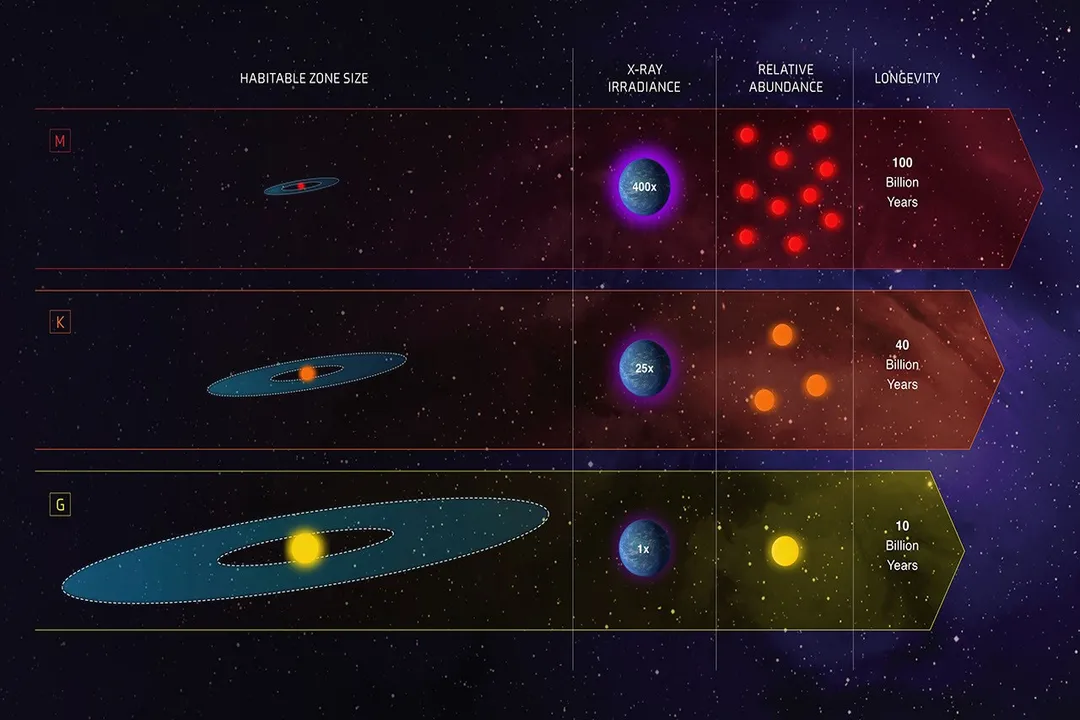
The prioritization in astronomical observation often involves a pragmatic balance between biological potential and observational feasibility. While K-dwarfs are analytically deemed the most suitable targets for hosting life due to their immense stable timescales, G-type stars, such as the Sun, possess a higher light output. This increased luminosity makes them significantly easier targets for current high-powered telescopes, like the Hubble Space Telescope, to study and characterize accurately regarding planetary systems and atmospheric compositions. Therefore, G-stars remain important benchmarks and targets for ongoing research efforts.
Related Questions
Why are K-type stars considered superior to M-dwarfs regarding stellar temperament?What is the primary evolutionary constraint associated with a G-type star like the Sun?What two main factors make F-type stars less suitable for long-term biological development?What primary environmental hurdles do planets face within the habitable zones of M-dwarfs?How long can the main-sequence lifespan of a K-type orange dwarf potentially extend beyond that of the Sun?What critical trade-off makes K-dwarfs the most balanced candidates for habitability?Why do astronomers still prioritize observing G-type stars, even if K-dwarfs show better potential?What non-lifespan factor related to a K-star's history is necessary for terrestrial planet formation?What specific orbital consequence affects planets located very close to M-dwarfs?What characteristic differentiates the habitable zone of F-type stars from that of G-type stars?