What stars are most likely to have life?

The search for worlds capable of harboring life does not focus on just any star illuminating the void; rather, it zeroes in on specific stellar types that offer the best blend of longevity, stability, and mild radiation. This quest begins with the fundamental requirement for life as we understand it: the presence of liquid water on a planetary surface. This critical orbital region is known to astronomers as the Habitable Zone (HZ), or the "Goldilocks zone"—not too hot, not too cold.
# The Habitable Zone

The concept of the Habitable Zone is the starting point for narrowing the astronomical haystack down to a manageable handful of stars. Simply put, every star possesses an HZ, but its size and location depend entirely on the star's mass and intrinsic brightness. A hotter, brighter star pushes the HZ much farther out, creating a wider band of potential habitability. Conversely, a dimmer star forces its HZ to be very tight and close to the stellar body. While liquid water is essential, the search extends beyond just finding a planet in this zone; the star itself must be stable enough to allow life to persist long enough for evolution to take hold.
# Stellar Archetypes
When sifting through the estimated billions of stars in the Milky Way, scientists categorize them based on their suitability for nurturing life. This evaluation usually weighs the star's lifespan against its propensity for energetic outbursts.
# G Dwarfs Sunlike
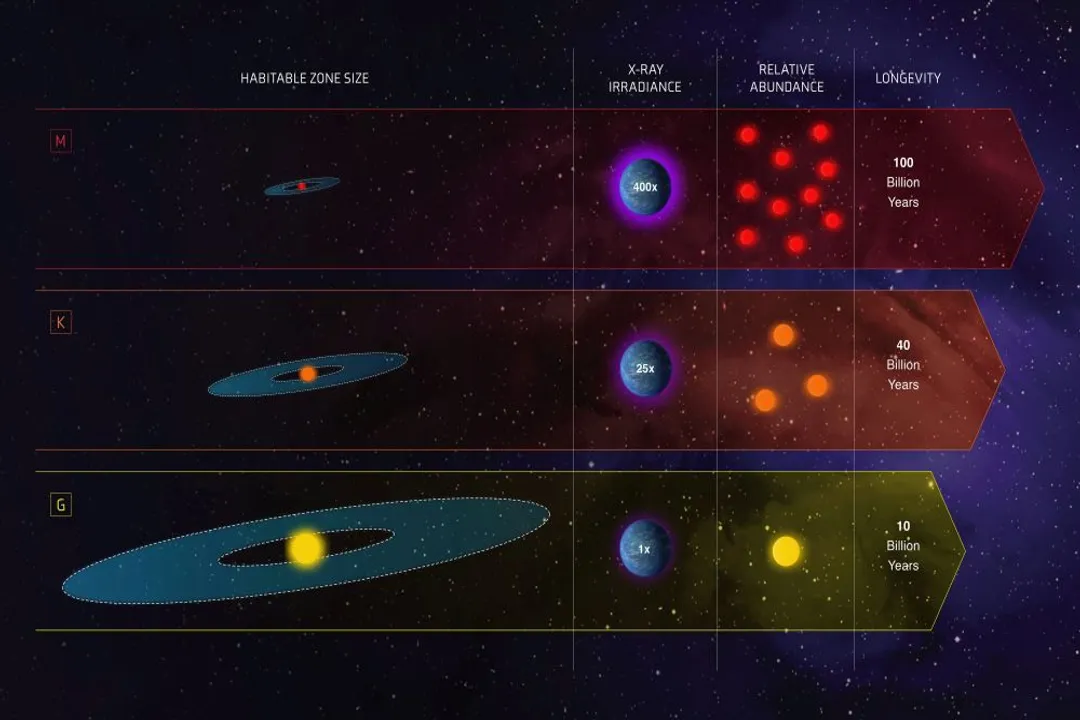
Our own Sun is a G-type main sequence star, a category that has successfully nurtured life on Earth for nearly four billion years. These stars typically have a lifespan of about 10 billion years, meaning our Sun is already about halfway through its tenure. While they are reliable and offer the planet Earth as a confirmed case study, G-dwarfs are relatively uncommon, making up perhaps only 6% of the galaxy’s stellar population. Furthermore, they are less long-lived than some other suitable candidates. Some researchers argue that because Earth exists around a G-type star, it must be the best model, but this relies on a sample size of one.
# K Dwarfs The Sweet Spot
A class of stars slightly cooler and less luminous than the Sun, known as K dwarfs or orange dwarfs, is increasingly favored by astrobiologists seeking the most likely hosts for life. Edward Guinan of Villanova University refers to K-dwarfs as the true "Goldilocks stars" because they strike an ideal balance between the two extremes of G-stars and the more numerous but volatile M-dwarfs.
K-dwarfs make up about 13% of the Milky Way population, meaning they are more abundant than Sun-like stars. Crucially, they are significantly longer-lived, burning steadily for 15 to 45 billion years. This extended lifespan offers a vast timescape—potentially double that of the Sun—for complex biological evolution to proceed without the primary threat of stellar death. Over the Sun’s entire 10-billion-year run, K stars only increase their brightness by about 10–15%. They also emit substantially less of the dangerous, atmosphere-stripping X-ray and ultraviolet (UV) radiation that plagues their smaller cousins. Researchers in the GoldiloKs Project, utilizing data from observatories like the Hubble Space Telescope, have focused heavily on these intermediate stars because their properties seem ideal for long-term habitability. For instance, the Kepler-442 system, host to the rocky world Kepler-442b, is often cited as a prime example of a "Goldilocks planet hosted by a Goldilocks star".
If we consider evolutionary time as a key metric, a planet orbiting a K-dwarf that has already lived 10 billion years has effectively had twice the time to develop advanced life compared to one orbiting a G-star of the same age. This difference means that if we detect life around a K-dwarf, we might be looking at a civilization potentially much older and more technologically advanced than our own.
# M Dwarfs The Common Problem
M-dwarfs, or red dwarfs, are the workhorses of the galaxy, constituting about 73% of all stars. Their sheer abundance suggests they should host the most life-bearing planets. However, they present significant drawbacks. Because they are so small and cool, their Habitable Zones are extremely close to the star.
Planets orbiting this close are highly susceptible to tidal locking, where one hemisphere permanently faces the star while the other remains in eternal darkness, leading to catastrophic temperature extremes. Even more concerning is the high volatility of young M-dwarfs. They are notorious flare stars, emitting powerful, unpredictable bursts of energy, including X-rays and UV radiation that can sterilize surfaces or completely strip away a planet’s atmosphere over geological timescales. While some studies suggest a planet might survive this early barrage, the consensus has shifted away from them being the best targets for finding advanced life. The famous TRAPPIST-1 system, for example, is an M-dwarf, and early atmospheric data from the James Webb Space Telescope for one of its seven Earth-sized worlds, TRAPPIST-1d, suggests a lack of atmosphere.
# High Mass Short Ages
Stars significantly larger and hotter than the Sun, such as F, A, B, and O-type stars, are generally excluded from the top candidate lists. Stars above the F-type burn through their fuel much too quickly, often lasting only a few hundred million years, a timescale widely considered too brief for life to arise and evolve complexity. These massive stars also tend to output high levels of damaging UV radiation.

# Non-Standard Systems
The search isn't strictly confined to single-star systems. Binary star systems, where two stars orbit a common center of mass, are incredibly common, estimated to make up between half and three-quarters of all stellar neighborhoods. While the gravitational dynamics in these systems were once thought to preclude stable HZs, new mathematical models suggest otherwise.
Researchers have shown that five known systems—Kepler-34, -35, -38, -64, and -413—that already host giant planets can still maintain a permanent Habitable Zone. In the case of Kepler-38, which contains a Neptune-sized planet, the system is considered a strong candidate for hosting an Earth-like world with liquid oceans. This demonstrates that the presence of large neighbors does not automatically rule out the possibility of life around the central stars.
In addition to multiple stars, the fate of dead stars is being reconsidered. While previously dismissed, computer simulations now suggest that white dwarfs, the remnants of stars like the Sun, could potentially host habitable exoplanets. Because white dwarfs are much colder, their HZ is very close to the remnant core. A rocky planet here would likely be tidally locked, but fast rotation in the simulation could allow for atmospheric heat circulation, keeping the planet above freezing and maintaining liquid water. With approximately 10 billion white dwarfs in the Milky Way, this possibility drastically expands the number of potential targets for life-hunting missions.
# Nearest Targets Observation
While statistical abundance points toward M-dwarfs, the practical reality of detection and characterization imposes a bias toward closer, more observable stars. Astronomer Margaret Turnbull developed a "habstar" list prioritizing stars old enough (at least 3 billion years) to have allowed life to evolve, while also being similar to the Sun.
For current radio astronomy efforts, like the Allen Telescope Array, Turnbull favored Sun-like stars such as Beta Canum Venaticorum and 18 Sco. For planned direct-imaging missions, like NASA’s Terrestrial Planet Finder (TPF), the list included nearby K-dwarfs and G-dwarfs like Epsilon Eridani (a K-dwarf) and Tau Ceti (a G-class star).
This focus on nearby targets illustrates an important point in astrobiology: the most habitable star may not be the one we prioritize for initial study. Instead, the stars we can observe with current or near-future technology—the ones that are closest—often receive the most attention, regardless of their specific spectral type. Alpha Centauri, only 4.35 light-years away, is a triple-star system and the closest stellar neighbor to our Sun, with estimates suggesting a rough 75% probability of finding a habitable planet around the A or B components. Even Proxima Centauri, the absolute closest star at 4.22 light-years, hosts Proxima b in its HZ, though its red dwarf nature raises major habitability concerns regarding tidal locking and stellar activity. The planet Wolf 1069 b, discovered 31 light-years out, is an Earth-mass world confirmed to be in its star's habitable zone, though it is also likely tidally locked.
# Measuring Radiative Stability
The difference between the Sun-like G-stars and the smaller K-stars is vividly highlighted by their high-energy emissions. A stable environment is one where the star’s output doesn't swing wildly or deliver sterilizing doses of hard radiation. K-dwarfs, being intermediate, are simply less active and hostile than M-dwarfs. Researchers found K-stars emit significantly less deadly X-rays compared to their dimmer cousins. Furthermore, any radiation increase over their long lives is minimal—only about 10–15% over 10 billion years. This contrasts with the potential for highly energetic behavior in younger G-stars and the perpetual volatility of M-stars, cementing the K-dwarfs’ status as the most promising stellar class for sustained, complex biology. For a planet to maintain its atmosphere over cosmic timescales, a quiet host star, such as a middle-aged K-dwarf, offers the most benign conditions for long-term geochemical cycles necessary for life.
#Videos
These Are The Best Stars to Find Potentially Habitable Earth Like ...
Related Questions
#Citations
Which type of star is the most habitable? : r/askastronomy - Reddit
The Perfect Stars to Search for Life On Their Planets - Universe Today
List of nearest terrestrial exoplanet candidates - Wikipedia
Top 10 List of Habitable Stars to Guide Search - Space
10 billion Milky Way stars might have habitable exoplanets after all
The Habitable Zone - NASA Science
Goldilocks stars best for alien life? | Space - EarthSky
Researchers identify five double star systems potentially suitable for ...
These Are The Best Stars to Find Potentially Habitable Earth Like ...