What causes the transition from a Sun-like main sequence star to a red giant?
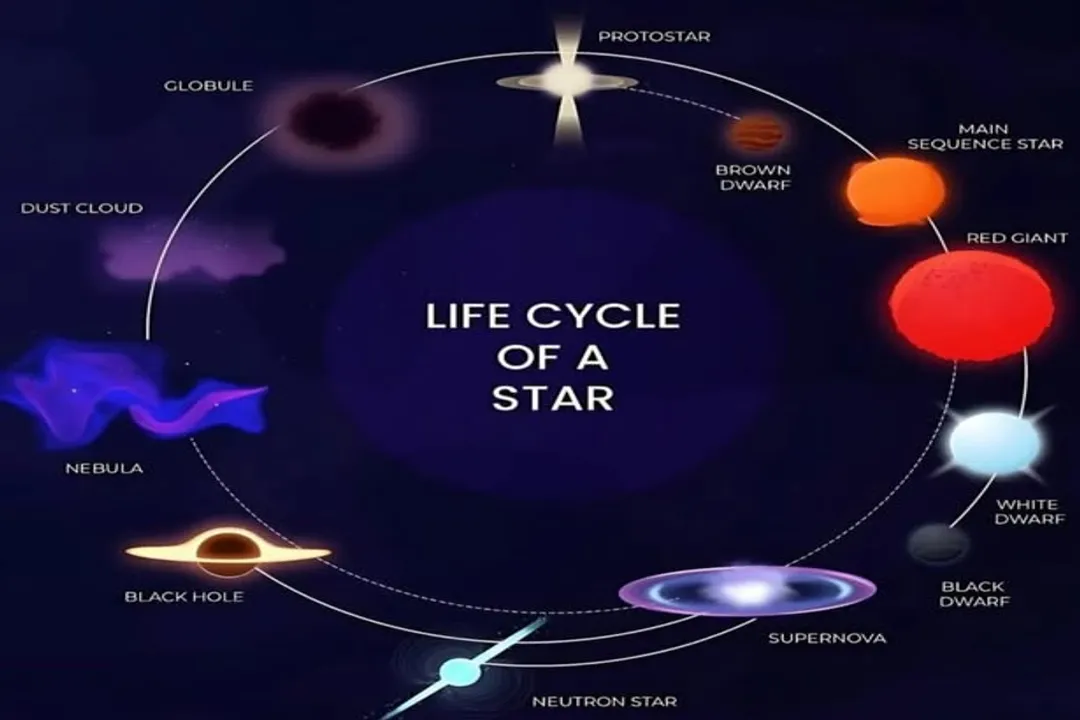
The eventual fate of a star like our Sun is one of the most dramatic transformations in the cosmos, a shift from a stable, middle-aged yellow dwarf to a bloated, luminous red giant. This transition marks the end of a star's primary life phase and initiates its final, expansive death throes. For billions of years, our Sun has existed in a state of equilibrium, a delicate balance between the crushing force of its own gravity trying to collapse it inward and the explosive thermal pressure generated by nuclear fusion deep within its core. This stable period, known as the main sequence, is where a star spends the majority of its existence, steadily consuming the most readily available fuel in the universe: hydrogen.
# Stable Fusion
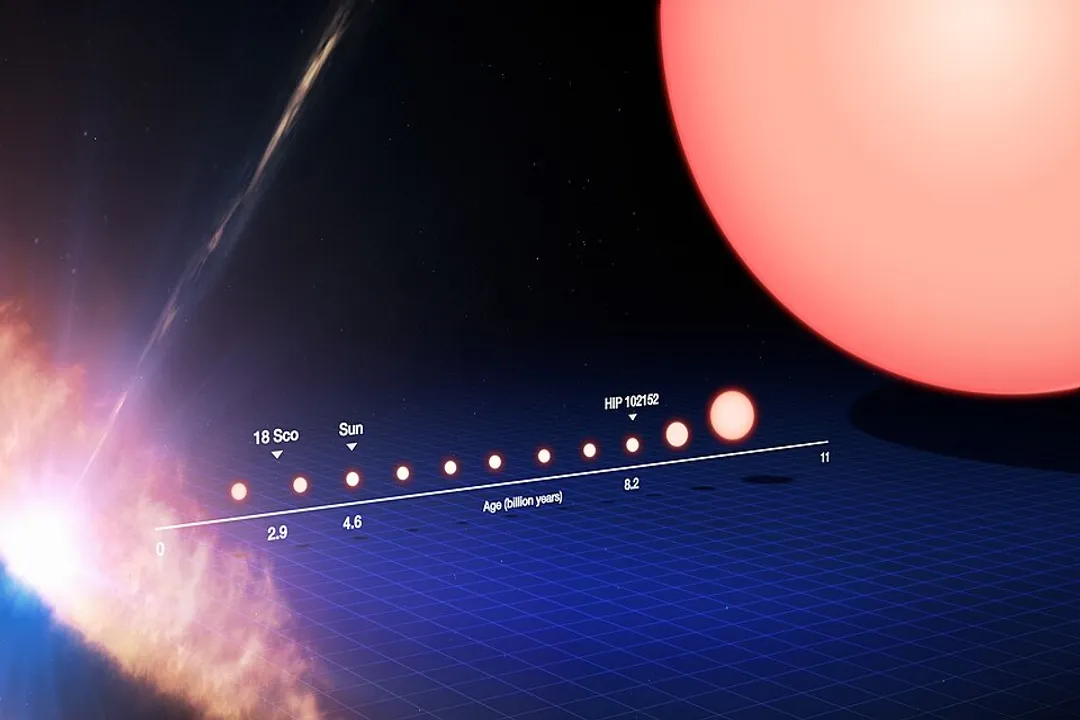
During its main-sequence life, a star like the Sun generates energy by fusing four hydrogen nuclei (protons) into one helium nucleus in its core. This process releases an immense amount of energy, which is what provides the outward pressure counteracting gravity. The Sun has been on the main sequence for about $4.6$ billion years and is expected to remain there for roughly another five billion years. Stars in this phase are characterized by having a core composed primarily of the ash from this fusion—helium—while the surrounding layers still burn hydrogen.
The star’s position and properties during this long phase are dictated almost entirely by its initial mass. Our Sun, being an average star, maintains a relatively consistent size and temperature while burning its core hydrogen slowly and efficiently. However, even small changes in the star's internal composition set the stage for the massive upheaval to come. As the fusion reactions proceed, the amount of hydrogen available in the very center of the star gradually decreases.
# Core Exhaustion
The key trigger for the red giant phase is the depletion of hydrogen fuel in the star’s core. Once the core runs out of hydrogen to convert into helium, the fusion furnace at the center sputters to a halt. With fusion stopping in the innermost region, the outward thermal pressure vanishes there, and gravity immediately takes over, causing the inert helium core to begin contracting under its own weight.
This gravitational collapse is a critical step. As the core shrinks, the surrounding material—specifically, the layer just outside the inert helium core—is compressed and heated immensely. In stars of about one solar mass, this heating becomes so intense that the hydrogen remaining in this shell ignites violently, beginning a new, frantic phase of fusion. This process is different from the initial main-sequence burning because the fuel is now located in a shell rather than a centralized core.
If we consider the structure of a Sun-like star nearing this point, it resembles an onion: a shrinking, inert helium center, surrounded by a thin, intensely hot layer of shell hydrogen fusion, enclosed by the vast, cooler outer layers. The energy output from this newly ignited shell fusion is significantly greater than the energy output from the previous core fusion.
# Shell Burning
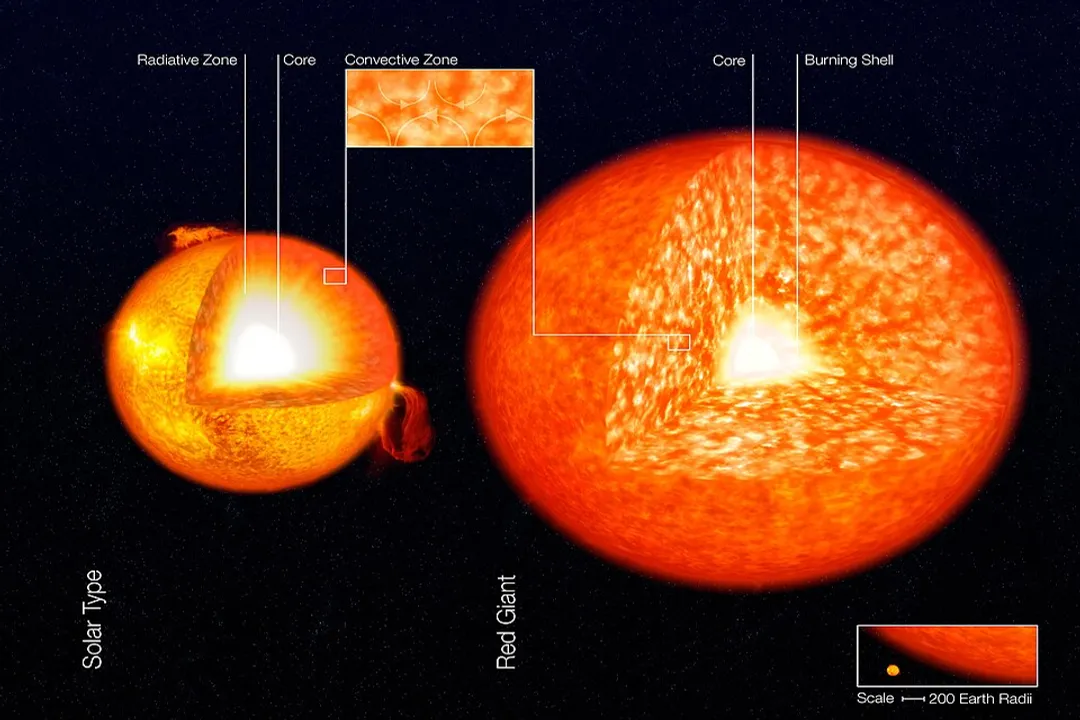
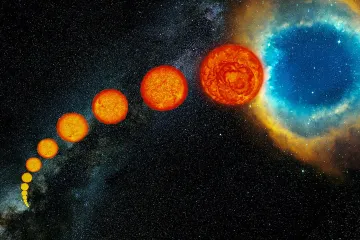
The dramatic increase in energy production from the hydrogen-burning shell is what drives the star toward its red giant appearance. This surplus of energy pushes outward on the star's outer layers with overwhelming force. Because the outer layers are no longer supported by the steady pressure from a core-sized furnace, they begin to expand enormously.
The star swells to hundreds of times its original diameter. While the total energy output (luminosity) increases substantially due to the larger surface area, the energy is now spread over a much vaster region. This spreading causes the surface temperature to drop significantly. A cooler surface temperature shifts the star's peak emission toward the red end of the spectrum, hence the name red giant.
It is fascinating to observe how a star can appear brighter overall while simultaneously becoming cooler at its surface. This is a direct consequence of the area-over-distance law applied to radiating surfaces. If a star expands to, say, 100 times its radius, its surface area increases by a factor of $100^2$, or $10,000$ times. Even if the surface temperature drops by a factor of two, the total energy radiated will be much higher. Think of it like turning a small, very hot lightbulb into a massive, dim red heater—the heater covers far more area, putting out more total heat, but any single point on its surface is much cooler than the original filament.
# Core Contraction Dynamics
The continuous gravitational collapse of the helium core underneath the burning hydrogen shell is the engine driving the entire expansion. This contracting core heats up dramatically, even though it is not generating energy via fusion yet. The pressure in the core eventually becomes so immense that the helium atoms begin to interact via electron degeneracy pressure.
For stars near the Sun's mass, this core contraction leads to a runaway heating effect. The core becomes incredibly hot and dense, but because it is supported by degeneracy pressure—a quantum mechanical effect that resists further compression—it doesn't immediately expand to relieve the pressure. The temperature rises, but the core itself doesn't grow or cool until a critical temperature is reached.
When the core temperature finally hits about $100$ million Kelvin, the helium ignites, not gradually, but explosively. This event is known as the Helium Flash.
# The Helium Flash
The Helium Flash represents a dramatic, though internal, punctuation mark in the star's evolution. In a Sun-like star, the helium fusion begins suddenly because the core is degenerate and unable to regulate the temperature through expansion; it cannot "turn down the thermostat". Once the temperature threshold is met, the rate of fusion skyrockets almost instantaneously.
This rapid ignition converts the inert helium into carbon and oxygen. The enormous burst of energy briefly destabilizes the core structure, and the core begins to expand, eventually becoming hot enough to allow for normal thermal pressure to take over from the degeneracy pressure. At this point, the star settles into a second, much shorter period of core fusion, burning helium into carbon in its center while the hydrogen shell outside continues to burn. This phase lasts only until the helium fuel in the core is exhausted.
# Red Giant Scale
The dimensions of a red giant are staggering compared to its main-sequence ancestor. When our Sun enters this phase, its outer layers will swell far past the orbit of Mercury and likely engulf Venus. Some models suggest the outer edge could even reach Earth's current orbit, rendering our planet uninhabitable long before the physical engulfment occurs due to intense stellar winds and heating.
A comparison of sizes helps illustrate the change:
| Stellar Phase | Approximate Radius (Solar Radii, ) | Surface Temperature (K) | Luminosity (Solar Luminosities, ) |
|---|---|---|---|
| Main Sequence (Sun Today) | |||
| Red Giant Maximum | |||
| Helium Burning Core | Slightly smaller than maximum | Varies | Varies |
This table highlights that the star’s dramatic increase in size and total energy output is intrinsically linked to its cooler surface temperature. This massive inflation is not instantaneous; it is a process that takes hundreds of millions of years for the Sun to complete its climb up the giant branch, though the final dramatic expansion phase can occur relatively quickly once helium ignition starts.
# Post-Helium Ascent
After the core helium is exhausted, the star develops a core of largely inert carbon and oxygen, surrounded by a shell of helium fusion, which is, in turn, surrounded by a shell of hydrogen fusion. The star's structure becomes even more complex: a degenerate carbon/oxygen core, a helium-burning shell, a less-dense helium layer, a hydrogen-burning shell, and the immense, expanded envelope. This configuration pushes the star to even greater sizes and luminosities, climbing higher on the Hertzsprung-Russell diagram.
This late-stage instability leads to significant mass loss via strong stellar winds and pulsations. A star like the Sun is expected to lose a substantial fraction of its mass during this highly evolved phase, possibly ejecting up to 50% of its total mass into space. This ejected material forms the beautiful, glowing shell we call a planetary nebula.
# Mass Thresholds
It is important to recognize that not all stars follow this exact path. The determining factor for whether a star avoids an explosive end and instead evolves into a red giant, then a white dwarf, is its initial mass. Stars significantly more massive than the Sun (roughly $8$ times the Sun’s mass or more) will bypass the electron-degenerate helium flash, fuse heavier elements past carbon and oxygen, and face a much more catastrophic end involving a supernova explosion.
For stars in the solar mass range, the process hinges on whether the core ever reaches the density required for electron degeneracy before helium fusion begins. Our Sun is just below the mass threshold required for a violent core ignition, instead experiencing a flash moderated by its expanded size.
The minimum mass required for a star to ignite helium fusion at all is about $0.5$ solar masses. Stars below this limit simply contract until they become faint helium white dwarfs without ever expanding into a red giant phase, essentially fading away slowly. Therefore, the transition to a red giant is reserved for stars that have enough mass to generate the requisite core temperature after the initial hydrogen supply is spent, but not so much mass that they violently skip the gentle, expansive death described here. The boundary between a fading low-mass star and a pulsating giant is surprisingly razor-thin in terms of initial stellar weight.
# Time Scale Insight
One way to contextualize this stellar life event is by comparing the duration of the main sequence to the red giant phase. Our Sun spends roughly $10$ billion years fusing hydrogen in its core. However, the subsequent phases—the ascent to the giant branch, the helium-burning phase, and the final ascent toward the carbon/oxygen core—last only a small fraction of that time. The entire transition from the main sequence to the stable helium-burning giant stage is expected to take only a few hundred million years, meaning the star spends perhaps $90%$ of its life in stable hydrogen burning and $10%$ or less in all the subsequent, more dramatic phases. The end stages, though spectacular, are relatively swift cosmic endeavors.
# Structure Insight
A deep dive into the structure reveals that the "red giant" is really a set of nested spheres of activity surrounding a shrinking core. If we could somehow stop the Sun just as it hits its peak giant size, we would find a structure far more complicated than its main-sequence self. It’s an inert lump of stellar ash () at the center, encased by a shell of burning into , which is then surrounded by a still-burning shell of into , all wrapped in a gigantic, tenuous atmosphere that might extend out past the terrestrial planets. This layered cooking process, driven by the core's initial failure, creates a much higher total energy flux than the original central engine ever could, illustrating that stellar death is often far more energetic than the stable life preceding it. The mass loss is a direct consequence of this structural instability and intense thermal stratification.
Related Questions
#Citations
Evolution from the Main Sequence to Red Giants | Astronomy
Why do stars become red giants? - Astronomy Stack Exchange
Red giant - Wikipedia
The Transition to the Red Giant Phase for Sun-like stars | ASTRO 801
Chapter 6: Aging Into Gianthood - NASA Science
The lifecycle of stars: red giant phase - Facebook
What causes a star like the Sun to turn into an orange/red giant or a ...
Stellar Evolution - | The Schools' Observatory
Ask Astro: How quickly will the Sun become a red giant?