How do stars go from main sequence to red giant?
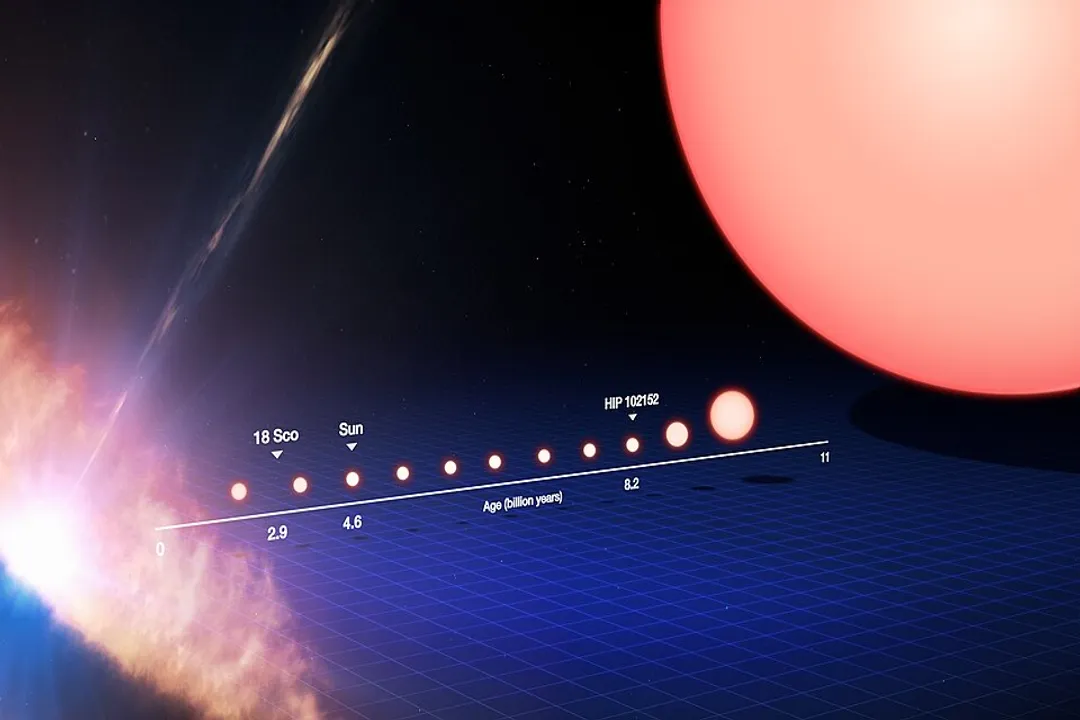
The life of a star is a constant, silent battle between two fundamental forces: the relentless inward crush of gravity and the explosive outward pressure generated by nuclear fusion. [1][8] For the vast majority of a star's existence, this equilibrium holds firm, defining the stable, long-lived main sequence phase. [1][8] Our own Sun is presently positioned in this middle age, diligently converting hydrogen into helium within its scorching core. [1][8] This thermonuclear engine provides the necessary support against its own enormous mass, keeping the star a relatively consistent size and temperature for billions of years. [1]
# Hydrogen Depletion
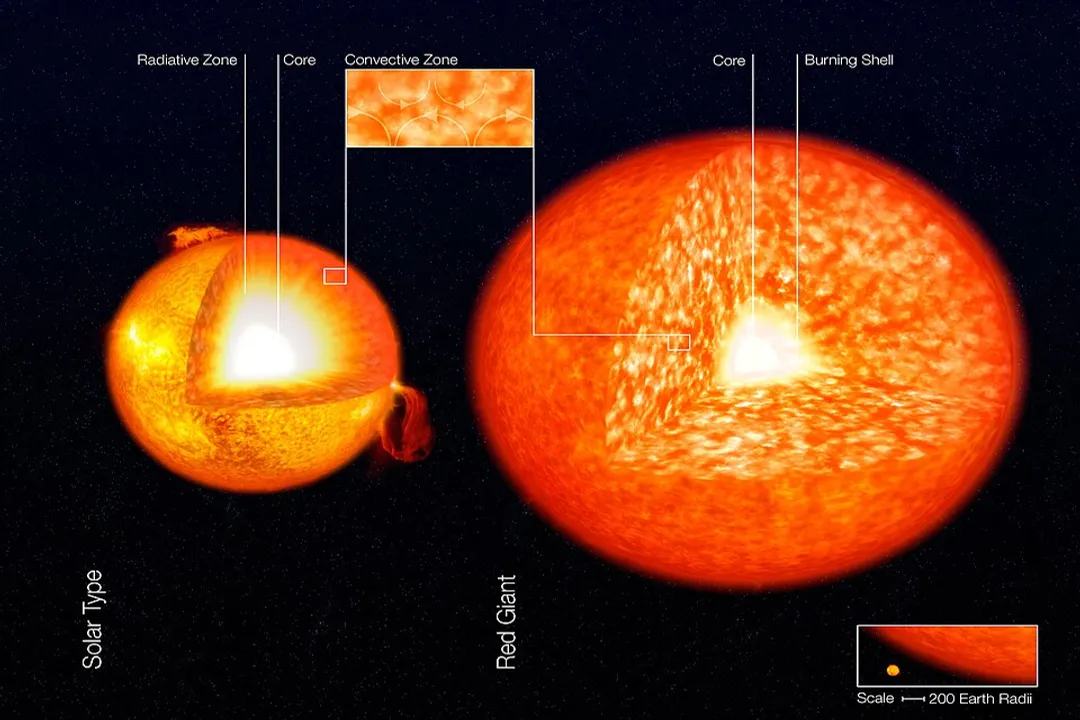
The main sequence reign ends not with a bang, but with the simple, unavoidable exhaustion of fuel at the center of the star. [1][10] Once nearly all the hydrogen in the stellar core has been transmuted into helium—an element that cannot be fused at the current core temperatures—the primary source of outward pressure vanishes. [1][10] This cessation of fusion in the core is the critical turning point in a star's life. [1]
# Core Collapse
When the fusion furnace in the center sputters out, gravity immediately gains the upper hand. [1][5] With no internal pressure pushing back, the inert helium core begins to contract under its own weight. [1][5][10] This gravitational compression is surprisingly violent, causing the core material to heat up immensely, even though it is no longer generating energy through hydrogen fusion. [1][10]
While the core shrinks and heats, the layers of material immediately surrounding the helium center still contain plenty of unused hydrogen. [1][6] As the core contracts, it heats these surrounding layers to the point where hydrogen fusion ignites in a shell around the now-dead core. [1][5][10] This process is sometimes called hydrogen shell burning. [1]
This shell burning is not as stable as core fusion was; it tends to be more vigorous, releasing a tremendous amount of energy. [1] In fact, the energy output from this shell fusion can significantly exceed the star's previous total luminosity when it was fusing hydrogen throughout its core. [1]
# Stellar Swelling
The massive energy surge originating from the hydrogen-burning shell pushes outward against the star's remaining outer layers with extreme force. [1][5] This intense pressure forces the outer envelope of the star to expand dramatically, sometimes reaching hundreds of times its original radius. [1][5]
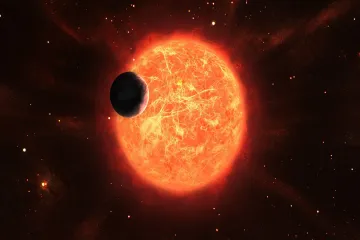
As these enormous outer layers move outward, they also cool down significantly. [1][5] This cooling causes the star's surface color to shift from its main sequence yellow or white to a distinct, cooler shade of red. [1][2] The star has now officially transitioned from a stable main sequence star into a red giant. [2][3]
Consider the Sun: when it begins this transition in about five billion years, its diameter is predicted to swell so much that it will likely engulf the orbits of Mercury and Venus, potentially even reaching Mars. [1][3] While the star becomes enormous in physical size, the density of its outer layers plummets due to this expansion. [6]
# Evolution Across Masses
The specific path a star takes after leaving the main sequence is dictated almost entirely by its initial mass. [5][6] Low-to-intermediate mass stars, like the Sun (which is typically defined as having less than about eight times the mass of the Sun), follow the path directly to the red giant phase. [2][5][6]
For a star like the Sun, the internal mechanics that follow the red giant phase are quite specific. Once the core becomes sufficiently hot and dense—requiring a core temperature of around $100$ million Kelvin—the helium ignites in a rapid event called the helium flash, allowing the star to begin fusing helium into carbon and oxygen in its core. [10] This marks the next major evolutionary step, moving the star off the "classical" red giant branch for a time. [10]
Massive stars, however, bypass or rapidly move through the standard red giant phase. Stars with masses greater than about eight solar masses become red supergiants. [2][5] These giants are far more luminous and their core fusion proceeds to heavier elements in successive, nested shells, leading to a much more dramatic end than their lower-mass cousins. [6] The primary difference is that the larger star's gravity is strong enough to initiate fusion of heavier elements before the shell burning creates an unmanageable expansion. [5]
| Stellar Mass Category | Main Sequence Luminosity | Post-MS Evolution Stage | Core Fusion Trigger |
|---|---|---|---|
| Low Mass (Solar mass) | Moderate | Red Giant | Helium Flash ($10^8$ K) [10] |
| High Mass () | High | Red Supergiant | Continues sequential fusion [5][6] |
The contrast in longevity is staggering. A star like the Sun spends roughly $10$ billion years on the main sequence. [1] In comparison, once the hydrogen in the core is gone, the subsequent red giant phase, leading up to the helium ignition, is incredibly brief, perhaps only a few hundred million years. [10] This difference highlights just how long the stable, hydrogen-burning phase dominates stellar existence.
# Stellar Atmospheres
As a star enters the red giant phase, the physics governing its atmosphere changes radically, leading to phenomena that are not seen on the main sequence. The cooler, extended outer envelope becomes susceptible to much stronger stellar winds. [3]
The Hubble Space Telescope and other observatories have captured dramatic images of these shedding outer layers. [3] The expanded atmosphere allows the star to lose mass at a much higher rate than it did during its main sequence life. [3] This expelled gas forms an expanding shell, often illuminated by the hot inner layers, sometimes resulting in beautiful planetary nebulae later in the star's life (though this occurs after the helium-burning phase for solar-mass stars). [3] This mass loss is a significant factor in determining the final remnant left behind after the star dies. [3]
For a star approaching this transition, the effect on any orbiting planets is catastrophic, not just due to the physical engulfment, but because the star's luminosity increases so much during the ascent to the red giant phase, potentially boiling away the atmospheres of nearby worlds long before physical contact is made. [1] It is a common misconception that the main sequence is the only stable period; rather, the subsequent stages are marked by rapid structural change driven by new, sometimes unstable, sources of energy generation.
# Comparing Luminosity and Size
A key takeaway when examining the shift from main sequence to red giant is the difference in stellar properties, which can be mapped on a Hertzsprung-Russell (H-R) diagram. On this diagram, main sequence stars follow a diagonal track based on their mass and temperature. [8]
When a star becomes a red giant, its temperature drops (moving it right on the H-R diagram), but because its radius swells so immensely, its overall luminosity skyrockets (moving it up the diagram). [1] For instance, while the surface of a red giant might be only $3,000$ Kelvin, its enormous surface area means it can shine hundreds or even thousands of times brighter than it did when it was a main sequence star with a surface temperature near $6,000$ K. [1] This expansion represents a massive internal redistribution of energy, where the star is attempting to find a new hydrostatic equilibrium by spreading the shell-generated heat over a vastly greater area. [5]
If one were tracking a star’s position over time on an H-R diagram, the main sequence phase is a long, horizontal stay; the departure into the giant phase is a steep, rapid climb upward and to the right, signaling the structural crisis that has begun in the core. [8] The star literally redraws its own location on this fundamental stellar map because its basic physical characteristics have fundamentally changed. [8]
# The Helium Core Dilemma
The entire red giant phase is essentially a holding pattern—a temporary state while the star struggles to deal with the inert helium ash accumulating in its center. [10] The star cannot fuse helium until the core gets hot enough, but the core only gets hot enough because the star is already undergoing the violent expansion caused by the hydrogen shell burning. [1][10] It is a paradoxical dependence: the star must swell into a giant to create the conditions necessary to stop being a giant. [5]
For solar-mass stars, the lack of degeneracy pressure when helium ignition occurs leads to the aforementioned flash, which stabilizes the core by initiating a new, more powerful fusion process. [10] For more massive stars, the increasing core temperature and density allow helium fusion to begin more gradually, without a runaway thermal pulse, because the greater gravity compresses the core more effectively throughout the earlier phases. [5][6] The fate of the subsequent evolutionary stages hinges entirely on how this central helium ash is eventually dealt with, making the red giant phase the definitive gateway between stellar youth and middle age. [6]
Related Questions
#Citations
Evolution from the Main Sequence to Red Giants | Astronomy
Red giant - Wikipedia
Red Giant - ESA/Hubble
G. C. Sloan: Main Sequence Stars, Giants, and Supergiants
Why do stars become red giants? - Astronomy Stack Exchange
The Transition to the Red Giant Phase for Sun-like stars | ASTRO 801
Stellar Evolution - | The Schools' Observatory
Ch. 22 Summary - Astronomy 2e | OpenStax
Why Do Stars Turn Red? I. Post-Main-Sequence Expansion ... - arXiv
Red Giant Branch - Astronomy 1101 - The Ohio State University