How long do stars stay in the main sequence stage?
The stable, long-lived phase of a star's existence, known as the main sequence, is defined by a singular, continuous process occurring deep within its core: the fusion of hydrogen atoms into helium. [1][2][3][7] This phase represents the majority of any star's life, acting as a benchmark against which stellar evolution is measured. [3][10] The question of precisely how long this peaceful period lasts is one of the most fundamental in astrophysics, and the answer is almost entirely determined by one initial characteristic: the star's mass. [4][9] A star’s mass dictates its internal pressure, core temperature, and, most critically, its rate of fuel consumption, creating an inverse relationship between size and longevity. [4][9][10]
# Stellar Stability
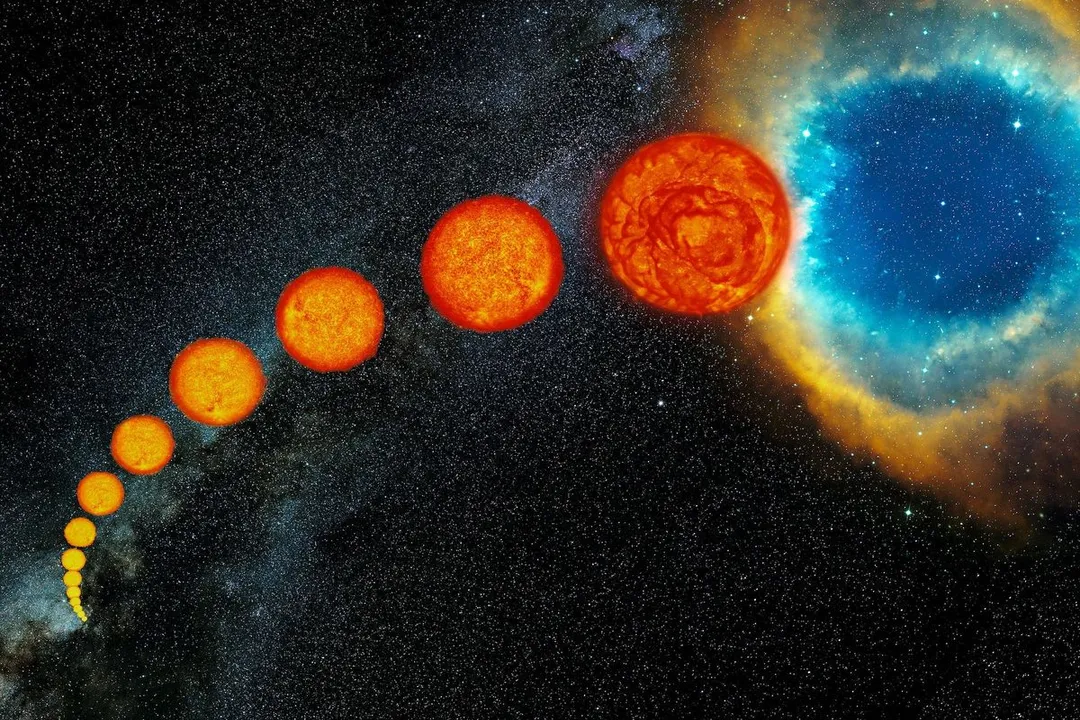
For a star to reside on the main sequence, it must have achieved a delicate equilibrium known as hydrostatic balance. [2][7] This balance is the standoff between the inward crush of gravity and the outward pressure generated by the energy released from nuclear fusion in the core. [2] When a protostar contracts under gravity until the core temperature and density reach a critical threshold—about $15$ million Kelvin—hydrogen fusion ignites. [1][2] At this moment, the star officially joins the main sequence. [1][7] As long as there is usable hydrogen fuel in the core to sustain this fusion, the star remains in this steady state. [1][2][3] Stars are born onto this sequence, and they remain there until the hydrogen supply in the very center of the star is exhausted, triggering the next evolutionary stage. [1][2]
# Mass Dictates Burn Rate
The duration a star spends on the main sequence is intrinsically tied to how quickly it burns its nuclear fuel. [4] More massive stars possess a greater gravitational force pressing inward, requiring a significantly higher core temperature and pressure to maintain balance. [9] This increased energy demand translates directly into a vastly accelerated rate of hydrogen fusion. [4][10]
Consider a star with ten times the mass of our Sun. While it has ten times the fuel supply, its energy output—its luminosity—is thousands of times greater. [4] This means it consumes its reservoir of hydrogen fuel at a staggering pace compared to a less massive star. [9] This fundamental difference in fuel consumption rates is why the lifespan varies so dramatically across the stellar population.
# Lifespan Contrasts
The scale of main-sequence lifetimes spans an astonishing range, covering nearly the entire history of the universe for the smallest examples. [4]
For stars similar to our Sun, which has a mass of $1$ solar mass (), the main-sequence duration is relatively fixed at approximately $10$ billion years. [4][10] Our Sun is currently middle-aged, having spent about half of its expected main-sequence life already, roughly $4.6$ billion years. [4]
In stark contrast, the most massive stars, those exceeding $15$ solar masses, live incredibly fast and die young. [4][10] A star $15$ times the mass of the Sun is predicted to remain on the main sequence for only around $10$ million years. [4] If we look at a star $30$ times the Sun's mass, its main-sequence tenure shortens to just about $10$ million years as well, highlighting the severe penalty for high mass. [10]
The lower end of the spectrum offers a different perspective. Stars with only $0.1$ times the mass of the Sun—cool, dim red dwarfs—are incredibly frugal with their fuel. [4] A star with just one-tenth the Sun's mass is calculated to remain fused in hydrogen for trillions of years. [4] Given that the universe itself is only about $13.8$ billion years old, these small stars have not yet exhausted their hydrogen supply, and likely never will in the universe's current lifespan. [4]
To illustrate this disparity, imagine two star systems born at the same time:
- Star A (Solar Analog): , expected main sequence life: $10$ billion years.
- Star B (Massive Giant): , expected main sequence life: million years.
If Star B has already completed its main sequence phase, which takes only a few million years, Star A would still have approximately $9.995$ billion years remaining on its own clock. [4]
When we look at the Hertzsprung-Russell (H-R) diagram, this relationship is visually represented: the very hot, luminous, and massive stars occupy the upper-left corner, signifying their brief but brilliant main-sequence runs, while the cool, faint, low-mass stars cluster in the lower-right, marking their potential for almost eternal stability. [7]
# Hot Stars Different
Stars are categorized by spectral type, which is closely linked to mass and temperature. [6] For example, B-type stars are intrinsically hot and massive compared to our Sun. [5][6] Because of their high surface temperatures—often ranging between $10,000$ and $30,000$ Kelvin—they are burning their hydrogen at a ferocious clip. [5] Even though they are not the absolute largest stars known, their high mass ensures they have main-sequence lifetimes measured in the tens of millions of years, rather than billions. [5] This contrasts sharply with lower-mass stars like K-type or M-type stars, which are cooler and can survive for hundreds of billions or trillions of years. [4]
# The End Point
The main sequence is not an arbitrary span of time; it is a precisely defined physical state dictated by the availability of core hydrogen. [1][2] The end of this phase occurs when the star’s core has converted so much of its hydrogen into helium that fusion can no longer be sustained at the necessary rate to counteract gravity. [1][2] At this point, the core contracts, heats up further, and the star's structure fundamentally changes, forcing it off the main sequence toward becoming a giant or supergiant, depending on its initial mass. [3]
This transition point is a critical boundary. For the Sun, this will happen when its core hydrogen supply is depleted, leading it to swell into a Red Giant. [4] The star's subsequent path, its post-main sequence evolution, is entirely different, involving the fusion of heavier elements or rapid collapse. [3]
# Time Scale Comparison
The sheer difference in scale between the lifespans of different stars offers a unique perspective on cosmic timescales. If we set the Sun's $10$ billion year main sequence life as our benchmark ( years), we can map out the relative longevity of other star classes.
| Star Mass (Relative to Sun) | Estimated Main Sequence Lifetime (Years) | Comparative Factor vs. Sun |
|---|---|---|
| $0.1$ | Trillion () | |
| $1.0$ (Sun) | Billion () | |
| $15.0$ | Million ($10^7$) | |
| $250.0$ (Max Estimate) | Million ($10^6$) | |
| [4][10] |
Looking at the low-mass end, a red dwarf star that forms today, with an estimated lifespan of one trillion years, has $98.6%$ of its main sequence life remaining, even if the universe were $13.8$ billion years old. [4] This means that for the common, low-mass stars populating the galaxy, the concept of "stellar death" is almost irrelevant on any timescale we can currently measure or observe in action.
# Contextualizing Stellar Time
To truly appreciate these durations, one must contextualize them against human experience. If we could somehow compress the Sun’s entire $10$-billion-year main sequence life into a single, convenient human lifetime of $80$ years, how long would the lives of other stars appear?
For the Sun, $1$ year in this compressed time equals about $125$ million years of real stellar time. If the Sun were $80$ years old in this analogy, it would be nearing its $40$th birthday, settling into middle age. [4]
Now consider a massive $20$ solar mass star. Its life is only about $5$ million years long. In our compressed $80$-year analogy, this star would complete its entire main-sequence existence in just $16$ days. It would be born, live out its furious life, and die before many human civilizations managed to establish lasting written records.
The key takeaway is that the main sequence is a period of relative calm, yet the length of that calm is dictated by the initial gravitational burden. The more massive the star, the shorter the period of calm before it must face the consequences of its massive fuel consumption. [9] Astronomers often use the main sequence lifetime as the primary yardstick for measuring stellar ages, as it provides a relatively predictable timeline based on the star’s observable properties. [3]
Related Questions
#Citations
Main sequence - Wikipedia
Main Sequence Stars: Definition & Life Cycle | Space
Stellar Evolution - | The Schools' Observatory
Main Sequence Lifetime | COSMOS
How long do low mass B-type stars live in the main sequence?
Stars in an Exoplanet World - NASA Science
How long does a star spend in its main sequence phase? - Facebook
Main sequence stars | Research Starters - EBSCO
What is the relationship between a star's mass and how long it stays ...
The Lives of High Mass Stars - NMSU Astronomy