How long does a star stay alive?

The time a star remains burning in the heavens is not a fixed constant; it is a dramatic, variable countdown set entirely by its initial mass. [1] While our own lives are measured in decades, the celestial timelines of stars span millions, billions, or even trillions of years. [1] This vast difference in longevity is the central theme in stellar evolution, defining which stars are brilliant flashes of cosmic youth and which are enduring, slow-burning embers. [3]
For the majority of its existence—roughly 90%—a star settles into the main sequence phase, a period of relative stability powered by the fusion of hydrogen into helium in its core. [1] The key to understanding how long this phase lasts is a simple, yet profound, relationship: a star's lifetime is its amount of fuel divided by its rate of consumption. [1] In stellar terms, this translates to the total mass divided by its luminosity.
# Mass Dictates Fate
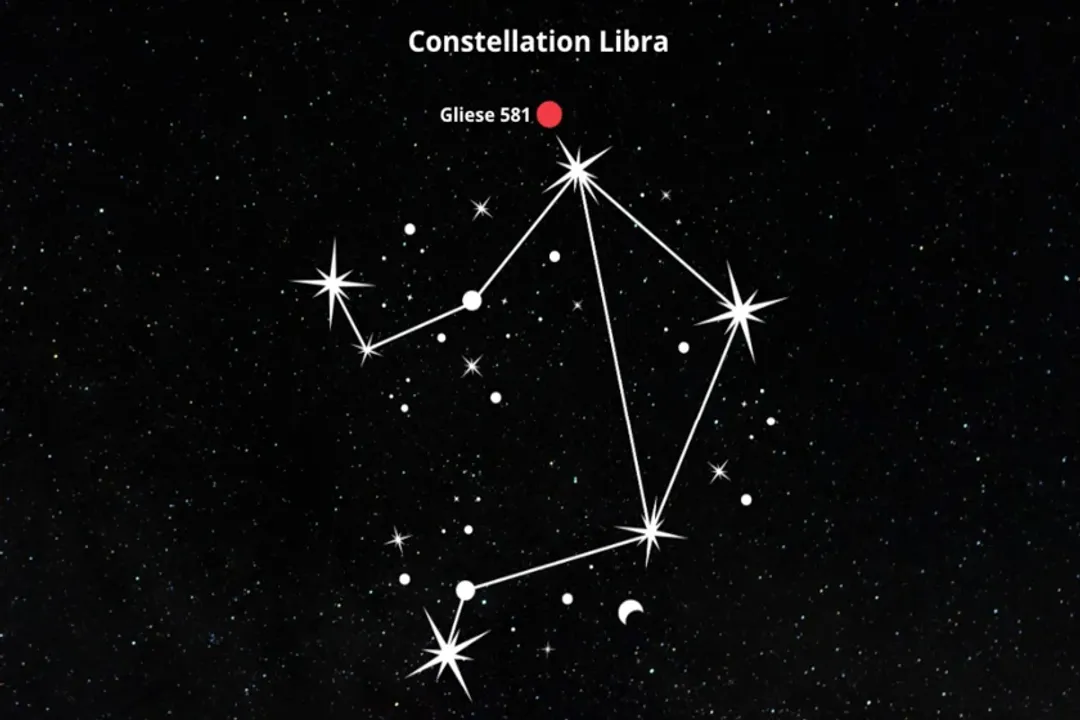
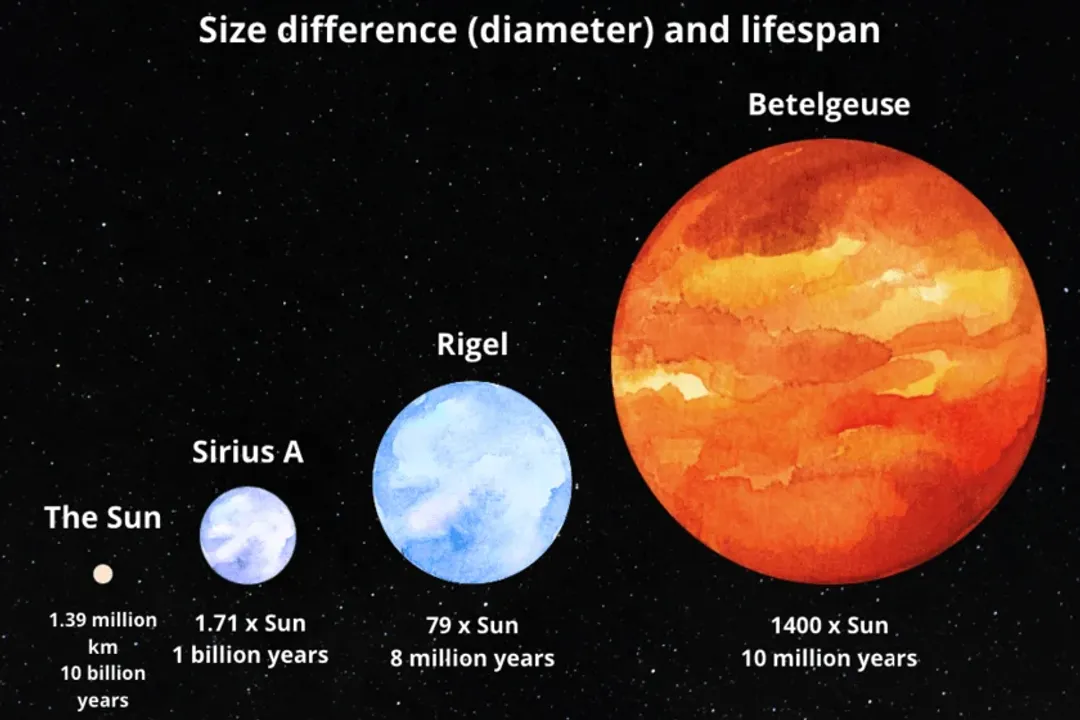
The most massive stars are the ostentatious spendthrifts of the cosmos, while the smallest stars are the ultimate frugal savers. [1]
The relationship between mass and luminosity is not linear, which is why the discrepancy in lifespans is so extreme. For main sequence stars generally, luminosity () increases with mass () raised to a power () between 3 and 4 (). [1]
Consider the mathematics behind this extravagance. For stars less massive than about $10$ solar masses, the power is close to $4$. [1] If a star has five times the hydrogen fuel of the Sun (five times the mass), one might naively expect it to last five times as long. However, its luminosity—its fuel consumption rate—is expected to be $(5)^4$, or 625 times greater than the Sun's. [1] The implication is clear: a slight gain in mass results in a geometrically larger increase in energy output, forcing the star to exhaust its fuel supply much faster. [1] A five-solar-mass star, while possessing five times the fuel, will only last about th as long as the Sun, clocking in at roughly $80$ million years on the main sequence. [1]
The evolutionary path is also dictated by mass. [1][3]
Massive Stars (e.g., ): These stars, often spectral types O or B, live fast and die young, sometimes for only a few million years. [1] They burn through their hydrogen rapidly, developing cores hot enough to fuse heavier elements sequentially—carbon, neon, oxygen, silicon—until they reach iron. [3] Iron fusion absorbs energy, leading to an immediate catastrophic core collapse and a massive explosion known as a supernova. [1][3] The remnant left behind is either a dense neutron star or, if the core is massive enough (greater than about remaining), a black hole. [1][3]
Mid-Sized Stars (e.g., to ): Stars like our Sun fall here. They spend about $10$ billion years on the main sequence. When the core hydrogen is spent, they puff up into red giants (or supergiants for the higher end of this mass range). [1][3] Sun-like stars fuse their core helium into carbon and oxygen, then later fuse elements in shells before gently puffing off their outer layers as a planetary nebula, leaving behind a hot white dwarf core. [3]
Low-Mass Stars (Red Dwarfs, e.g., ): These are the universe’s marathon runners, fusing hydrogen so slowly they can last for hundreds of billions to trillions of years. [1][3]
# Sun's Position

Our Sun, classified as a G2 main sequence star, is currently about $4.6$ billion years old. With an estimated main sequence lifespan of $10$ billion years, it is already middle-aged, having about $5$ billion years left in its current, stable state.
When the core hydrogen is depleted, the Sun will transition over about $1$ billion years into a red giant, swelling so much that it will likely engulf Mercury and Venus, possibly even Earth. [1] Following this swollen phase, it will shed its outer material to form a white dwarf, which will then cool down over eons. The total lifespan, encompassing all stages, is estimated around $12$ billion years. Even Alpha Centauri A, a near twin to our Sun, is following this same familiar track.
# Cosmic Timelines
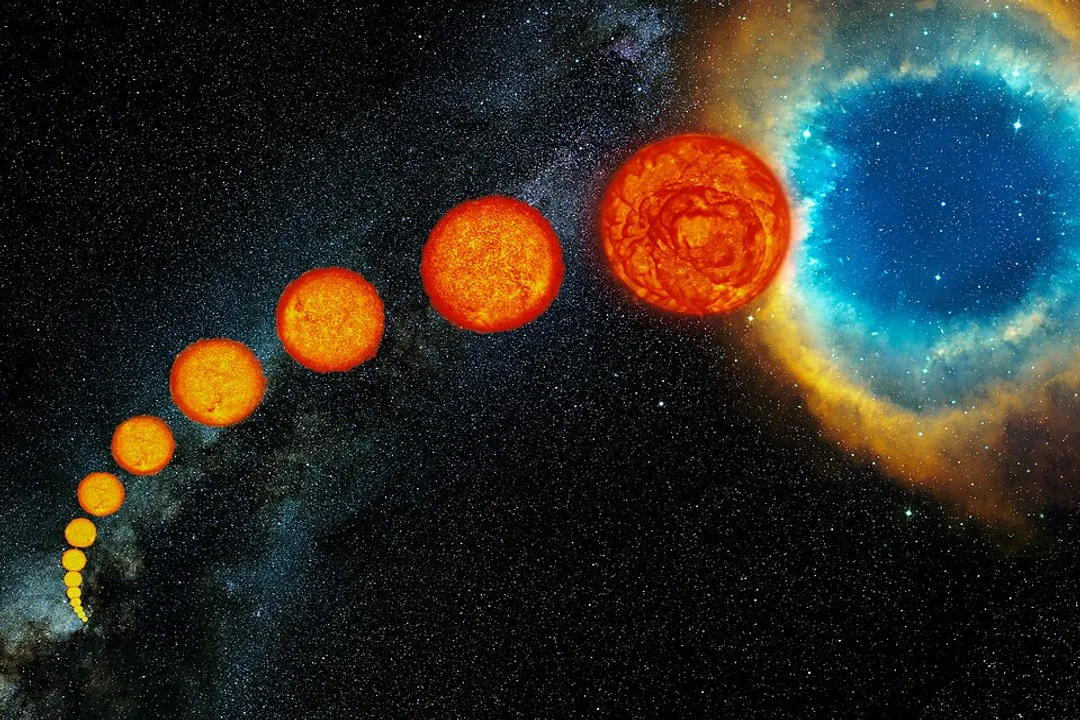
The disparity in stellar lifetimes is arguably the most striking feature of stellar evolution. The universe itself is only estimated to be about $13.8$ billion years old. This fact has a profound implication: the least massive stars, the red dwarfs, have predicted main sequence lifetimes far exceeding the age of the cosmos. [3]
| Star Type (Approx. Mass ) | Spectral Type | Main Sequence Lifetime (Years) | Example Star | End State |
|---|---|---|---|---|
| million | Eta Carinae (High-Mass) | Supernova Neutron Star/Black Hole | ||
| Blue Supergiant | million | Rigel / Betelgeuse | Supernova Neutron Star/Black Hole | |
| $1.0$ | (Sun) | billion | Sun / Alpha Centauri A | Planetary Nebula White Dwarf |
| $0.1$ | Thousands of billions | Barnard's Star | Slow Fade White Dwarf | |
| $0.2$ | -type | billion | Proxima Centauri (Low-Mass) | Slow Fade White Dwarf |
Stars smaller than about $0.6$ solar masses may not even achieve the core temperatures necessary to ignite helium fusion. [3] The very smallest red dwarfs () are modeled to remain on the main sequence for perhaps $6$ to $12$ trillion years. [3] This means that every red dwarf star that has ever formed is, theoretically, still fusing hydrogen today. We are observing stellar youth in these objects, even as we look across vast cosmic distances.
# Stellar Cycle
Regardless of their mass, all stars progress through a fundamental series of physical states. [1]
- Formation: Begins with the gravitational collapse of a Giant Molecular Cloud. [1][3]
- Protostar: The collapsing clump heats up, radiating strongly in infrared before visible light can escape the dust cocoon. [1][3]
- T-Tauri: The young star develops strong winds that blow away surrounding gas and dust, allowing it to become visible. [1]
- Main Sequence: Hydrostatic equilibrium is achieved, establishing the star's long, stable hydrogen-burning life. [1]
- Post-Main Sequence: Hydrogen fuel in the core is exhausted, gravity contracts the core, and hydrogen fusion begins in a shell around the new helium core, causing the outer layers to expand into a subgiant, then a red giant or supergiant. [1][3]
- Death: The end path splits based on mass: gentle ejection of outer layers for low-mass stars, or catastrophic collapse leading to a supernova for the massive ones. [1][3]
- Remnant: The final, compact core remains: a white dwarf, neutron star, or black hole. [1][3]
# Future Observation
It is impossible to determine stellar evolution by watching a single star, as the changes occur far too slowly for human observation over centuries. [3] Instead, astrophysicists rely on two main tools: observing numerous stars at various points in their life cycles and, crucially, developing sophisticated computer models. [1][3] These models take a star's initial mass and composition as input and calculate its entire evolutionary track across the Hertzsprung-Russell diagram. [3]
Because the predicted lifespan of a red dwarf far outstrips the $13.8$ billion year age of the universe, we cannot rely on direct observation to confirm the final stages of these objects. Verifying the long-term models for these low-mass stars is a significant challenge because we only see them in their youthful hydrogen-fusing phase. [3] We must extrapolate their fate based on the physics we can observe in the short-lived, massive stars that meet their dramatic ends relatively quickly.
This dependence on theoretical models for the longest-lived objects provides an interesting point of comparison. While we can trace the precise sequence of fusion and death for a star like the Sun based on observable relatives, for a red dwarf, its entire predicted life is a projection based on physics principles like hydrostatic equilibrium and mass-luminosity laws. [1][3] The sheer length of time involved means that any civilization arising around a red dwarf star will have an unimaginably long stellar host, but they will never observe the star reaching its final, cool state—that event is still trillions of years in the cosmic future. [3]
Related Questions
#Citations
Stellar evolution - Wikipedia
Is there anyway to maintain a star forever (or at least much longer ...
How Long Do Stars Live? - Label Stars
Main Sequence Lifetime | COSMOS
Lives and Deaths of Stars