Which stars are low-mass stars?
The universe is populated by stars of every imaginable size and temperature, but among them, the low-mass stars are by far the most common inhabitants of the cosmos. [3] These stellar bodies represent the lower end of the main-sequence spectrum, a vast category that includes stars significantly smaller and cooler than our own Sun. [6][1] Understanding which stars fall into this grouping requires looking at their mass—the fundamental property that dictates a star's entire life story, from birth to eventual death. [8] Generally, a star is classified as low-mass if its mass is less than about 0.5 to 0.8 times the mass of the Sun, though the exact definition can shift slightly depending on the specific evolutionary track being considered. [1]
# Mass Boundaries
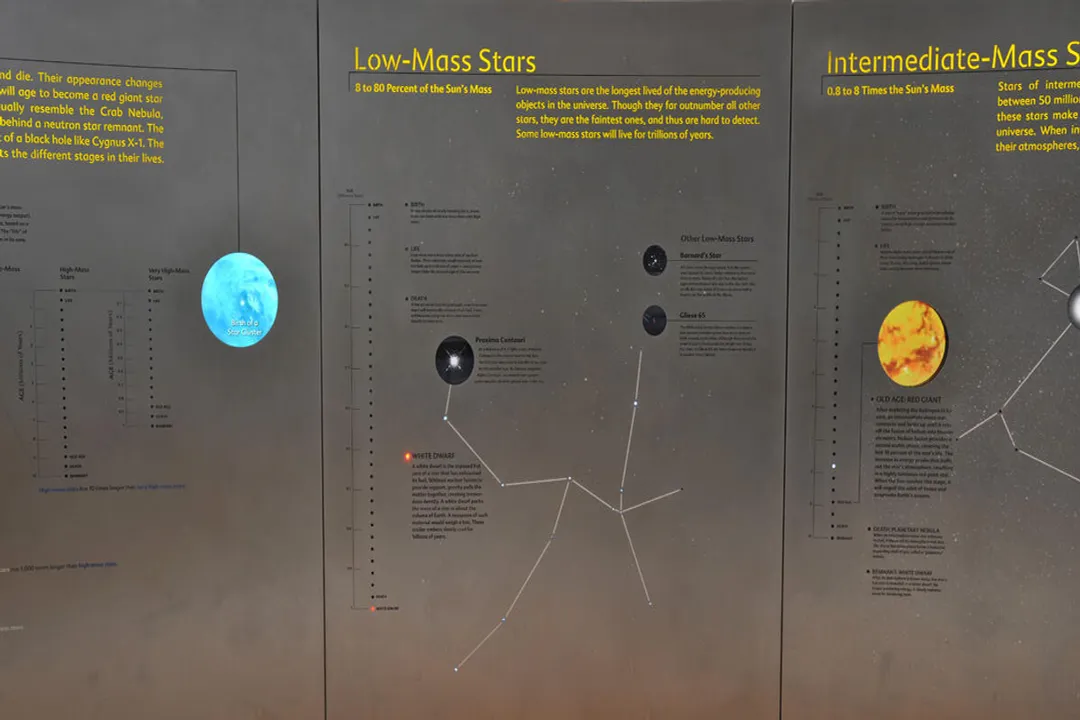
Stellar classification relies heavily on mass, which determines the core temperature and pressure, thereby controlling the rate of nuclear fusion. [8] Stars are typically categorized into three broad groups based on mass: low-mass, intermediate-mass (like the Sun), and high-mass stars. [3]
Low-mass stars possess insufficient gravitational pressure to ignite fusion reactions involving elements heavier than hydrogen. [1] The defining characteristic that sets them apart from their more massive counterparts is rooted in how they burn fuel. Stars less massive than about $0.08$ times the mass of the Sun, or roughly 80 times the mass of Jupiter, cannot sustain hydrogen fusion in their cores and instead become brown dwarfs, which are often considered "failed stars". [4][1] On the other end of the spectrum, stars significantly more massive than the Sun evolve much faster and die more spectacularly, leaving the realm of low-mass stars behind. [3]
When we discuss low-mass stars, we are primarily talking about those ranging from about $0.08$ solar masses up to perhaps half a solar mass (). [1] Our Sun, at $1$ solar mass, sits above this range, firmly in the intermediate category, which means it burns through its fuel at a comparatively furious pace. [6]
# Red Dwarfs
The vast majority of stars across the Milky Way—and likely the universe—are red dwarfs. [5] These are the quintessential low-mass stars, inhabiting the lowest rung of the main-sequence ladder where stable hydrogen fusion occurs. [5][6]
Red dwarfs are characterized by being quite dim and cool compared to the Sun. [3] Their surface temperatures hover below $4,000$ Kelvin. [5] The smallest known stars, such as EBLM J0555-57Ab, are incredibly tiny, sometimes approaching the size of the planet Saturn. [2] This specific star, for instance, is only about $85%$ the radius of Jupiter, yet it still manages to be a true star. [2] This comparison helps illustrate the scale: a low-mass star can be only slightly larger than a gas giant planet, a surprising concept when thinking about what constitutes a star. [2]
One of the most important physical traits of red dwarfs, stemming directly from their low mass, is their internal structure. Unlike the Sun, which has distinct layers and convective zones, many low-mass stars are fully convective. [5][1] This means that material from the core, where fusion occurs, is constantly churned outward to the surface, and cooler surface material sinks inward toward the core. [5][1] This mechanism is extraordinarily efficient at transporting energy and, crucially, it allows the star to use nearly all of its available hydrogen fuel, rather than just the hydrogen in its core, before evolving off the main sequence. [5]
This efficient convection leads to an interesting comparison when thinking about stellar demographics. While the Sun has enough core hydrogen to last for roughly 10 billion years, a typical red dwarf, depending on its exact mass (say, $0.2$ solar masses), has an estimated lifespan that can stretch into the trillions of years. [6][1] If we consider a hypothetical region of space containing a mixture of Sun-like stars and red dwarfs, the sheer number of red dwarfs means that their collective mass might actually outweigh the collective mass of all Sun-like and higher-mass stars combined, even though individually they are dim. [5]
# Longevity and Fate
The extremely low rate of fuel consumption is what grants low-mass stars their defining feature: unparalleled longevity. [6] The fusion rate in a low-mass star is incredibly slow, leading to an extended main-sequence lifetime that dwarfs the current age of the universe—approximately $13.8$ billion years. [8]
Stars in the lower mass range, such as those around $0.1$ solar masses, are predicted to live for perhaps 10 trillion years. [1] This duration is so immense that no star of this type has yet reached the end of its life since the universe began. [6] In fact, the universe is simply too young for us to have observed a red dwarf actually leaving the main sequence. [8] They are, in a sense, the eternal residents of the cosmos. [1]
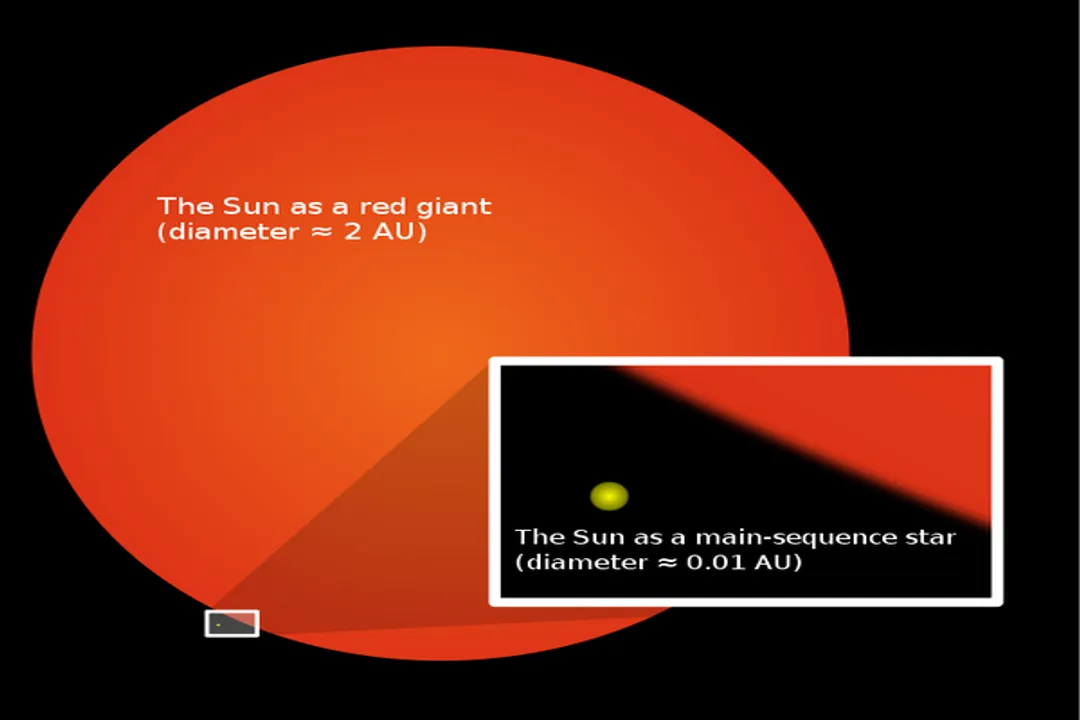
When they do eventually exhaust their fuel supply—a process trillions of years in the future—their fate will be remarkably serene compared to the dramatic supernovae of massive stars. [8] Since they lack the mass to generate the core temperatures needed to fuse helium into carbon, these stars are expected to simply contract, cool down, and eventually fade away, becoming dim white dwarfs composed primarily of hydrogen, or perhaps even fading into theoretical black dwarfs once the universe has aged sufficiently for them to cool completely. [6][1] This contrasts sharply with intermediate-mass stars like the Sun, which will swell into red giants before shedding outer layers to form a standard white dwarf composed of carbon and oxygen. [8]
# Surveying the Smallest
While red dwarfs represent the stable, fusing end of the low-mass spectrum, looking further down the mass scale reveals truly diminutive stellar objects. [2] The study of these smallest known stars often involves searching in binary or multiple-star systems, as finding an isolated, extremely faint star is difficult due to the low luminosity of the objects themselves. [4]
The smallest stars are often cataloged by their radius, which can be surprisingly small. As noted, some are comparable in size to Jupiter. [2] When assessing the absolute smallest confirmed stars, the data shows that their radii can dip close to the boundary where they transition into brown dwarfs. [2] For instance, one of the smallest known confirmed stars has a radius of $0.121$ times the radius of the Sun, or about $1,330$ times the radius of Jupiter, which is a tight squeeze around the Jupiter-sized end of the scale. [2] It is important to remember that mass, not radius, is the definitive characteristic for stellar classification, but radius serves as a convenient observational proxy. [2]
Consider a star like Proxima Centauri, our nearest stellar neighbor, which is a red dwarf of about $0.12$ solar masses. [1] Its faintness means that while it is physically close, it requires dedicated telescopes to study its properties properly. [4] This highlights a practical difficulty: the dimness of these low-mass stars, especially those near the lower mass limit, means they are systematically underrepresented in many stellar surveys that rely on brightness detection. [4] A typical survey might be biased towards finding brighter, more massive stars, leading to an undercount of the true cosmic population of the low-mass variety. [4]
# Practical Stellar Comparisons
To truly appreciate the dominance and lifespan of these faint stars, putting their existence into context helps. If we were to look at a cluster of stars in the halo of the Milky Way—perhaps an ancient globular cluster whose stars formed nearly 12 billion years ago—we would find that all the massive stars have long since perished, and even the Sun-like stars are only about halfway through their lives. [8] Yet, every red dwarf born in that cluster at the same time is still burning hydrogen exactly as it did when it formed. [1] Their remaining lifespan is orders of magnitude greater than the entire history of the cosmos we observe today.
To better visualize where the Sun fits, one can establish a rough mass-luminosity relationship. While the actual physics is complex, a very simplified model shows that a star with only $0.1$ solar masses might shine with just $0.0001$ times the luminosity of the Sun. [3] This immense difference in brightness is why, despite their overwhelming numbers, they don't dominate our night sky observations; our eyes are simply not sensitive enough to see them from interstellar distances. [4]
This leads to an interesting consideration for aspiring astronomers: if you are trying to locate the most numerous type of star in our immediate galactic neighborhood, you won't find them by looking for the brightest objects. Instead, you need instruments specifically designed to detect very faint, cool infrared light, as these objects radiate most strongly in the longer wavelengths where the high temperatures of massive stars do not peak. [5]
# The Abundance Factor
The sheer abundance of low-mass stars has profound implications for galactic evolution and the search for life. Because they burn their fuel so slowly, they offer a timescale for stable planetary habitability that is unmatched by any other stellar type. [6]
It has been theorized that a planet orbiting a red dwarf could remain warm enough for liquid water on its surface for trillions of years. [6] If life were to arise on such a planet, it would have effectively limitless time—vastly longer than the current age of the universe—to develop and potentially evolve toward complexity. While these stars present challenges, such as tidal locking and intense early flare activity, their unparalleled longevity makes them compelling targets in the search for extraterrestrial biology. [6] An abstract discussing stellar populations suggests that understanding the distribution of low-mass stars is key to understanding the history of star formation within the Milky Way itself, as they retain the chemical signature of their birth era more cleanly due to their slow evolution. [7]
The distribution and properties of these small stars are not uniform across all environments; they are slightly more common in the galactic disk where star formation is ongoing, compared to the very ancient halo, although they are still present everywhere. [7] Their sheer numbers mean that even if the probability of life arising around any single red dwarf is low, the sheer quantity of candidates makes the possibility of life existing around some low-mass star quite high when factoring in the time dimension. [6]
In summary, low-mass stars are the cosmic majority, defined by masses below roughly half that of the Sun, with red dwarfs representing the most populous and longest-lived members of this stellar class. [1][5] Their slow-burn fusion, driven by full convection, guarantees them lifetimes extending far beyond the current age of the universe, making them the true veterans of cosmic history. [6][1]
#Videos
Low Mass Stars: Crash Course Astronomy #29 - YouTube
Related Questions
#Citations
Low mass star - Las Cumbres Observatory
List of smallest known stars - Wikipedia
Star Types - NASA Science
Low Mass Stars: Crash Course Astronomy #29 - YouTube
Low-Mass Stars | AMNH
Low- and Intermediate-Mass Stars - NASA ADS
Stellar Evolution - | The Schools' Observatory
Low Mass Stars: Crash Course Astronomy #29 - PBS