When the mass of a star increases does the luminosity change?
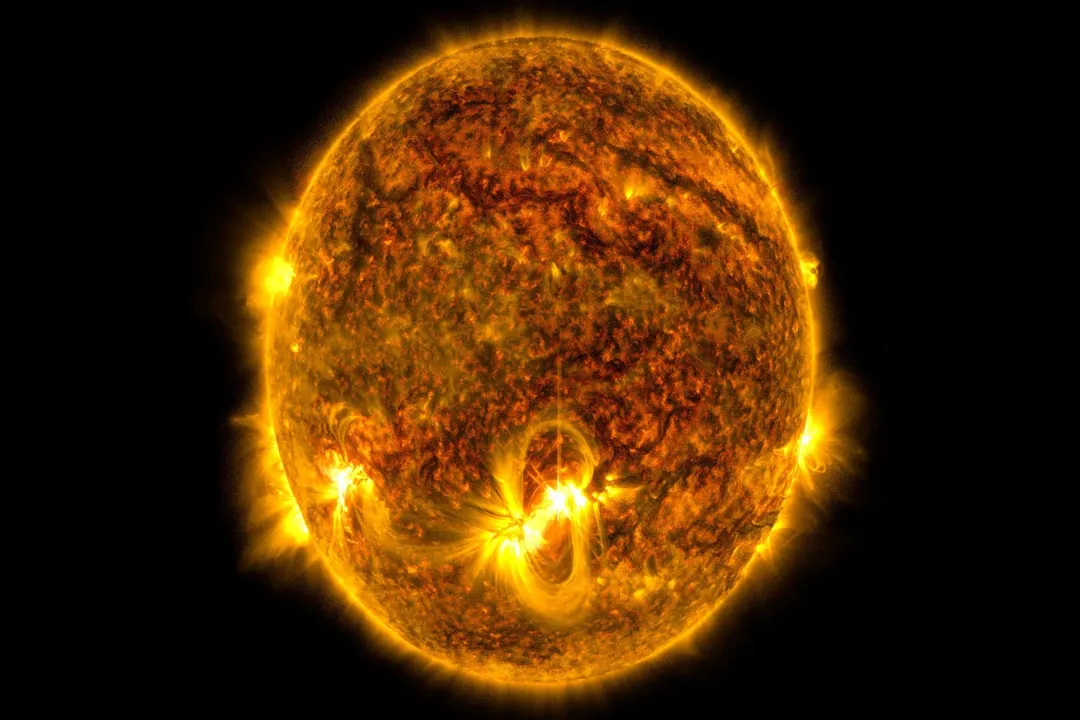
The simple answer is a resounding yes: when the mass of a star increases, its luminosity changes dramatically, increasing by a very large margin. This relationship is not just a casual correlation; it is one of the most fundamental and tightly defined laws governing the lives of stars while they reside on the main sequence, the longest phase of their existence. For an astronomer charting the heavens, a star's mass serves as the single most important predictor of its eventual brightness, color, and lifespan.
The physical driver behind this change lies deep within the stellar core. A star generates its light and heat through nuclear fusion, typically converting hydrogen into helium. The rate at which this fusion occurs—which directly determines the star's luminosity—is exquisitely sensitive to the pressure and temperature at the core. If you add more mass to a star, gravity squeezes the core more intensely. This increased compression raises the central temperature and density to vastly higher levels than in a less massive star. Consequently, the rate of nuclear reactions accelerates much faster than the increase in mass itself.
# Fusion Pressure
To appreciate the scale, think of mass as the throttle on the stellar engine. When a star is more massive, the crushing weight of its outer layers forces the inner material into a much smaller volume. This results in a substantially hotter core, meaning that fusion reactions don't just happen slightly faster; they can proceed at an exponential rate relative to the extra mass added. This dependence means that a star only slightly heavier than our Sun will shine significantly brighter because its core is operating under conditions far more vigorous than those found in the Sun.
# The Power Factor
Astronomers quantify this relationship using the mass-luminosity relation, typically expressed as a power law: , where is luminosity, is mass, and is an exponent that varies depending on the mass range of the star. For the vast majority of main-sequence stars, this exponent is often approximated around $3.5$.
This is not a linear relationship; it is governed by that power factor, which fundamentally changes the outcome. If a star has twice the mass of the Sun (), its luminosity won't just be twice as great; using the approximation, it would be , or about $11.3$ times brighter. If we consider a star with ten times the solar mass (), its expected luminosity jumps to , resulting in nearly 3,162 times the Sun's luminosity.
It is important to note that this exponent is not universal across all masses, reflecting differences in the internal structure and the dominant fusion process. For lower-mass stars, especially those near the bottom end of the main sequence, the exponent might be closer to $2$. However, for the most massive stars—those much larger than the Sun—the exponent can climb higher, sometimes approaching $4$. Understanding this variation is key to accurately predicting the energy output of any given star type.
A helpful way to view this scaling is to consider the comparison between the Sun () and the smallest stars we currently classify as true hydrogen-burning stars, called red dwarfs. While a red dwarf might only have $0.1$ times the mass of the Sun, its luminosity drops drastically, perhaps to only $0.001$ times the solar luminosity, illustrating the steep fall-off on the low-mass end of the spectrum.
When examining star clusters freshly formed from nebulae, one can see this relationship played out immediately. The more massive stars in the cluster blaze into existence, dominating the cluster's total light output almost instantly, while the low-mass companions barely glow in comparison. This immediate and extreme difference in energy output dictates the entire timeline for the cluster’s evolution, as the massive stars burn through their fuel reserves at a terrifying rate.
# Main Sequence Anchor
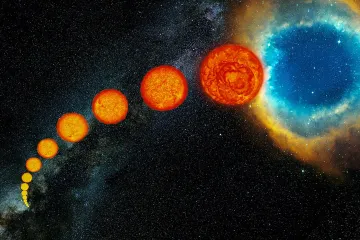
The mass-luminosity relation is specifically strong and reliable for stars currently fusing hydrogen in their cores—the main sequence stars. On the Hertzsprung-Russell (H-R) diagram, which plots stellar luminosity against temperature (or spectral type), the main sequence appears as a distinct, diagonal band. A star's position on this band is almost entirely determined by its initial mass. More massive stars appear at the upper-left of the main sequence, meaning they are hotter and far more luminous. Less massive stars are found at the lower-right, being cooler and much dimmer.
This connection is so tight that if an astronomer measures a star's luminosity and temperature, they can reliably calculate its mass, provided they can confirm it is on the main sequence. This diagnostic power is central to stellar astrophysics.
However, this relationship breaks down once a star exhausts the hydrogen fuel in its core and leaves the main sequence. When a star becomes a red giant, for instance, its internal structure rearranges; it swells up, its surface cools, and its luminosity increases due to its enormous surface area, even though its mass has not changed significantly. A red giant might be far more luminous than a main-sequence star that actually possesses more mass, demonstrating that stellar evolution moves the object off the neat track.
# Scaling Up Output
Let us consider the practical implications of this intense scaling. If we take the Sun as our baseline, a star with $5$ times the Sun's mass would have an estimated luminosity of about , which is roughly 279 times the Sun's output. That extra is fueling an energy generation system that is almost 300 times more powerful.
This disproportionate energy output directly relates to the star's fate. Because the more massive star is burning its fuel so much faster to counteract the overwhelming gravitational force, its main-sequence lifetime is drastically shorter than that of a low-mass star. The Sun is expected to live for about 10 billion years on the main sequence. A star, despite having five times the fuel, might only last about 100 million years. This trade-off—vastly increased immediate brightness exchanged for a brief existence—is the great cosmic bargain dictated by mass. If you could somehow inject mass into a star like the Sun without immediately triggering a dramatic shift in core physics, the immediate increase in light output would be blindingly obvious from Earth, even if the star only gained a fraction of a solar mass.
For example, imagine a young binary system where Star A is and Star B is . Using the approximate rule, Star A ( solar luminosities) would appear significantly brighter than Star B ( solar luminosities), a difference of nearly an order of magnitude in brightness stemming from a relatively small mass gap. This calculation underscores how sensitive the observational appearance of a star cluster is to its initial mass distribution, providing a powerful tool for characterizing stellar populations based on their observed light profiles.
# Evolutionary Context
The mass-luminosity relationship is therefore not just a static measurement; it is the defining characteristic of a hydrogen-fusing star's power source. It demonstrates that the structure of a star must achieve an immediate hydrostatic equilibrium where the outward pressure from fusion perfectly balances the inward pull of gravity. Any star that forms with a mass that cannot sustain this equilibrium for a reasonable period will collapse or somehow shed mass until it settles onto the main sequence where and are correctly balanced.
This implies that the entire star-forming environment is governed by this relationship. When we observe giant molecular clouds collapsing, the resulting stellar masses dictate the entire energy budget of the resultant cluster. A cluster dominated by high-mass stars will appear brilliant blue-white and will evolve quickly toward its death, while a cluster dominated by red dwarfs will remain faint and stubbornly cling to its main-sequence life for trillions of years. The initial mass, set at the star's birth, locks in its luminosity track for most of its active life, setting the stage for everything that follows, from its color to its eventual demise as a white dwarf, neutron star, or black hole.
#Videos
Why Would The Size Of A Star Affect Its Luminosity? - Physics Frontier
How Does A Star's Mass Determine The Mass Luminosity Relation?
Related Questions
#Citations
Mass–luminosity relation - Wikipedia
The Mass-Luminosity Relationship | ASTRO 801
Does the luminosity of a star on its main sequence increase or ...
Why Would The Size Of A Star Affect Its Luminosity? - Physics Frontier
Mass-Luminosity Relation Explained - The Sun and Stellar Structure
As the mass of a star increases, how do you think its luminosity ...
Mass Luminosity Relationship - Astronomy - CliffsNotes
Star Basics - NASA Science