What causes a star to increase in size?
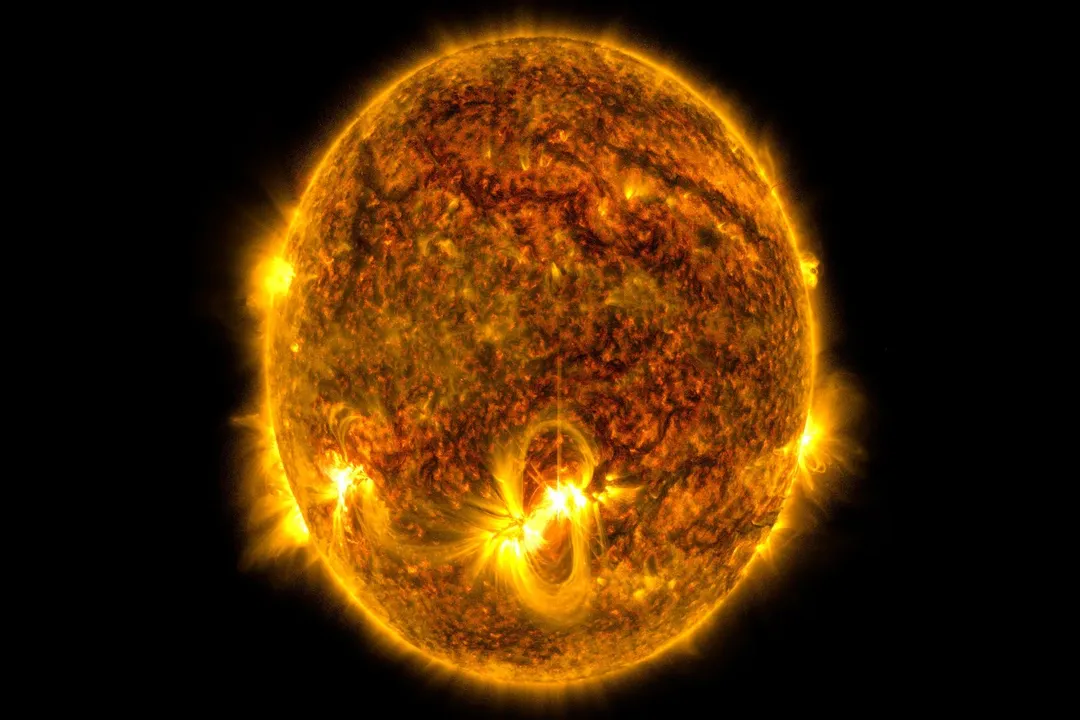
Stars are dynamic entities, not just fixed points of light, and their size changes dramatically over their lifetimes, often growing to immense proportions. The process that forces a star to swell up is a fundamental part of stellar evolution, driven entirely by changes in its internal furnace—the nuclear fusion occurring deep within its core. [2][4] It’s a story about running out of one type of fuel and having to switch to a less efficient, but more expansive, backup plan.
# Main Sequence
For the vast majority of a star’s life, it exists in a state known as the main sequence. [4] During this long, stable period, which for a star like our Sun lasts about ten billion years, the star maintains a delicate equilibrium. [2] This balance is called hydrostatic equilibrium: the crushing inward force of gravity is perfectly matched by the outward pressure generated by thermonuclear fusion in the core. [4][9] In this phase, the star converts hydrogen into helium in its center. [2] As long as this core fusion is steady, the size and luminosity of the star remain relatively constant. [9]
# Core Depletion
The expansion begins when the hydrogen fuel in the star’s very center is completely exhausted. [3] When the hydrogen runs out, the primary, steady source of outward pressure suddenly vanishes from the innermost region. [1] With nothing to counteract gravity in the core, that central region begins to contract under its own immense weight. [3][9] This gravitational collapse is surprisingly violent in its effect; as the core shrinks, the pressure and temperature within it skyrocket. [3]
This heating is crucial because it doesn't just affect the core; it superheats the layer of fresh hydrogen surrounding the inert helium core. [1][3] This new layer ignites, beginning hydrogen shell burning. [1]
This shift is analogous to turning up the heat on a stove under a pot of water. If you stop stirring the water (the core fusion stops), the bottom layer still heats up intensely from the burner (the contracting core). That intense heat then causes violent bubbling and steaming in the water above it (the outer layers expanding). [1]
# Outer Swell
The energy output from this new hydrogen shell burning is far more intense than the energy produced when the core itself was burning hydrogen. [3] This flood of extra energy pushes outward on the star's remaining outer layers with tremendous force. [1] Because the pressure increase is so powerful, gravity can no longer hold the envelope of gas near the star’s surface, and the star begins to swell dramatically. [1][3]
As the outer layers expand, they move farther away from the now-hot helium core. This increased distance means the surface gas cools down significantly. [3] A star that was once yellow or white (like the Sun) will appear reddish because its surface temperature drops, even though its total energy output, or luminosity, is much higher due to its sheer size. [3][9] This expansion transforms the star into a Red Giant or, for more massive stars, a Red Supergiant. [4] The size increase can be astonishing; a star like the Sun could swell up large enough to engulf Mercury, Venus, and possibly Earth. [2]
The process is a direct consequence of the energy source moving location. When the core runs out of fuel, the mechanism for support has to move outwards, inflating the star like a balloon being pumped from a ring of fire just outside the dead center. [1]
# Size Versus Mass
It is easy to confuse an increase in size with an increase in mass, but these two properties usually move in opposite directions during this late stage of stellar life. [5] While the star expands hugely, it is generally losing mass over time through powerful stellar winds driven by the high luminosity. [5]
For Sun-like stars, the mass loss is relatively minor, perhaps losing 10 to 20 percent of its original mass before it sheds its outer layers entirely to become a white dwarf. [5] In contrast, truly massive stars can lose a substantial fraction of their mass when they become supergiants. [5] If the star is part of a binary system, however, the situation changes completely. If a giant star swells close enough to a companion, its outer gas can be gravitationally pulled onto the neighbor, causing the companion’s mass to increase significantly. [5] This accretion can trigger new fusion reactions on the companion star's surface or even lead to a Type Ia supernova event, though the initial expansion mechanism described above is internal, not based on gaining external mass. [5]
# Stellar Fates
The final size a star reaches and the subsequent evolutionary path depend almost entirely on its initial mass. [8]
| Initial Mass Category | Resulting Expansion Stage | Approximate Final Size Increase (Relative to Main Sequence) |
|---|---|---|
| Low Mass (Like the Sun) | Red Giant | Up to 100 times original radius [4] |
| High Mass (8+ Solar Masses) | Red Supergiant | Hundreds of times original radius [4] |
| Very High Mass (Over ~25 Solar Masses) | Hypergiant/Supergiant | Can exceed 1,000 times original radius [4] |
For stars near the Sun's mass, the expansion stops once the core gets hot enough to begin fusing helium into carbon—a process that temporarily halts the rapid growth. [4] For stars significantly more massive than the Sun, the core never stops contracting and heating until it reaches the point where it can fuse heavier and heavier elements, cycling through carbon, neon, oxygen, and silicon fusion in successive shells. [4] These stars become Red Supergiants, swelling to gargantuan sizes before eventually collapsing catastrophically. [4]
Understanding the mechanics of this growth shows a key principle in astrophysics: stellar size is not fixed by initial conditions alone; it is a direct, observable measure of the star's internal fuel history. [9] A star is huge because it is currently inefficiently burning fuel in a shell instead of efficiently burning it in its center.
#Videos
Why Do Red Giant Stars Get Bigger? - YouTube
Related Questions
#Citations
Why does a dying star grow in size if there is only gravitational force ...
Star Basics - NASA Science
Why do stars become red giants? - Astronomy Stack Exchange
Stellar Evolution - | The Schools' Observatory
Why does the mass of a star increase as it ages? - Quora
How do stars form with such a huge variety in size? - Facebook
Why Do Red Giant Stars Get Bigger? - YouTube
What determines how big a star is? - Astronomy Magazine
Why do main sequence stars get bigger and more luminous as they ...