What force causes an interstellar cloud to eventually become a star?
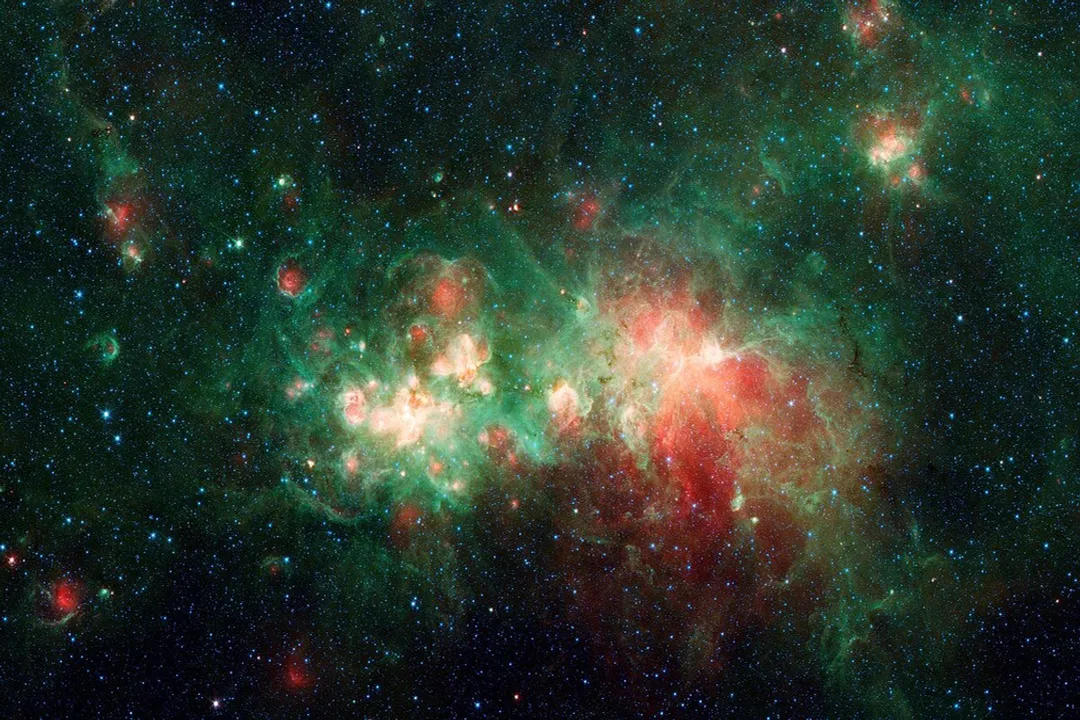
The fundamental engine that drives an enormous, diffuse cloud of gas and dust in space to condense and ignite into a shining star is a single, relentless force: gravity. [1][5][6] These stellar nurseries, known as interstellar clouds, are vast repositories of the raw material for suns, often residing within massive structures called Giant Molecular Clouds (GMCs). [1][5] For star formation to begin, a localized region within this cloud must overcome the outward pressure and internal motions that keep it dispersed. It is the internal pull of its own mass—gravity—that eventually wins this cosmic tug-of-war, initiating the slow, inexorable process of collapse. [6]
# Molecular Nurseries
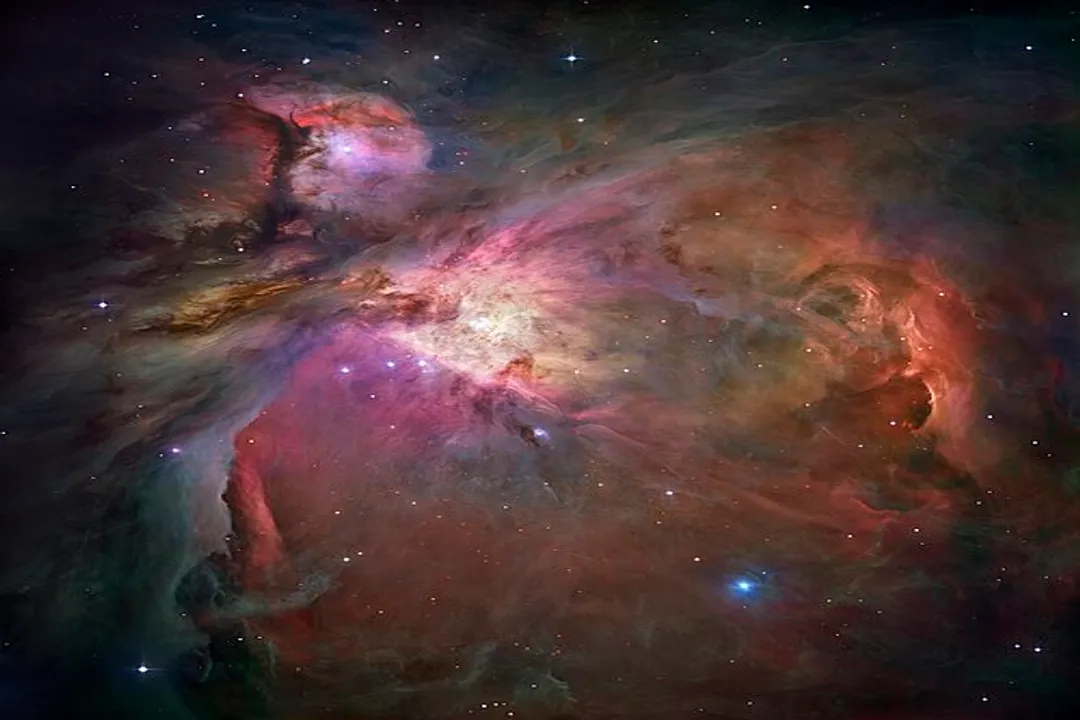
Interstellar clouds, the cosmic cradles where stars are made, are not uniform throughout the galaxy. They are primarily composed of cold, dense pockets within the interstellar medium. [1] These regions are characterized by temperatures hovering around just $10$ Kelvin or sometimes colder, a frigid state necessary for the gas atoms to move slowly enough for gravity to take hold. [5] Primarily, these clouds consist of molecular hydrogen () and helium, along with trace amounts of dust grains and other molecules. [1]
A GMC can span hundreds of light-years across and contain enough mass to form many thousands of stars, sometimes exceeding a million times the mass of our own Sun. [5] Inside these immense, dark structures, the material is not smoothly distributed. Instead, it is clumpy, with density variations marking the potential sites for future stellar systems. [5] The sheer scale and low temperature are the prerequisites; without the extreme cold, the thermal motion of the gas particles would exert too much outward pressure, keeping the cloud stable and preventing collapse. [5][6]
# Gravitational Trigger
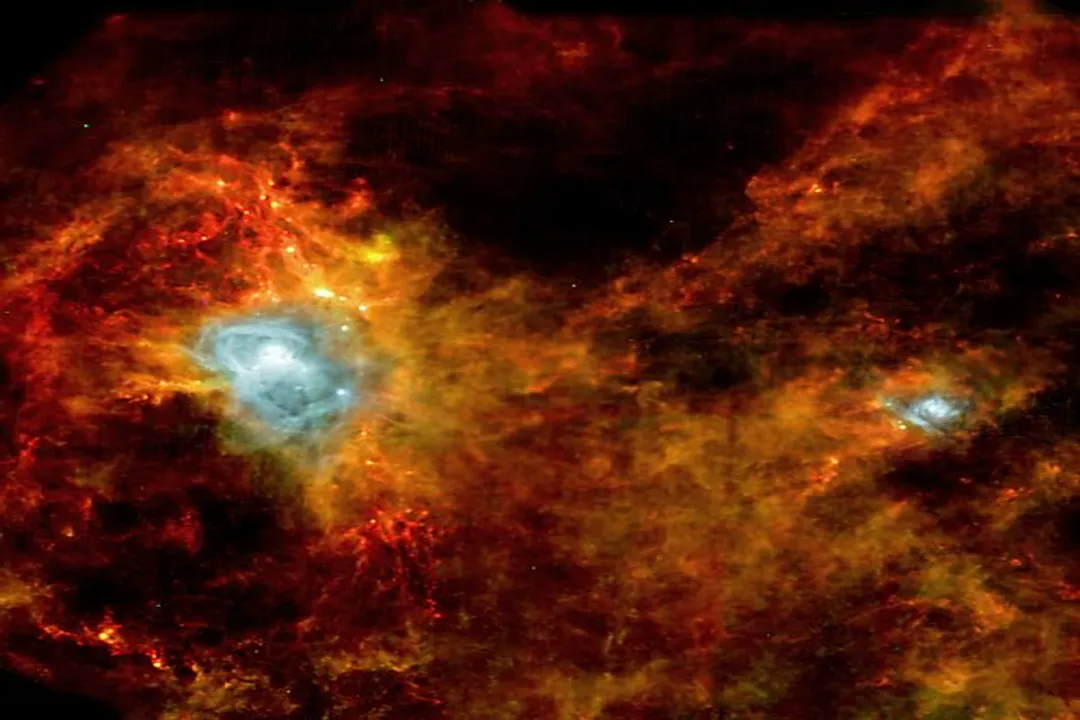
The transition from a stable cloud fragment to a collapsing core hinges on the relationship between the cloud's mass, temperature, and density. When a region within a GMC becomes sufficiently massive and dense relative to its temperature, its self-gravity exceeds the forces attempting to push it apart, initiating a runaway collapse. [6] This theoretical tipping point is often described by the Jeans Mass concept in astrophysics—the minimum mass a cloud fragment must possess to overcome internal pressure and contract under its own gravity. [1]
It is fascinating to consider the tightrope walk that occurs in these vast structures. A region might be gravitationally bound but held in a precarious equilibrium by turbulence or magnetic fields. [8] For collapse to proceed towards becoming a star, a localized increase in density—perhaps triggered by a nearby supernova shockwave or simply random density fluctuations—must push that region past the critical threshold. [5] If the mass is too small, the cloud remains supported; if it is too large, it may fragment into multiple, smaller collapsing cores rather than forming a single star. [1] The initial distribution of matter, therefore, dictates the number and size of the stars that will eventually emerge from that parent cloud. We can observe regions that are very large but possess only modest internal turbulence, suggesting that in many cases, the collapse is initiated by slow, internal gravitational accretion over millions of years, rather than a sudden external shock, making the initial density profile incredibly critical. [8]
# Opposing Forces
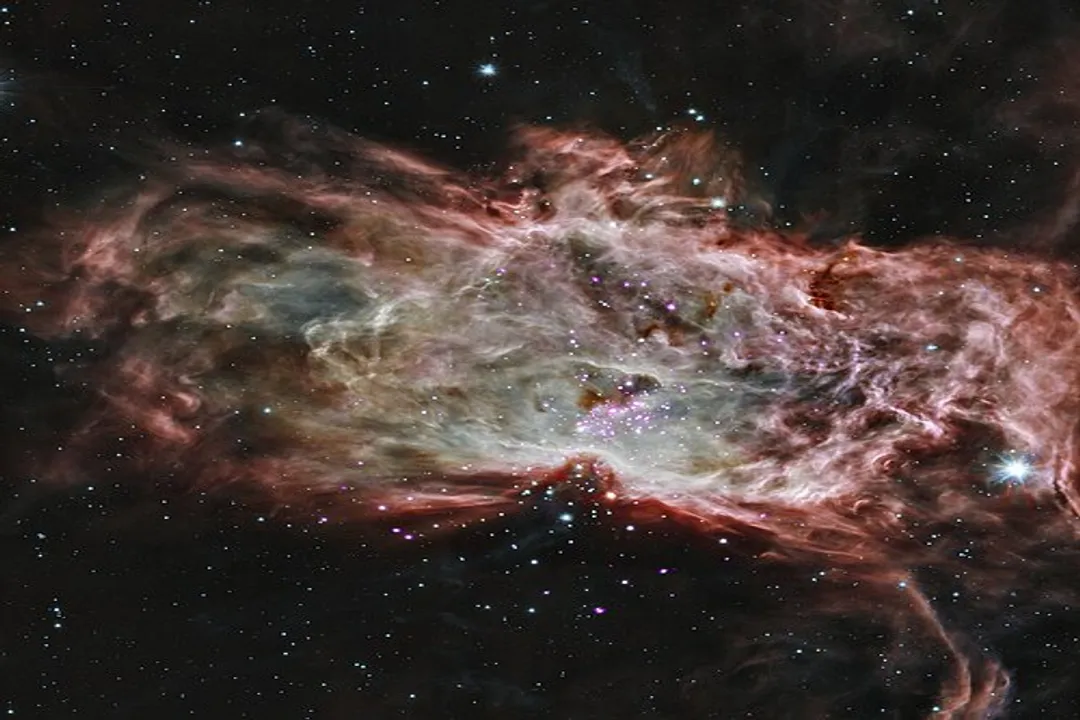
While gravity is the architect of star formation, it is not unopposed. Several physical mechanisms actively work to stabilize the gas and slow down or even halt the collapse of the molecular cloud. [8] Chief among these opposing influences are magnetic fields and turbulence. [8]
Magnetic fields, threaded throughout the interstellar medium, exert a force that resists compression. As a cloud begins to contract, the magnetic field lines are forced closer together, increasing the magnetic pressure. This magnetic tension can support a significant portion of the cloud's mass against gravitational collapse. [8] For the core to shrink further, the magnetic field must be somehow weakened or dispersed from the central region, a process sometimes referred to as magnetic flux leakage or diffusion. [8]
Turbulence, the chaotic, large-scale swirling motions of gas within the cloud, also contributes to stability by generating internal kinetic energy that pushes outward. [8] The interplay between these forces is complex. Turbulence can sometimes aid star formation by creating pockets of locally high density where gravity can gain an advantage, but on a larger scale, it acts as a stabilizing pressure against the general collapse of the entire GMC. [8] The final fate—collapse or dispersal—often depends on which of these forces, gravity, magnetic pressure, or turbulence, proves dominant in that specific volume of gas.
# Core Formation
Once gravity begins to win, the process accelerates locally, leading to the formation of dense cores. [6] As a large fragment collapses, it tends to break down into smaller, denser pieces through a process called fragmentation. [1] Each fragment continues to contract independently. [1]
As a core shrinks, the gravitational potential energy is converted into kinetic energy, and eventually, as particles collide, this kinetic energy transforms into thermal energy, causing the center of the collapsing core to heat up significantly. [6] This hot, dense object at the center of the contracting envelope is the protostar. [1] Crucially, the protostar is not yet a true star; it is generating heat and light solely from the energy of gravitational contraction, not from fusion. [5]
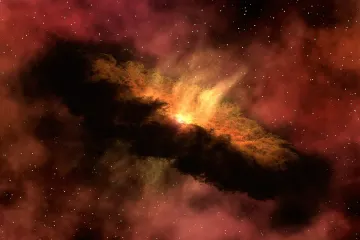
During this phase, the material doesn't fall directly onto the protostar; conservation of angular momentum causes much of the surrounding gas and dust to flatten into a rotating accretion disk around the central object. [1] This disk feeds material onto the growing protostar over time, increasing its mass. [5] The duration of this accretion phase can vary widely, sometimes lasting several million years, depending on the initial mass of the forming star. [1]
# Protostellar Life
The protostar continues to gather mass from the surrounding disk and envelope. Simultaneously, intense stellar winds and bipolar outflows—jets of material ejected perpendicular to the accretion disk—begin to clear away some of the surrounding gas and dust. [1] These outflows are vital because they eventually halt the inflow of material, defining the final mass of the star. [1]
The protostar evolves into a visible T Tauri star once it becomes optically visible, having ejected or blown away most of its surrounding cocoon of gas. [5] Even at this stage, the object is still fundamentally a hot ball of gas powered by contraction, not fusion. The internal temperature and pressure are steadily rising due to the sustained gravitational squeeze.
Consider the sheer timescale involved here. Our Sun took perhaps 50 million years to evolve from a cold cloud fragment to its current main-sequence state, a duration that seems immense to us. [5] Yet, for a massive star, the entire pre-main-sequence lifetime might be compressed into less than a million years, while for a small, low-mass star, the process can drag on for tens or even hundreds of millions of years. This disparity in pacing is directly linked to how quickly gravity can compress the core against its internal resistance based on the initial mass collected. [1]
# Achieving Fusion
The final step in becoming a star is reaching the critical temperature and pressure in the core necessary to ignite sustained nuclear fusion. [1][5] As the gravitational contraction continues, the core temperature climbs steadily. When the core temperature finally reaches about $15$ million degrees Celsius ( million degrees Fahrenheit), the kinetic energy of the hydrogen nuclei becomes high enough to overcome their mutual electrical repulsion (the Coulomb barrier) and initiate the fusion of hydrogen into helium. [5]
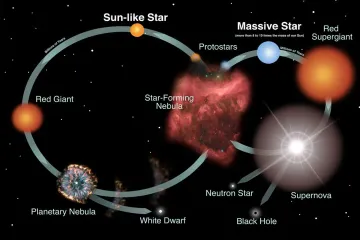
This ignition marks the moment the object officially transitions from a contracting protostar to a true main-sequence star. [1][5] The energy released by this nuclear furnace creates a massive outward thermal pressure that exactly balances the inward crush of gravity, establishing a state of hydrostatic equilibrium. [1] This balance is the hallmark of a stable star like our Sun, capable of shining steadily for billions of years while systematically consuming its core hydrogen fuel. [5] If fusion never ignites, the object becomes a brown dwarf, a 'failed star' that cools down over time. [1]
# Stellar Mass Thresholds
The minimum mass required for sustained hydrogen fusion is approximately $0.08$ times the mass of the Sun, or about $80$ times the mass of Jupiter. [1] This threshold is the dividing line between the stellar realm and the sub-stellar realm of brown dwarfs. The entire sequence, from the initial slight overdensity in a cold molecular cloud to the final steady burn of a main-sequence star, is a demonstration of gravity's long-term supremacy over entropic disorder and magnetic pressure, provided the initial conditions—the amount of mass available—are sufficient. [1][6] This gravitational imperative, acting over cosmic timescales, is the single causal force behind every star we see.
Related Questions
#Citations
Star formation - Wikipedia
Stars - Imagine the Universe! - NASA
If an interstellar cloud contracts to become a star, it is due to ... - Brainly
How exactly does a star form from interstellar gas and dust? - Reddit
Astrobiology Institute at the University of Hawaii
Star Formation | Research Starters - EBSCO
Astronomy Birth of Stars Flashcards - Quizlet
Gazing into Magnetized Interstellar Clouds to Understand How Stars ...
How Do Stars Form? - Frontiers for Young Minds