What force causes the nebula to begin to pull together and become more dense?
The initial process of star formation begins within the vast, seemingly empty reaches between existing stars—a region filled with the interstellar medium (ISM). [6] Within the ISM, certain areas become dense enough to coalesce into nebulae, which are essentially gigantic clouds composed primarily of gas, overwhelmingly hydrogen and helium, mixed with fine cosmic dust made of elements like carbon and silicon. [3][5] These clouds, particularly the Giant Molecular Clouds (GMCs) often referred to as cold, dark nebulae, are the nurseries where stars ignite. [3][6]
# Inward Outward
For a nebula to begin pulling together and increasing its density, a specific condition must be met: the inward pull of gravity must be stronger than the outward push of internal pressure within the cloud. [6] Most nebulae, despite their enormous total mass, are extremely diffuse, with densities far lower than the air we breathe on Earth. [5] In a quiescent state, the gas particles are moving, possessing kinetic energy that we measure as temperature. As these particles collide, they exert outward pressure, which effectively counters the mutual gravitational attraction trying to draw the mass together. Think of blowing up a balloon: the air pressure inside prevents it from collapsing due to the slight external pressure from the atmosphere. Similarly, in a stable nebula, this thermal pressure acts as a counterbalance to gravity.
# Gravitational Scale
The crucial shift occurs when the mass and scale of the cloud allow gravity's influence to overwhelm this internal resistance. While gravity is considered a weak fundamental force—for example, the gravitational pull of the entire Earth is something we overcome every time we take a step [6]—its efficiency is dependent on distance and total mass. In a nebula, which can contain the mass equivalent of many stars, the gravitational attraction between every atom adds up significantly over the cloud's vast expanse. [5]
The balance is highly dependent on the cloud's geometry and size. As a region begins to shrink, the mass within that shrinking radius increases proportionally to the volume, while the gravitational force exerted by that mass follows an inverse square law with distance from the center. [5] For small regions, thermal fluctuations can easily push material apart, maintaining stability. [5] However, once a region—known as a protostellar or solar nebula—reaches a critical threshold of mass (related to the theoretical concept known as Jeans Mass), the long-range gravitational attraction dominates over the internal thermal pressure, initiating a decisive collapse. [5][1] This means that while the force is always present, it only becomes the dominant organizing force when the accumulated mass is sufficiently large.
# Thermal Brakes
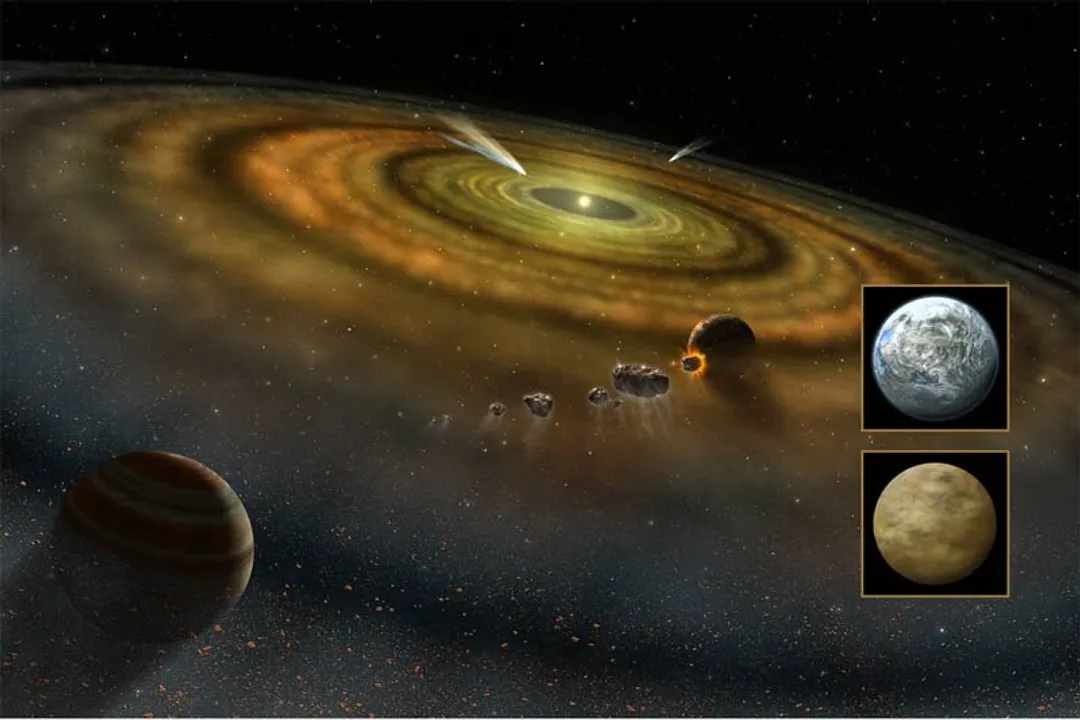
The collapse initiated by gravity is not a simple freefall; it changes the cloud's properties in ways that try to halt the process. As the nebula shrinks, the conversion of gravitational potential energy into kinetic energy heats the in-falling gas particles. [6] These particles crash into each other, converting that kinetic energy into thermal energy, thus raising the cloud’s temperature and increasing the outward pressure, which directly slows the collapse. [6]
For the contraction to proceed toward star formation, this generated heat must escape the cloud efficiently. The material in the nebula is often opaque to many forms of radiation, trapping heat. A key mechanism that allows this necessary cooling, especially in older, more chemically complex nebulae, involves specific molecules emitting photons that can escape into space. [5] For instance, carbon monoxide can radiate radio waves that pass through the cloud, effectively carrying thermal energy away and allowing the gas to continue contracting under gravity. [5] It is interesting to note that the very first stars in the universe, which formed from gas clouds lacking these cooling elements like carbon and oxygen, would have required vastly greater initial masses for gravity to overcome the thermal pressure barrier compared to the molecular clouds that form Sun-like stars today. [5]
# External Kick
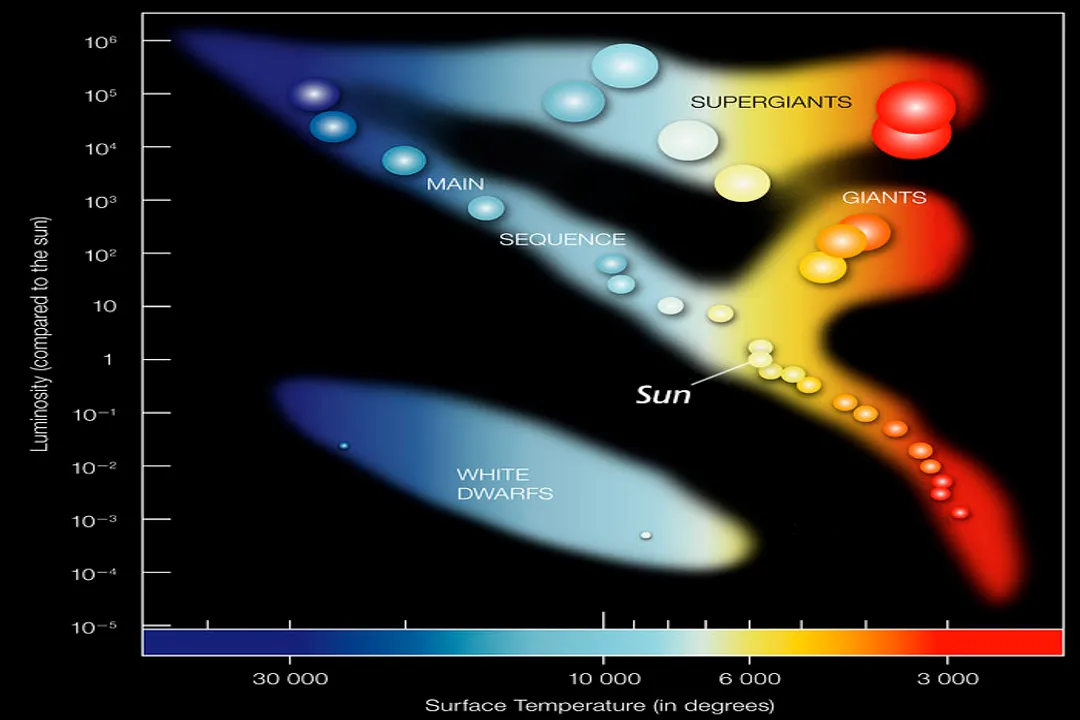
While a massive, cold cloud can become intrinsically unstable and collapse on its own, this initial "tipping point" is often assisted by external compression. [5][6] This external stimulus introduces an initial shock or compression that rapidly increases local density, tipping the local balance in favor of gravity before internal thermal pressure has a chance to build up significantly. [5]
Several astrophysical events are cited as potential triggers for this initial concentration:
- Supernova Shock Waves: The blast wave from a nearby star that has exploded violently can pass through a molecular cloud, providing the necessary compression to initiate collapse. [6] In fact, the material that formed our own Solar System is thought to have originated from the remnants of a predecessor star that ended in a supernova.
- Stellar Winds/Collisions: Intense stellar winds emanating from nearby massive, hot stars, or even the collision between two entire molecular clouds, can supply the required external pressure. [6][5]
However, modern observations suggest a pluralistic model, confirming that while triggers like supernovae are effective, gravitational collapse driven by internal cloud conditions alone is also observed in star-forming regions. [5]
# Protostar Seed
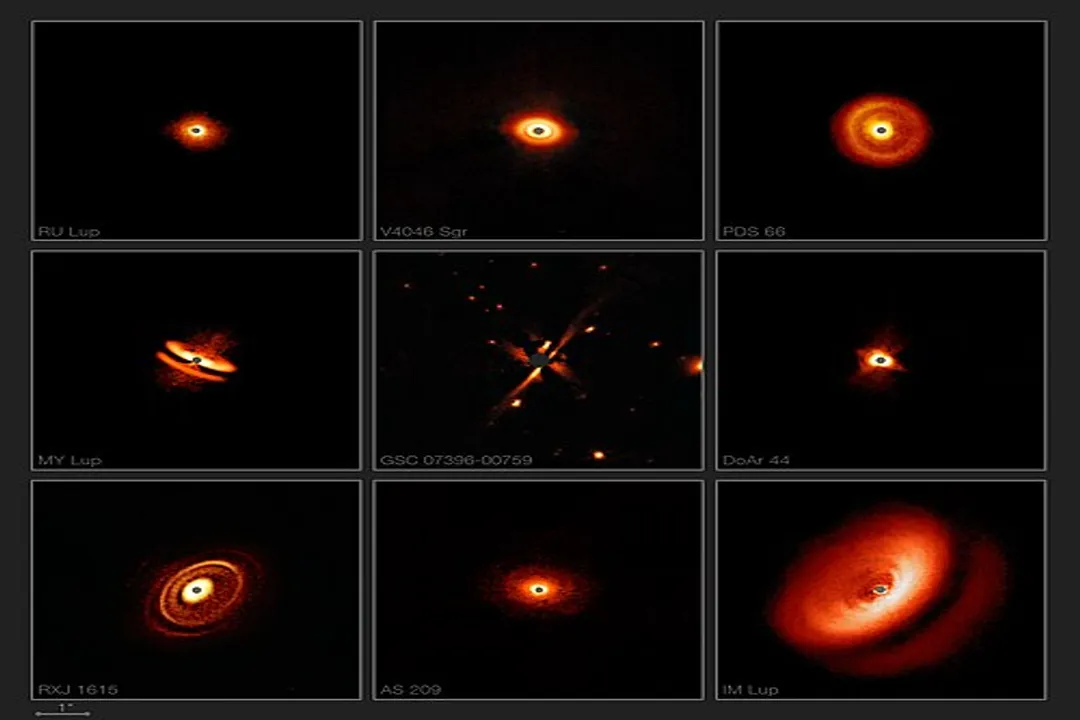
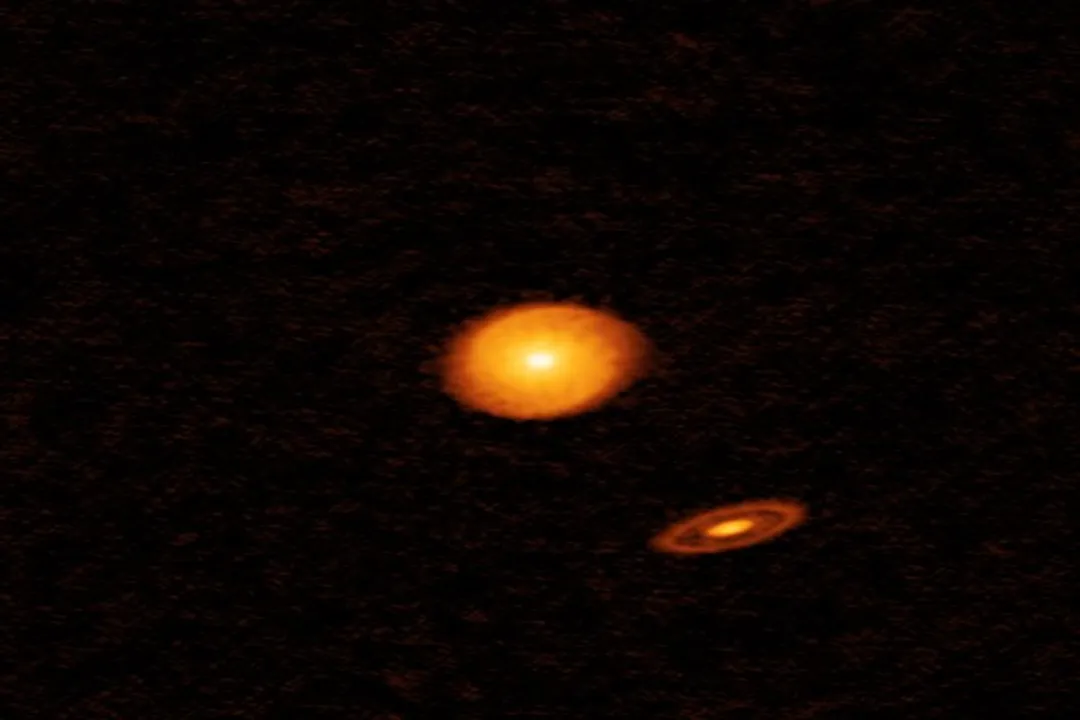
Once the balance tilts toward gravity, the process of making the nebula denser becomes self-sustaining. The collapsing material first forms smaller, denser cores, sometimes called protostellar nebulae. [1] The central regions, having the lowest angular momentum, experience fast compression, forming a hot core that will become the star. [1] The entire process sees the initial diffuse material—the gas and dust—being systematically drawn together, organizing itself into fewer, more concentrated objects. As the central mass grows, its gravitational reach strengthens, ensuring the continued inward flow of surrounding material. [6] This results in the formation of a rotating, flattening disk around the nascent star, a protoplanetary disk, which is the direct consequence of angular momentum conservation during the gravitational squeeze. [1][6] It is this reorganization of matter—from a diffuse cloud to a dense central object surrounded by an orbiting disk—that signifies the successful initiation of stellar and planetary system birth, all driven by the fundamental, long-range force of gravity. The intense energy released during the subsequent phases, like the protostar radiating heavily due to gravitational contraction, is simply the conversion of that initial gravitational work into heat and light, a process that continues until fusion pressure balances the crush of gravity. [1][6]
Related Questions
#Citations
What causes a nebula - a very diffuse cloud of Hydrogen to ... - Reddit
Hubble's Nebulae - NASA Science
Formation of Galaxy - Solar Nebulas and Solar System - Turito
The Outer Planets: A Star is Born
Nebular theory and the formation of the solar system - OpenGeology
Nebular hypothesis - Wikipedia