What were the three major components of the solar nebula?
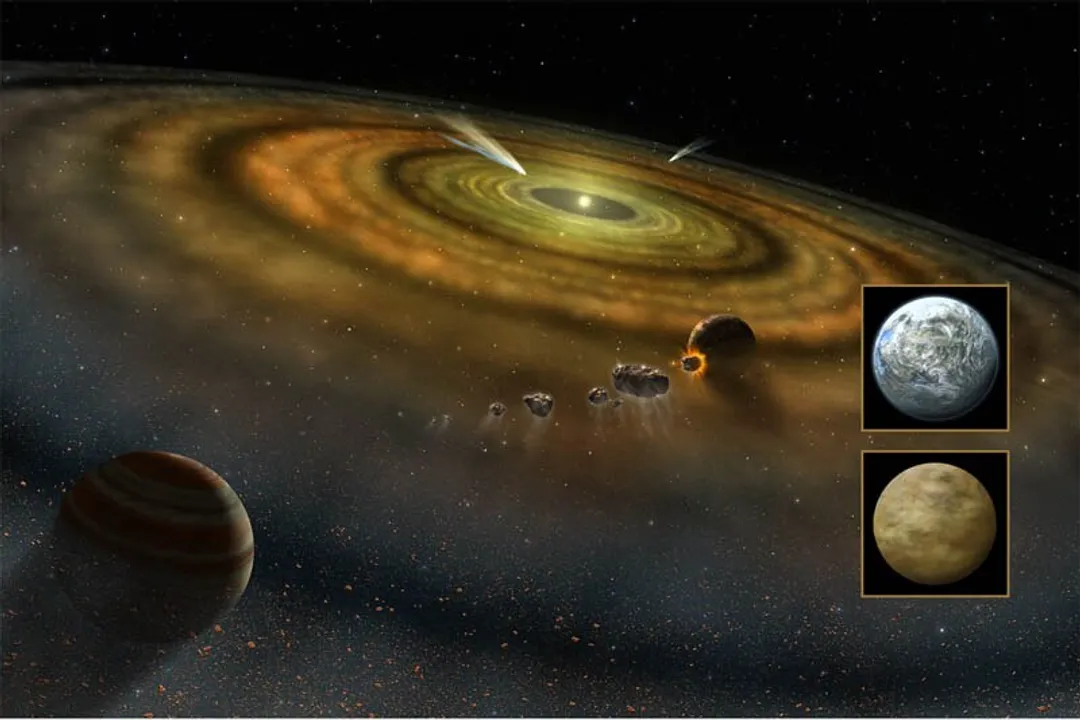
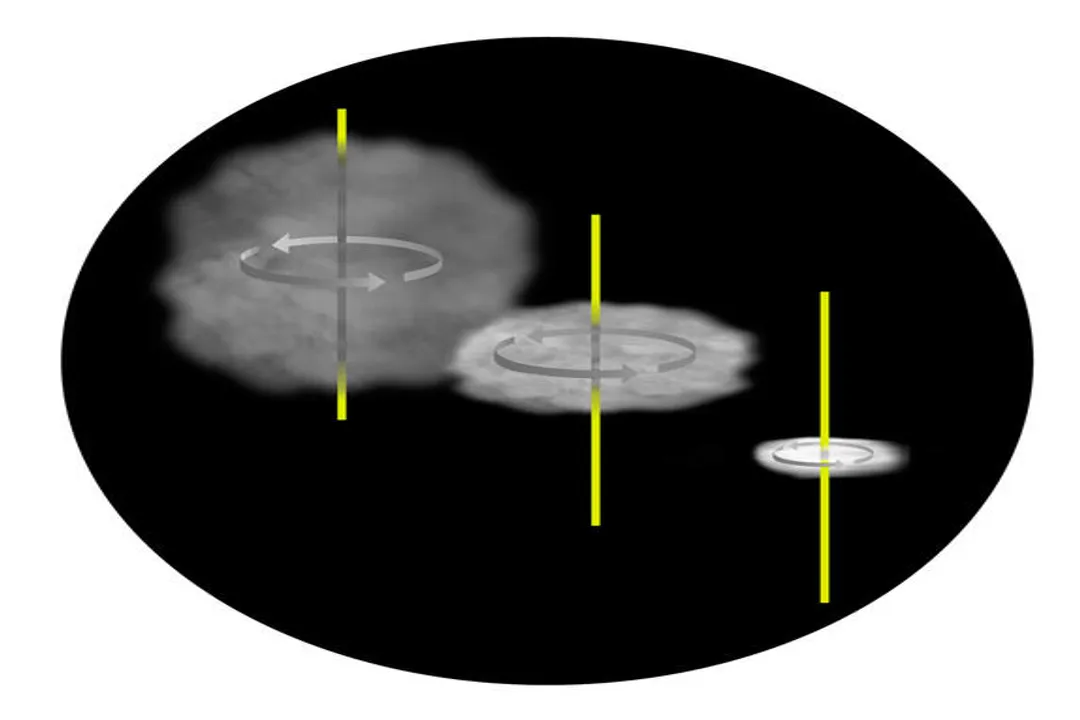
The vast, swirling cloud of gas and dust that birthed our Sun and its attendant planets—the solar nebula—was not a homogenous soup. Imagine a massive, flat, rotating disk, nearly light-years across, slowly spinning around a central proto-star. While the overall mix was dictated by the elemental forging of older, exploded stars, the material present was chemically zoned, a direct consequence of the steep temperature gradient radiating from the nascent Sun. Understanding the solar system we inhabit requires appreciating the three primary classes of material that composed this primordial structure. These ingredients dictated where rocky worlds could form, why the giants became gargantuan, and how the final architecture separated itself so distinctly between the inner and outer realms. [1]
# Primary Constituents
The most abundant, and perhaps most fundamental, component of the solar nebula was the primordial gas itself: hydrogen () and helium (). [2] These elements, the simplest and lightest products of the Big Bang, constituted the overwhelming majority of the cloud’s mass. Estimates suggest that and made up about $99.9$ percent of the total mass available in the nebula. [2]
As the cloud collapsed under gravity, this gas became concentrated at the center, forming the protostar that would become our Sun. [1][2] Once the core achieved sufficient temperature and pressure, nuclear fusion ignited, and the Sun was born, pouring out energy that defined the subsequent condensation zones throughout the remaining disk. [2] The sheer ubiquity of this hydrogen and helium gas meant that any body massive enough to hold onto it would become a gas giant. Far from the heat of the Sun, beyond a crucial boundary known as the frost line, proto-planets grew cores so massive that their gravity could pull in, and permanently retain, this lightweight gaseous component. [1] Therefore, the existence of Jupiter, Saturn, Uranus, and Neptune—the gas and ice giants—is a direct testament to the enduring presence of this primary gaseous component in the outer solar system. [2]
# Refractory Solids
Contrasting sharply with the abundant gas were the heavier elements that formed the basis of all solid bodies: rock and metal. These materials are referred to as refractory because they possess high melting points, meaning they remained solid even in the intense heat close to the developing Sun. [2]
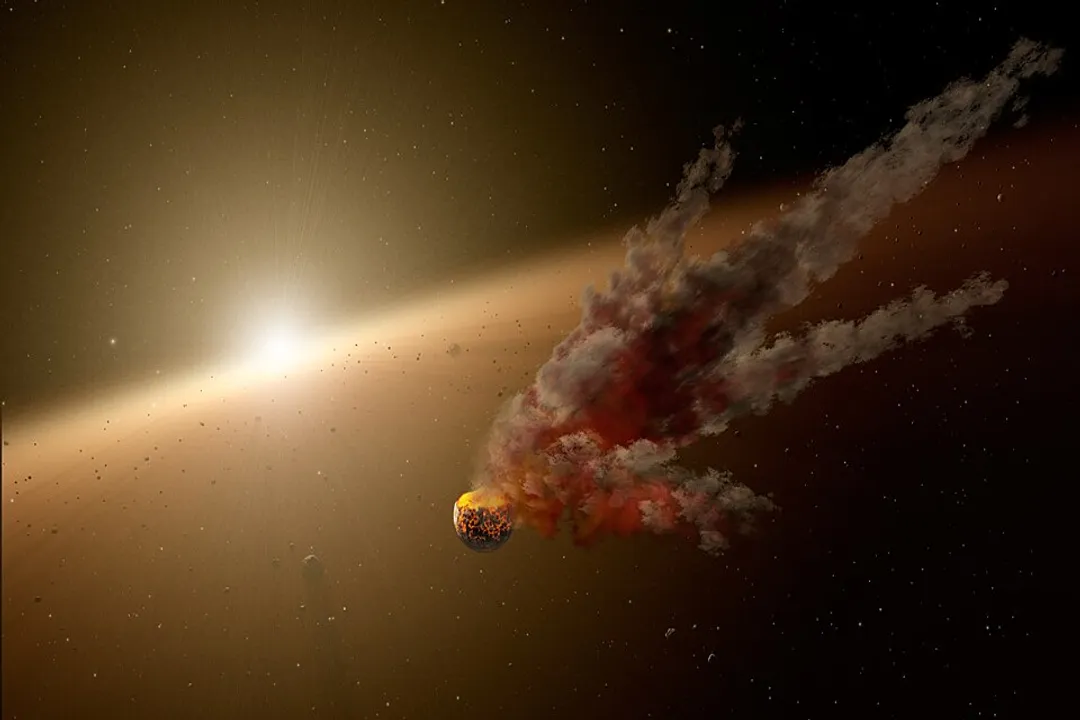
In the inner portion of the protoplanetary disk, where temperatures soared, only these sturdy materials could condense out of the gaseous fog into solid dust grains. [1] The building blocks of Earth, Mars, Venus, and Mercury—silicates (rock) and iron/nickel (metal)—began their aggregation here. [1][2] These small, solid dust grains started to stick together, a process called accretion, eventually building up kilometer-sized planetesimals. [1] The inner solar system was a region of material poverty, relative to the gas content, and the resulting worlds were dense, small, and built from these high-temperature condensates. [2]
It is fascinating to consider the disparity: while the vast majority of the nebula's mass was and , the matter that comprises the terrestrial planets—the material we stand on—represents the sparse, leftover residue, the "grit" that could withstand the Sun's initial heat. [1][2] If one were to map the elemental abundance of the Sun today, that composition would accurately reflect the original solar nebula, highlighting just how much and dominated, and by extension, how much of the heavier elements had to be cleared or segregated into the inner system. [1]

# Volatile Ices
The third major component class bridges the gap between the pure gas and the high-temperature solids. These are the hydrogen compounds, often referred to simply as ices, which include substances like water (), methane (), and ammonia (). [2]
These compounds are much more volatile than rock or metal; they require significantly lower temperatures to condense into solids. This critical temperature threshold defines the frost line, a boundary located somewhere between the orbits of modern Mars and Jupiter. [1] Inside this line, these substances remained vaporized, mixed into the surrounding gas, which the young Sun eventually blew away. [2] Outside the frost line, however, temperatures dropped sufficiently for these volatiles to condense alongside rock and metal dust, forming abundant icy materials. [1]
The consequence of this third component is arguably the largest structural feature of our solar system. The presence of ample ice beyond the frost line provided a massive boost to the mass available for building the giant planets. Planetesimals formed from ice were about four times more massive than those formed purely from rock and metal at the same distance. [1] This allowed the cores of Jupiter and Saturn to grow rapidly enough to cross the critical mass threshold—perhaps 5 to 10 Earth masses—necessary to begin the runaway accretion of the surrounding hydrogen and helium gas. [1] Without this abundance of solid, frozen hydrogen compounds, the formation of the gas giants as we know them would have been far more difficult, perhaps resulting only in smaller ice-rock cores. [1]
# Temperature Gradient Effect
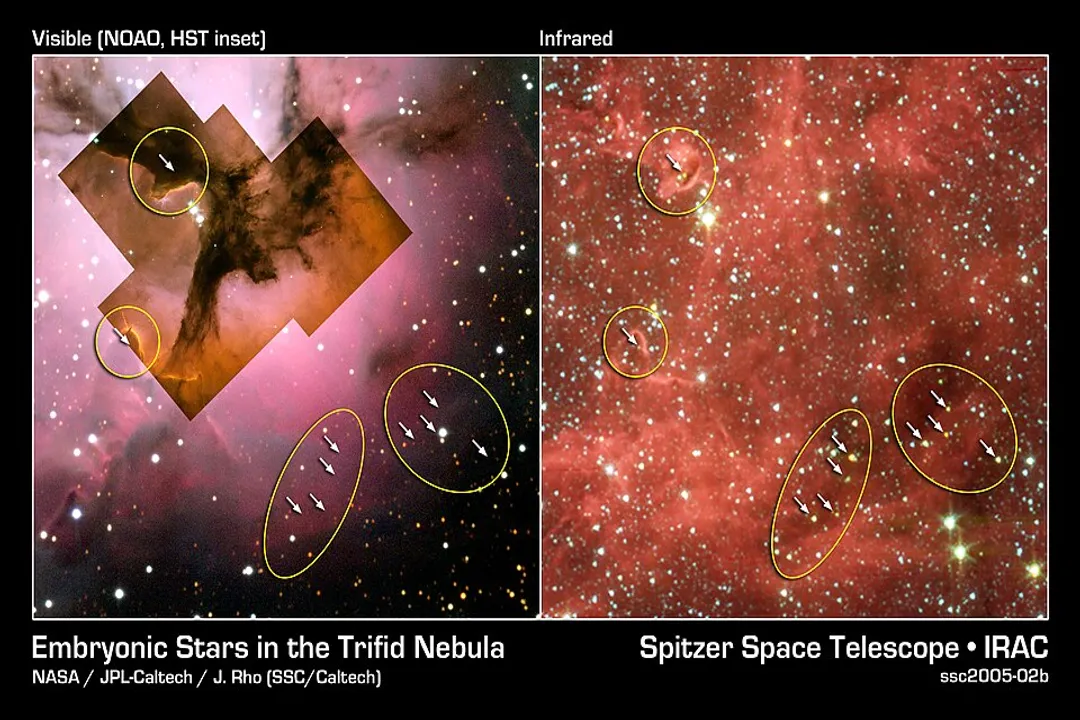
The definitive sorting mechanism that separated these three components was the temperature gradient across the protoplanetary disk. [1] The initial nebula was extremely hot near the center, cooled steadily with distance, and was frigid in its outermost reaches.
This gradient established a clear chemical sorting that directly led to the two distinct types of planets we observe:
| Zone | Temperature Range | Dominant Condensing Material | Resulting Bodies |
|---|---|---|---|
| Inner Disk | Very Hot | Rock and Metal (Refractories) | Terrestrial Planets (Mercury, Venus, Earth, Mars) [1] |
| Outer Disk | Cold (Past Frost Line) | Rock/Metal + Hydrogen Compounds (Ices) | Cores of Gas Giants (Jupiter, Saturn, Uranus, Neptune) [1] |
| Entire Disk | Varied | Hydrogen and Helium Gas | Sun and Gas Envelopes of Giants [2] |
The inner region was so hot that only the most refractory elements, like iron, could condense; lighter silicates were also present, but everything else remained gaseous. [1][2] Any small proto-planet forming here could not capture the remaining and because the solar wind, once the Sun ignited, swept that gas away before the cores became massive enough. [2] The planets that formed—Mercury through Mars—are, therefore, defined by what could condense in the heat: rock and metal cores with thin or non-existent atmospheres. [2]
Conversely, the outer region was cool enough for ices to solidify. [1] This availability of more condensed mass allowed for the rapid formation of large cores, which then transitioned into the massive gas-enveloped worlds we recognize as Jupiter and Saturn. [1]
An interesting observation arises when we compare the terrestrial planets to the icy giants. While the Earth’s composition is dominated by silicates and iron (rock and metal), the Jovian planets are overwhelmingly and . [2] This segregation means the bulk of the material (/) was relegated to the giant planets and the Sun, while the refractory materials (/) were entirely locked into the small inner worlds or the small inner cores of the giants. The hydrogen compounds acted as the essential "glue" or mass-enhancer that unlocked the potential for true gas giant formation in the outer system.
# Component Behavior Sorting
The physical processes governing how these components moved and interacted were governed by their state. The solid components—dust grains, then planetesimals—were subject to gravitational instabilities and collisions to build the larger planetary embryos. [1] The gas, however, exerted drag and viscosity on these solids. For instance, the growth of planetesimals into Moon- to Mars-sized embryos in the inner disk slowed down due to gravitational perturbations from these growing oligarchs, eventually limiting the mass of the future terrestrial worlds. [1]
The gas itself—the first component—was responsible for carrying away angular momentum from the spinning disk, allowing the central star to form while the disk flattened. [1] This dissipation of gas, often through photoevaporation or accretion onto the star, effectively set the hard deadline for the formation of the gas giants; if their cores weren't big enough before the gas vanished, they became "failed cores," like Uranus and Neptune. [1]
Consider the Earth’s eventual atmosphere and oceans. The volatiles that made up the Earth’s original, hot, outgassed atmosphere (, , ) were derived from the hydrogen compounds component, but these materials had to be delivered to the inner system late in the process, likely via impacts from comets or asteroids whose orbits were perturbed from the outer disk. [2] This late delivery of volatiles—the very stuff required for oceans and a thicker early atmosphere—from the region dominated by ices highlights how material interchange, even after the initial zoning, continued to shape planetary interiors and surfaces. [2] The initial component separation was clear, but later gravitational scattering provided a mechanism for the "outer" materials to enrich the "inner" worlds.
# A Note on Inheritance and Loss
A subtle but critical detail arises from comparing the elemental abundances in the Sun (the nebula's primary reservoir) to the final planets. If we look at the rocky inner worlds, we see they contain almost no light gas—the solar wind successfully purged this component from the inner realm. [2] However, the heavier elements, the rock and metal, were concentrated in the inner disk because they could condense there. The gas giants, on the other hand, captured vast quantities of the primary / gas, but their cores are only a small fraction of their total mass, built from the , , and that fell in before the gas supply was cut off. [1]
The efficiency of this process offers a point of reflection. The nebula was $99.9%$ gas, yet the terrestrial planets—our immediate environment—are almost entirely composed of the remaining $0.1%$ of solids. This demonstrates that the formation of rocky planets is an extremely efficient, but fundamentally material-limited, process. The building blocks for Earth were the "trace elements" of the solar system inventory, yet they managed to aggregate into planetary cores right next to the star that was actively clearing away the overwhelming majority of the original cloud’s mass. [1][2] This imbalance suggests that any solar system forming around a star like ours is predisposed to having a small, solid inner region surrounding a massive, gaseous outer region, provided the initial disk lifetime is short enough to halt gas accretion on the inner cores. The very structure of our system is a direct, almost inevitable outcome of how temperature governed the condensation state of these three core material classes.
Related Questions
#Citations
Mysteries of the Solar Nebula | NASA Jet Propulsion Laboratory (JPL)
The Solar Nebula Formation of the Earth Origin of the Atmosphere ...
What were the three major components of the solar nebula? - Chegg
Nebular hypothesis - Wikipedia
Formation of Our Solar System | AMNH