What provided the necessary mass boost for the cores of Jupiter and Saturn to rapidly accrete hydrogen and helium gas?
Answer
The abundance of solid, frozen hydrogen compounds (ices).
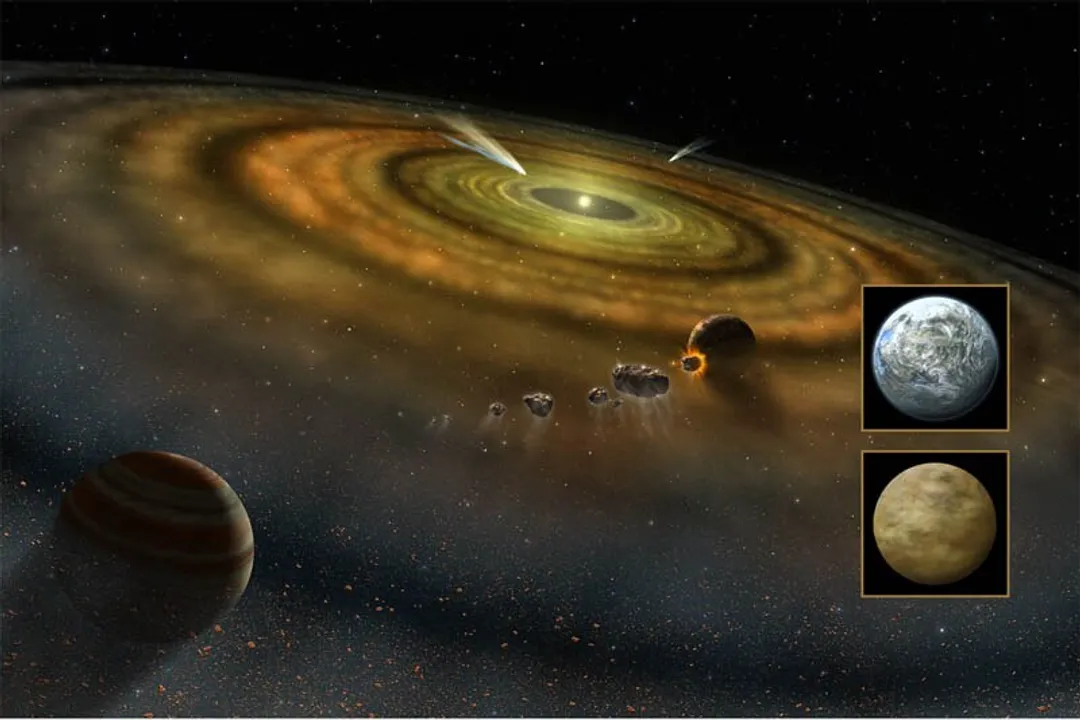
The availability of abundant ices beyond the frost line allowed proto-planets to build cores significantly more massive than those in the inner system, enabling them to reach the critical mass needed to capture the surrounding lightweight gas.
Related Questions
What percentage of the solar nebula's total mass was composed of primordial hydrogen ($ ext{H}$) and helium ($ ext{He}$)?What characteristic defines refractory solids like rock and metal?What materials condensed exclusively in the hot inner portion of the protoplanetary disk?Where is the frost line generally located in relation to the orbits of modern planets?Which group of compounds is classified as volatile ices in the solar nebula context?What was the definitive sorting mechanism that separated the three primary material classes in the nebula?What provided the necessary mass boost for the cores of Jupiter and Saturn to rapidly accrete hydrogen and helium gas?How were the hydrogen compounds necessary for Earth's oceans and early atmosphere primarily delivered?What fate befell Uranus and Neptune compared to Jupiter and Saturn regarding gas accretion?Relative to the gas content, how is the material composition of the inner solar system described?