What does the solar nebula consist of?
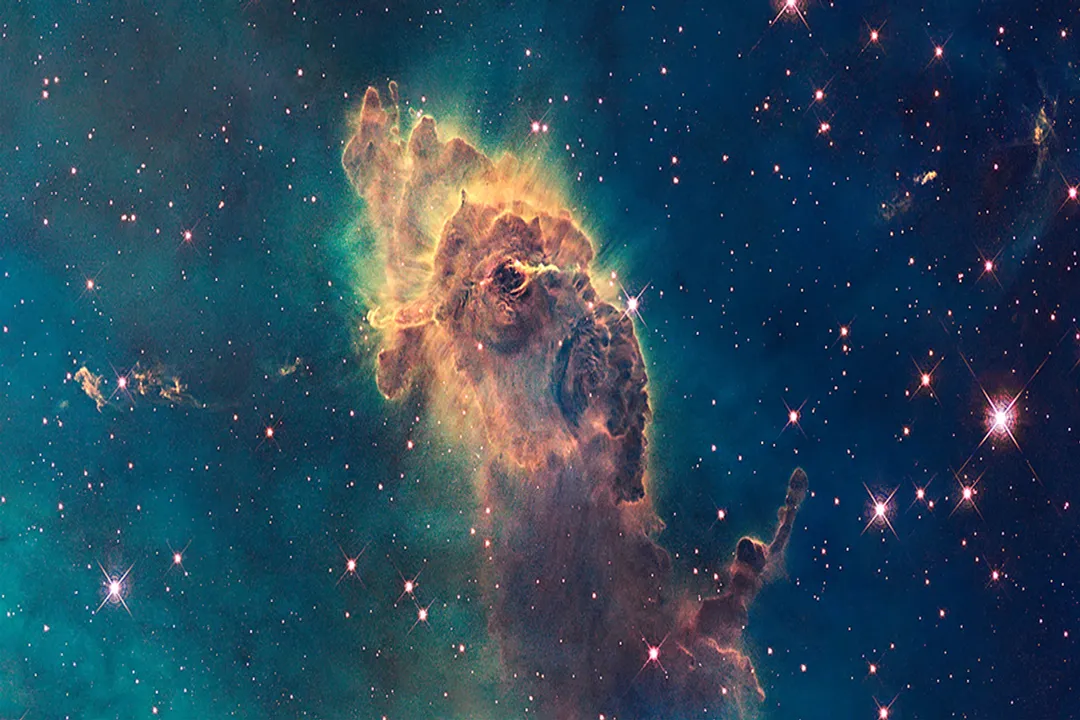
The earliest moments of our solar system began with a vast, spinning cloud of gas and dust, a structure known today as the solar nebula. This cloud was not static; it was the raw material—the cosmic starter kit—from which the Sun, the planets, moons, asteroids, and comets would eventually accrete. [1][7][9] To understand what the solar nebula consisted of is to understand the elemental building blocks of Earth and everything upon it. Essentially, it was a vast reservoir primarily composed of the same material that constitutes the Sun today. [1]
# Gas Dominance
The overwhelming majority of the solar nebula’s mass was gaseous, which is typical for the raw material that forms a star system. [1][9] Hydrogen () and helium (), the two lightest and most abundant elements in the universe, dominated this disk. [1] Together, these gases accounted for roughly 98 percent of the total mass present in the nebula. [1][7]
Hydrogen, existing mostly as molecular hydrogen () in the cooler regions or atomic hydrogen () closer to the nascent Sun, provided the gravitational bulk necessary for the entire structure to collapse and heat up. [1][7] Helium, the second lightest element, was also present in huge quantities, though it remained largely inert during the subsequent planet-building phase. [1] The sheer scale of this gaseous component meant that the formation of the Sun itself was the main event, with planetary formation being the secondary process that utilized the leftovers.
# Trace Solids
If hydrogen and helium made up 98 percent of the mass, this leaves the remaining 2 percent, which is an astonishingly small fraction, to account for everything that is solid in our solar system—every rock, every piece of metal, and every ice particle. [1][7] This small residue is what scientists refer to as the "dust" component, comprised of heavier elements, often termed "metals" in astronomical parlance. [1]
These solid grains were essential because they provided the initial nucleation sites for accretion. Without them, gravity alone would have struggled to form objects large enough to survive the solar wind sweeping through the nebula. This dust included several categories of material:
- Refractory Materials: These are substances with very high melting points, such as silicates (rock-forming minerals) and metallic iron and nickel. [1][7] These materials condensed earliest, forming grains even when temperatures were extremely high near the center of the disk. [7]
- Volatiles (Ices): Cooler regions farther from the proto-Sun contained frozen compounds, often referred to as ices. These included water ice (), methane (), ammonia (), and carbon monoxide (). [1][7][9] These ices dramatically increased the total solid mass available beyond the "snow line". [1]
It is fascinating to consider that the rocky cores of Earth and Mars, and the icy mantles of the gas giants, all originated from this scant $2%$ reservoir. The elemental abundances within this trace material generally mirrored the solar composition for elements heavier than helium, suggesting the nebula was chemically primitive, reflecting the composition of the molecular cloud from which it formed. [7]
# Cosmic Inheritance
The composition of the solar nebula was not arbitrary; it was dictated by the history of the Milky Way galaxy. [2] The elements heavier than hydrogen and helium—everything from carbon to uranium—were created in previous generations of stars, either through standard nuclear fusion within their cores or during violent explosive events like supernovae. [2]
Our Sun and its accompanying nebula formed as a Population I star system. [2] Population I stars are characterized by having a relatively high abundance of these heavier, or "metal," elements compared to the very first stars (Population III) that formed in the early universe. [2] This means that when the nebula collapsed, it carried the chemical legacy of stars that lived and died long before the Sun ever ignited. The specific ratios of silicon, oxygen, iron, and carbon in the nebula directly influenced the types of planets that formed. [2] If the preceding generations of stars had produced much less iron, for example, the terrestrial planets might have been significantly smaller or perhaps not formed at all in the inner system.
# Temperature Gradient
The solar nebula was not uniformly hot or cold; it possessed a pronounced temperature gradient that fundamentally determined the chemical structure of the resulting planetary system. [1][7][9] As the material settled into a disk orbiting the protosun, the region closest to the Sun was intensely hot, while the outer reaches remained frigid. [7]
This temperature variation dictated where different materials could exist in a solid state. Close to the Sun, temperatures were high enough that only the most refractory materials—metals and silicate rock—could condense into solid grains. [7] This confinement of solid material to the inner region explains why the inner planets (Mercury, Venus, Earth, Mars) are predominantly rocky and metallic.
Further out, past a critical boundary often called the snow line or frost line, the temperature dropped sufficiently for water ice to condense. [1][7] Beyond this line, the available solid material suddenly included vast quantities of frozen water, dramatically increasing the total amount of solid matter available to aggregate. [1] This is the critical reason why the outer solar system hosts the gas giants (Jupiter, Saturn, Uranus, Neptune); they were able to accumulate significantly more solid material quickly enough to reach masses capable of gravitationally sweeping up the abundant surrounding hydrogen and helium gas. [7]
A useful way to conceptualize this is through the relative mass budget available for planetesimal formation. If we imagine a 100-unit volume of the inner nebula past the frost line, perhaps only 2 units were solid matter (rock and metal). However, if we take that same 100-unit volume beyond the frost line, those 2 units of rock/metal are supplemented by the mass of water ice, perhaps bringing the total solid budget up to 10 or more units. This difference in solid budget provided the necessary head start for the core accretion that built Jupiter and Saturn so rapidly.

# Material Zoning
The chemical composition of the nebula varied in a predictable, layered fashion, which scientists can model based on condensation temperatures. [1] This layering isn't just about location; it's about which elements survived the gravitational settling and subsequent heating processes.
| Zone Relative to Sun | Primary Solid Composition | Examples of Resulting Bodies |
|---|---|---|
| Inner System (Hot) | Metals (Iron, Nickel) and Silicates | Terrestrial Planets (Rocky) [7] |
| Transition Zone | Silicates and Frosts (Water Ice) | Asteroid Belt Objects (Mixture) |
| Outer System (Cold) | Silicates, Metals, and Abundant Ices | Jovian Planet Cores and Icy Moons [1] |
The actual inventory of the nebula was constantly being reworked by processes such as the turbulence induced by the rotating disk and the outflowing solar wind. [9] Furthermore, the initial mixing of materials wasn't perfectly uniform. Evidence from primitive meteorites suggests that even within the early dust cloud, small, hot inclusions of presolar grains—tiny bits of dust formed around extinct stars—existed alongside cooler, amorphous material. [2] The solar nebula was therefore a mixture of newly synthesized stellar material and the debris from previous stellar generations, all churned together before settling into the temperature-dependent zones that formed our planets. The presence of these presolar grains gives us a direct sample of the nebula’s composition before any significant chemical processing occurred locally. [2]
The entire solar nebula, from its massive gaseous envelope to its microscopic dust grains, represented a snapshot in time—a mixture of primordial galactic material processed through one star's birth—and its composition encoded the entire architectural plan for the solar system that followed. [9]
#Videos
What Was The Composition Of The Solar Nebula? - Physics Frontier
Related Questions
#Citations
Solar nebula | Formation, Accretion, Protoplanetary Disk - Britannica
Mysteries of the Solar Nebula | NASA Jet Propulsion Laboratory (JPL)
Solar Nebula
The Solar Nebula Formation of the Earth Origin of the Atmosphere ...
Physics and chemistry of the solar nebula - PubMed
Astronomy- Ch. 8 Flashcards - Quizlet
How our solar system was born | Natural History Museum
What Was The Composition Of The Solar Nebula? - Physics Frontier
8.2: Origin of the Solar System—The Nebular Hypothesis