What does the solar nebula contain?
The solar nebula, that vast, rotating cloud of gas and dust from which our Sun and all the planets coalesced, was a dynamic, chemically rich environment governed by fundamental laws of physics and chemistry. To understand what it contained is to understand the very building blocks of everything we see today, from the blazing core of the Sun to the icy moons of the outer giants. At its birth, this primordial cloud, known as the protosolar nebula, was essentially a large portion of the interstellar medium that had collapsed under its own gravity, likely triggered by a nearby event such as a supernova shockwave.
# Cloud Makeup
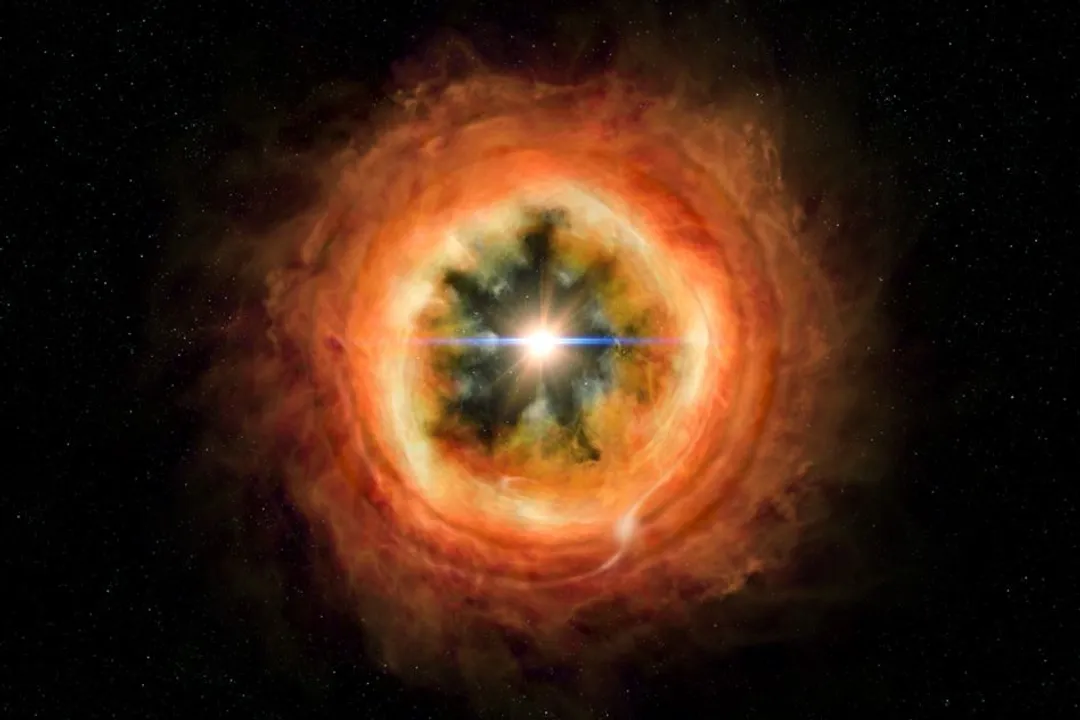
The overwhelming bulk of the material present in the solar nebula was dictated by the elemental abundance found in the universe at large, which is dominated by the two lightest elements. This initial mixture was primarily composed of nearly pure hydrogen and helium gas. Hydrogen, the most abundant element, and helium, the second most abundant, together made up roughly 98% of the nebula’s total mass. These elements remained gaseous throughout almost the entire volume of the forming system because the temperatures, even near the central proto-Sun, were not low enough for them to condense into solids.
The remaining approximately two percent constituted the "metals" and "ices"—the materials that would eventually form the planets, moons, asteroids, and comets. This minor fraction is where the true complexity of planetary formation lies, as it represents all the elements heavier than helium. These heavier elements were often categorized by astronomers simply as "metals," although this category includes elements like oxygen and carbon.
# Refractory Solids
Within that minority fraction, the first materials to condense out of the cooling gas were the most refractory substances, meaning they have very high melting points. These solids formed the initial seed particles for planetesimals. The most common refractory elements included iron, nickel, silicon, and various metals and silicates (compounds of silicon and oxygen). Think of these as the raw materials for rocky bodies. In the hottest, innermost regions of the nebula, close to the forming Sun, only these extremely tough materials could survive in solid form as the gas continued to cool and accrete. The existence of terrestrial planets like Earth is a direct testament to the high concentration of these refractory components that were available in the inner solar system.
# Volatile Ices
As one moved outward from the Sun’s immediate vicinity, the temperature dropped significantly, allowing compounds with lower melting points to condense into solid, icy grains. These materials are generally referred to as ices or volatiles, though their composition is far more varied than simple water ice. The inventory of ices included frozen water (), methane (), ammonia (), and carbon dioxide ().
The boundary where water ice could begin to condense as a solid—where the temperature dropped below the freezing point of water—is famously known as the frost line or ice line. This demarcation is perhaps the single most critical piece of information regarding the initial composition distribution, as it fundamentally separated the building blocks available to the inner and outer Solar System. Inside the frost line, only silicate rock and metal grains could form solids, leading to the creation of smaller, rocky worlds. Outside the frost line, the vast reservoir of abundant frozen water, along with methane and ammonia ices, provided a much larger pool of solid material. This readily available solid mass allowed the cores of the giant planets to grow much larger, much faster, enabling them to gravitationally capture the enormous envelopes of hydrogen and helium gas that surround them today.
# Chemical Distribution
To appreciate the scale of composition, considering the relative proportions of these ingredients is helpful. A simple summary, based on the elemental makeup typical of the resulting Sun, shows a stark contrast between the gas and the solids available for planet formation.
| Element/Compound Class | Approximate Percentage by Mass in Nebula (Excluding H/He) | Condensation State (Inner System) | Condensation State (Outer System) |
|---|---|---|---|
| Oxygen (bound in silicates/ices) | of solids | Solid (Silicates) | Solid (Silicates and Ice) |
| Silicon (bound in silicates) | of solids | Solid (Silicates) | Solid (Silicates) |
| Iron/Nickel (Metals) | of solids | Solid (Metal) | Solid (Metal) |
| Carbon (bound in organics/methane) | Varies | Solid (As carbides/organics) | Solid ( Ice) |
| Hydrogen/Helium | of total mass | Gas only | Gas only |
It is an interesting exercise to compare this nebula budget with the composition of a finished terrestrial planet, such as Earth. While the nebula was mostly and , Earth is about $32%$ iron and $30%$ oxygen, with significant silicon and magnesium, yet it contains almost no primordial hydrogen or helium gas. The processes of condensation and subsequent migration or photo-evaporation effectively stripped the solar nebula of its light gases in the inner regions, leaving behind only the high-melting-point materials that formed our world. This selective removal means that Earth’s mass is an extreme concentration of the non-volatile component of the original cloud.
# Dust Grains and Aggregation
The solid components did not start as planets or even large asteroids; they began as microscopic dust grains. These grains were likely composed of amorphous or crystalline silicates, carbon compounds, and perhaps even amorphous ices before any significant heating occurred. The initial material was probably highly disordered. As the nebula cooled, these tiny constituents—initially smaller than smoke particles—began to collide and stick together through electrostatic forces, initiating the process of accretion.
The formation of these initial micron-sized grains required cooling from the initial stellar material. The specific chemical pathways that led to the formation of complex silicates in the warm inner nebula are a subject of ongoing study, as the required reaction kinetics need rapid cooling rates to prevent simple elemental condensation. These aggregated particles eventually grew into larger pebbles, and then kilometer-sized planetesimals, which then collided to form the larger bodies we observe today.
The structure of the nebula also played a role in material segregation. The gas and dust were not uniformly mixed across the entire disk. While the gas dominated the mass, the dust was concentrated in the midplane of the flattened disk. This concentration in the midplane allowed for more frequent collisions between solid particles, accelerating the growth process in that layer where planets would eventually form.
# The Nebular Lifetime
The composition of the solar nebula wasn't static over time; the material was actively being processed and removed. The lifetime of the gas component is particularly relevant because its dissipation marks the end of the primary feeding time for the gas giant planets. Scientists have estimated that the gaseous phase of the solar nebula likely persisted for only about 10 million years. This relatively short window meant that the large, massive cores of Jupiter and Saturn had to form quickly—within a few million years—to gravitationally capture the remaining hydrogen and helium before the solar wind, or other clearing mechanisms, blew the remaining gas away.
If the nebula had persisted for, say, 100 million years, we might have a Solar System populated by several additional gas giants, or perhaps even larger versions of the ones we currently have. The swift disappearance of the and reservoir dictated the final mass limits of the outer planets. The solid components, however, continued to evolve through impacts and orbital migration for much longer, long after the initial gas was gone.

# Insight on Uniformity and Budget
The material constituting the solar nebula, before the Sun ignited fully and cleared the remaining gas, represented the total budget for the entire Solar System. This initial, relatively uniform distribution of elements—rich in light gases and modestly endowed with heavier elements—is the starting line for all subsequent planetary evolution. When we examine the chemical differences between an Earth-like rock and a Jupiter-like gas giant, we are not looking at different starting materials; we are looking at the consequences of location within that initial, common cloud. If the nebula had formed with a slightly lower abundance of silicon, for instance, the density of Earth-like planets would be substantially lower, or they might not have formed at all, depending on the exact temperature profile.
Another point to consider is the inhomogeneity that developed very quickly. Although the nebula started as a homogeneous mix of roughly 98% and 2% heavy elements, the rapid temperature gradient meant that effective composition varied wildly across radial distances. For a planet-forming region only one Astronomical Unit (AU) out, the effective "solid-only" budget was dominated by refractory elements, whereas at , the budget was overwhelmingly dominated by ices. This immediate, sharp chemical differentiation, caused by temperature, is the mechanism that created two fundamentally different classes of planets from the same initial cloud of matter. This illustrates how a simple physical parameter—temperature—acts as the master sorting mechanism in solar system formation.
# Material Segregation
The process of material condensation and segregation is key to understanding the final contents of the nebula at any given moment, especially once accretion began. As the nebula contracted and heated near the center, a temperature gradient formed: hot near the center, cool far away.
This gradient dictates what exists as solid versus gas at a given radius:
- Innermost Region (Near Sun): Extremely hot. Only the very highest-melting-point materials—metals like iron and nickel, and some silicates—exist as solids. Volatiles remain entirely gaseous.
- Terrestrial Zone (1–4 AU): Temperatures allow silicates and metals to form solid grains. Water ice is still gaseous or vaporized. This is where rocky planetesimals form.
- Frost Line Region (): Water transitions from vapor to solid ice. The amount of available solid material effectively triples here because water is abundant in the nebula.
- Outer Region (): All volatiles, including , , and , are frozen solids, providing massive amounts of material for the cores of the giant planets.
The nebular material, therefore, wasn't just what elements were present, but in what phase they existed, which determined their ability to aggregate into larger bodies. The material that constitutes a comet today—a pristine chunk of ice and dust—is a relic from the outer, colder reaches of the nebula, having remained largely undisturbed since its condensation. Conversely, the material in a metallic asteroid is a fragment of the highly processed, metal-rich inner nebula.
In summary, the solar nebula was a massive reservoir of gas, over $98%$ hydrogen and helium, interspersed with a small but critical fraction of heavier elements. This heavier fraction included refractory metals and silicates concentrated near the center, and abundant ices that dominated the outer regions beyond the frost line. This inventory, subject to intense thermal gradients and a relatively short lifetime of about 10 million years for the gas phase, contained the complete chemical blueprint for everything that would follow.
#Videos
What Was The Composition Of The Solar Nebula? - Physics Frontier
Related Questions
#Citations
The Solar Nebula Formation of the Earth Origin of the Atmosphere ...
Astronomy- Ch. 8 Flashcards - Quizlet
Scientists estimate solar nebula's lifetime | MIT News
Physics and Chemistry of the Solar Nebula - PubMed
What Was The Composition Of The Solar Nebula? - Physics Frontier
Solar Nebula Definition - Earth Science Key Term - Fiveable
Planets and How They Formed - Las Cumbres Observatory
Solar nebula | Formation, Accretion, Protoplanetary Disk - Britannica
Solar system | AMNH