What is the definition of solar nebula theory?

The formation of our solar system, from a vast, swirling cloud of gas and dust to the organized architecture we observe today, is explained through the Solar Nebula Theory, sometimes referred to simply as the Nebular Hypothesis. [2] This theory posits that approximately 4.6 billion years ago, our Sun and the planets coalesced from a massive, rotating interstellar cloud composed primarily of hydrogen and helium, alongside trace amounts of heavier elements formed in previous stellar generations. [3][7] It is the leading scientific explanation for how the Sun, Earth, the asteroid belt, and the outer gas and ice giants came to be arranged as they are. [4]
# Nebular Origin

The starting material for everything familiar in our neighborhood—the Sun, the planets, their moons, and even the minor bodies like asteroids and comets—was this immense, cold, low-density cloud of gas and dust known as the solar nebula. [7][2] This cloud was part of a much larger molecular cloud existing within the Milky Way galaxy. [7] The material composition reflected the general cosmic abundance: roughly 98% hydrogen and helium, with the remaining percentage made up of heavier elements like silicates, iron, carbon, and water ice—the building blocks for rocky planets and volatile-rich outer worlds. [7][1] The sheer scale of this original cloud is hard to fathom; it had to contain enough mass to form the Sun and all the subsequent planetary bodies combined. [3]
# Collapse Trigger
For the process to begin, the equilibrium of this diffuse cloud had to be disturbed, initiating a gravitational collapse. [7] While the exact trigger isn't always definitively proven for every star system, the most commonly cited mechanism involves an external shockwave. This shockwave likely originated from the explosion of a nearby massive star, known as a supernova. [7][2] Such an event would compress a region of the nebula, increasing its density enough for its own gravity to overcome the internal outward pressure, causing that localized region to begin collapsing inward. [7][3] The historical roots of this concept are quite old, dating back to the 18th century when thinkers like Immanuel Kant and Pierre-Simon Laplace independently proposed similar ideas describing a rotating, flattened primordial cloud. [2]
# Disk Mechanics
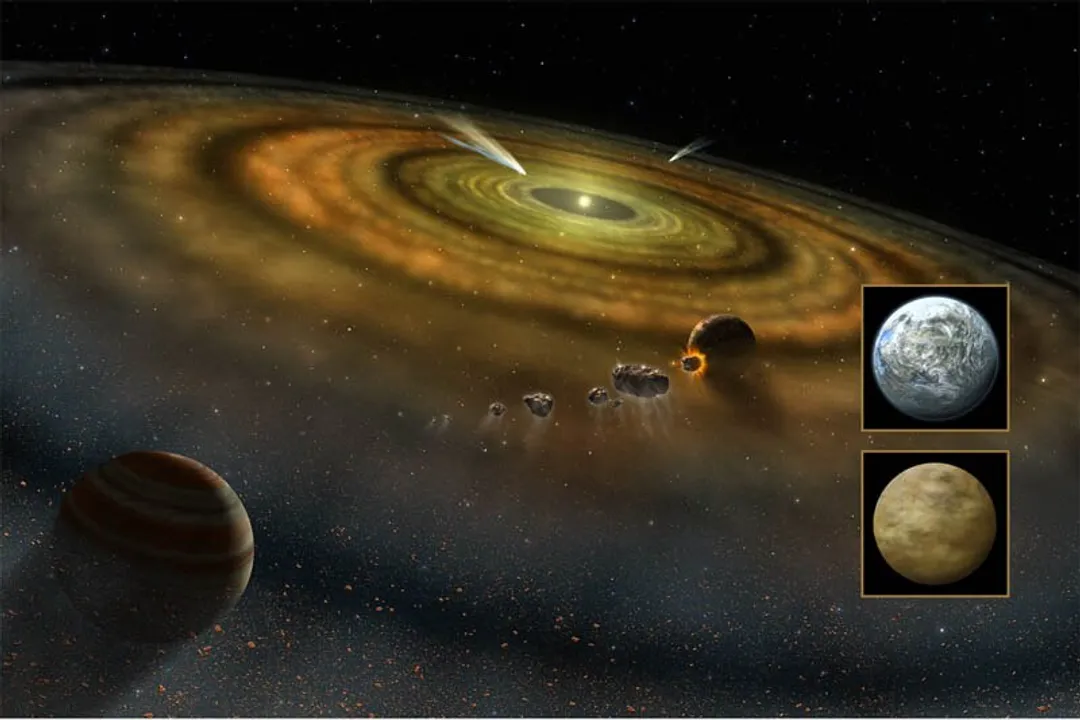
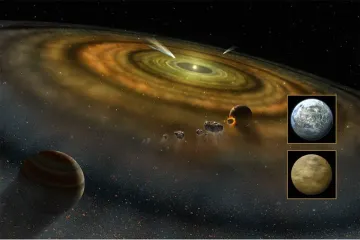
Once the collapse commenced, two fundamental physical principles governed the subsequent shape change: the conservation of mass and the conservation of angular momentum. [7] As the cloud contracted under its own gravity, its density increased dramatically in the center, leading to a corresponding rise in temperature—this central region would eventually become the Sun. [7][3] Crucially, as the cloud shrank, its rotation speed had to increase to conserve its angular momentum, much like an ice skater pulling their arms in speeds up their spin. [7] This forced rotation prevented all the material from simply falling straight toward the center. Instead, the cloud flattened perpendicular to the axis of rotation, transforming the spherical nebula into a vast, thin, spinning structure called a protoplanetary disk. [7][1][2]
The resulting structure was not uniform; it was a differentially rotating disk. The material nearer the center orbited faster than the material farther out, maintaining a steady inward fall against the centrifugal force, creating a stable, pancake-like configuration around the developing star. [1]
A useful way to visualize this phase is to picture a blob of dough being spun into a pizza crust. The initial collapse is the kneading, and the spin-up while flattening is the rapid outward stretching. If the initial nebula had any slight, inherent rotation, the conservation law amplifies that spin dramatically as the radius decreases, ensuring the resulting disk is far flatter than the initial cloud was spherical. [1]
# Protostar Ignition
At the heart of this flattening disk resided the densest concentration of matter, which continued to pull in surrounding gas and dust. [7] As mass accumulated, the pressure and temperature in the core soared. This growing, hot core is known as a protosun. [7] The accretion process continued, heating the center until the temperature and pressure were high enough to ignite nuclear fusion—the process where hydrogen atoms combine to form helium, releasing vast amounts of energy. [7] This ignition marks the birth of a true star, our Sun, which then began to clear out the surrounding gas and dust primarily through strong solar winds and radiation pressure. [7]

# Accretion Process
While the central star was forming, the leftover material in the surrounding disk began the process of building planets through accretion. [7][5] Initially, microscopic dust grains collided gently and stuck together through electrostatic forces, much like dust bunnies forming under furniture. [7] As these clumps grew into larger bodies, perhaps meter-sized, they gained enough gravitational influence to actively attract more material. [7] This process escalated: small clumps formed larger ones, which formed kilometer-sized objects called planetesimals. [7] Planetesimals were the planet builders; their continued, higher-velocity collisions led to the formation of protoplanets, which eventually swept up the remaining material in their orbital paths to become the final, major planets. [7][3]
# Zonal Chemistry
One of the most powerful pieces of evidence supporting the Nebular Theory lies in explaining the distinct differences between the inner and outer planets. [7][1] The protoplanetary disk was not uniformly hot; it possessed a steep temperature gradient, being extremely hot near the protosun and progressively colder farther out. [7][1]
This temperature variation dictated what materials could condense and survive at specific distances:
- Inner System: Close to the hot young Sun, only materials with very high melting points could solidify. This includes metals like iron and silicates (rock-forming minerals). [7][1] Consequently, the inner terrestrial planets—Mercury, Venus, Earth, and Mars—formed from these refractory materials, resulting in their dense, rocky composition. [7]
- Outer System: Farther away, beyond the "frost line" (or ice line), temperatures were low enough for volatile compounds like water, methane, and ammonia to condense into solid ices. [7][1] Because ices were far more abundant in the original nebula than rock or metal, the planetesimals that formed beyond this line could grow much larger, much faster. [7] Once these cores reached a critical mass (estimated to be about 10 Earth masses), their gravity became strong enough to rapidly capture the vast quantities of surrounding hydrogen and helium gas remaining in the disk, leading to the formation of the gas giants: Jupiter and Saturn, and the ice giants Uranus and Neptune. [7]
This difference in raw materials—rock/metal versus rock/ice/gas—is an inherent prediction of the theory that matches observations perfectly. The successful formation of the four small, dense inner worlds and the four massive, gas-enveloped outer worlds stems directly from that initial thermal structure of the disk. [1]
# Theory Evidence
The Nebular Hypothesis is considered highly successful because it explains many key features of the solar system that other models struggled to account for. [3] For instance, it explains why all the planets orbit the Sun in the same direction—the original direction of the nebula’s spin—and why they orbit generally in the same flat plane (the ecliptic). [7][3] If planets had formed via chaotic capture events, this orderly arrangement would be highly improbable. Furthermore, the theory naturally accounts for the existence of belts of smaller, unaccreted material, such as the Asteroid Belt (material trapped between Jupiter’s strong gravity) and the Kuiper Belt/Oort Cloud (remnants from the outer reaches of the disk). [7]
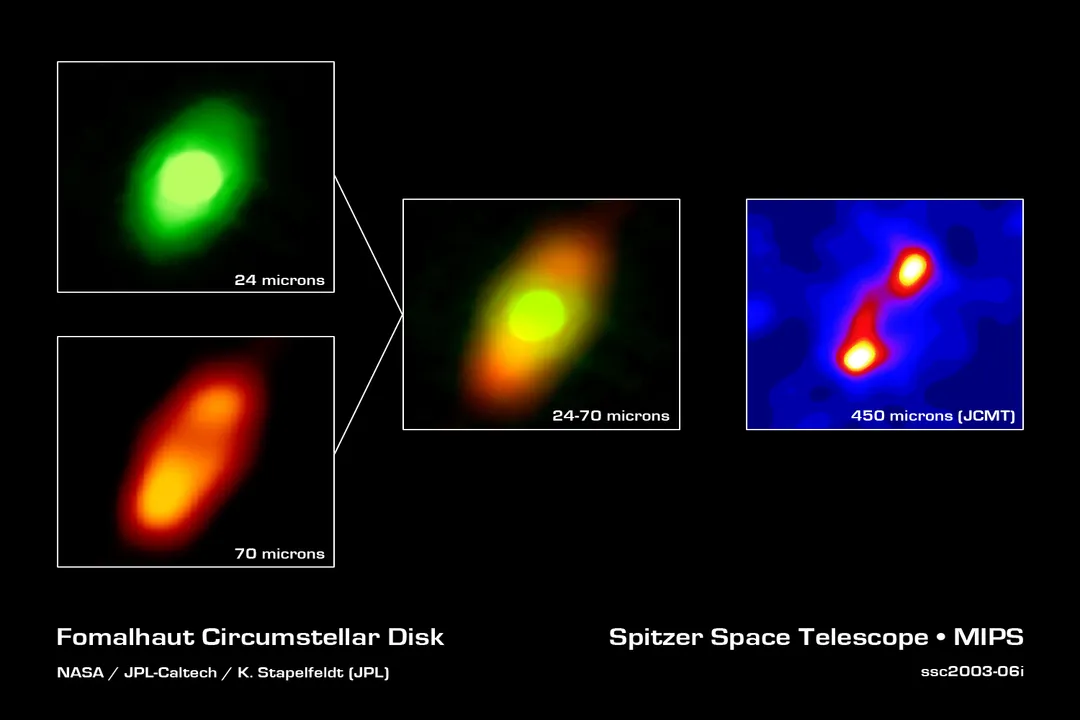
When we look at other stars today, we often observe other young systems that are still in the protoplanetary disk stage, providing direct visual confirmation that the process described by the theory—a central star surrounded by a rotating disk of material—is a common occurrence in the galaxy. [4] The theory remains the current standard because it provides a single, internally consistent narrative for the architecture, composition, and motion of our entire planetary neighborhood. [3]
#Videos
Formation of the Solar System - The Solar Nebula theory Explained
Related Questions
#Citations
8.2: Origin of the Solar System—The Nebular Hypothesis
Nebular hypothesis - Wikipedia
The Nebular Theory – Introduction to Astronomy
1.2. How did our Solar System form? - NASA Astrobiology Program
Nebular Theory | Definition, Development & Problems - Lesson
Solar nebula | Formation, Accretion, Protoplanetary Disk - Britannica
The Solar Nebula Formation of the Earth Origin of the Atmosphere ...
Formation of the Solar System - The Solar Nebula theory Explained
Nebular theory and the formation of the solar system - OpenGeology