What is nebula cloud theory?
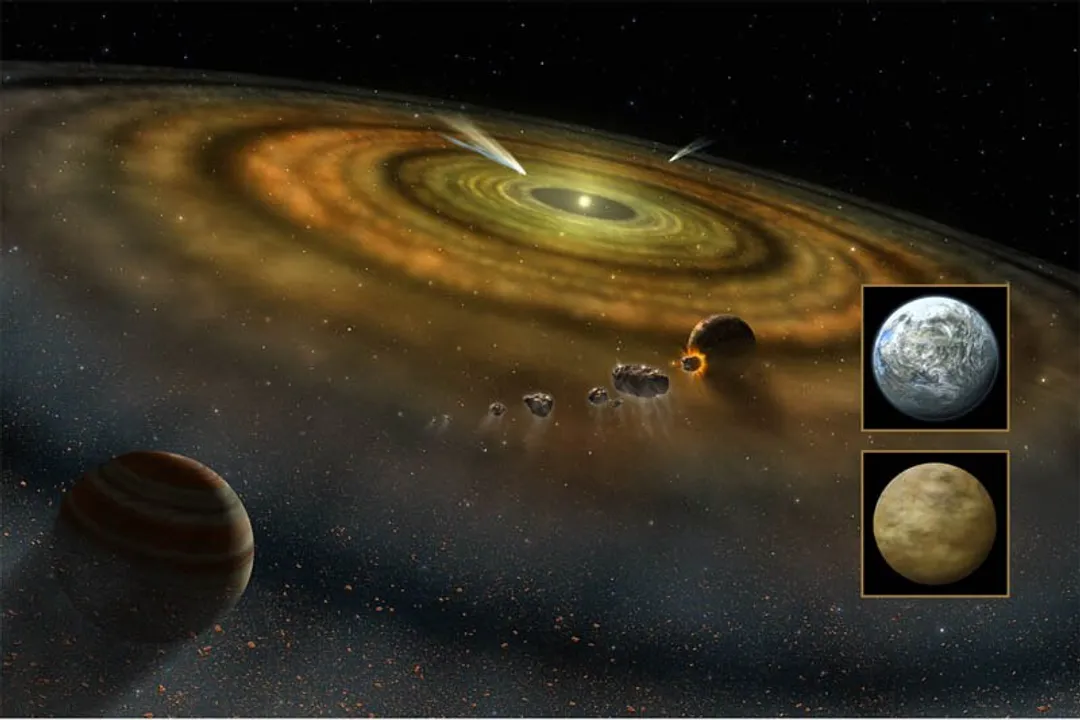
The idea explaining how our Solar System came to be centers around the Nebular Hypothesis, a scientific model suggesting that the Sun, planets, and other bodies formed from a rotating cloud of interstellar gas and dust. [1][2] This cloud, often referred to as a solar nebula, collapsed under its own gravity billions of years ago. [2][8] Understanding this theory moves past simple chance, offering a mechanical explanation for the almost uniform direction of planetary orbits and the general flatness of the ecliptic plane. [2] While the general concept has roots stretching back centuries, the modern version provides a step-by-step account of the transformation from diffuse cloud to the structured system we observe today. [1]
# Nebula Defined
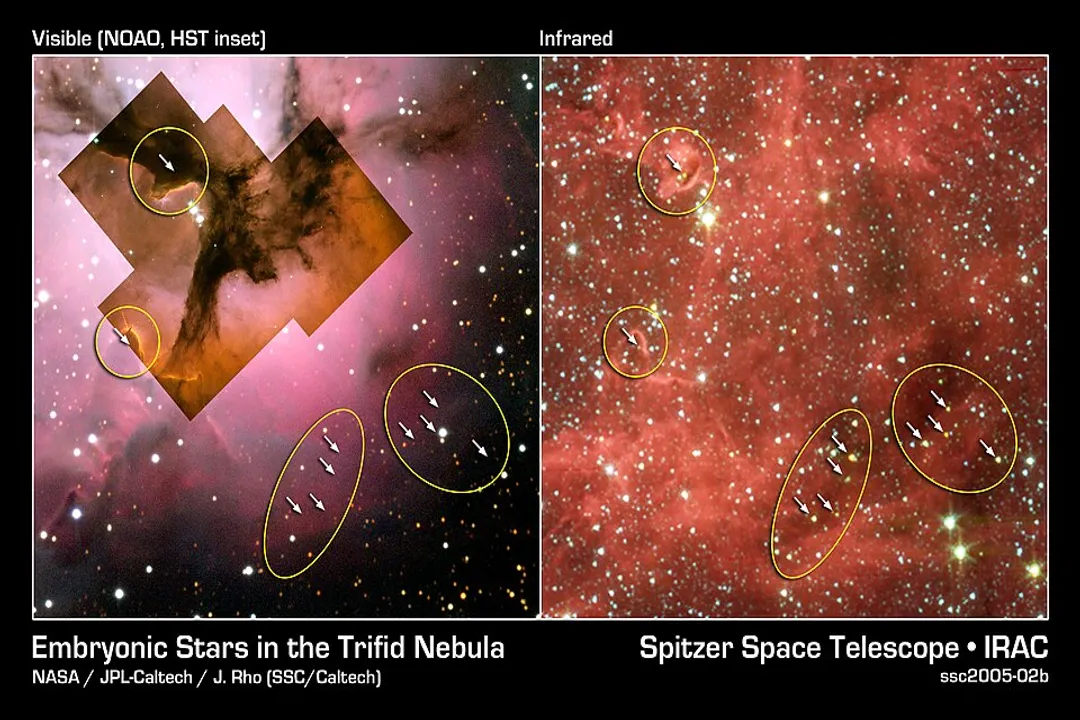
A nebula, in the general astronomical sense, is simply a vast cloud of gas and dust in outer space. [9] For the Solar System's formation, scientists focus on a specific type: the solar nebula or protosolar nebula. [4] This material was likely enriched by the remnants of previous generations of stars that died in supernovae explosions, seeding the cloud with heavier elements necessary for forming rocky planets. [8] This initial cloud was enormous, likely spanning hundreds of astronomical units (AU), and composed primarily of hydrogen and helium, the universe's most abundant elements. [4][6]
# Collapse Trigger
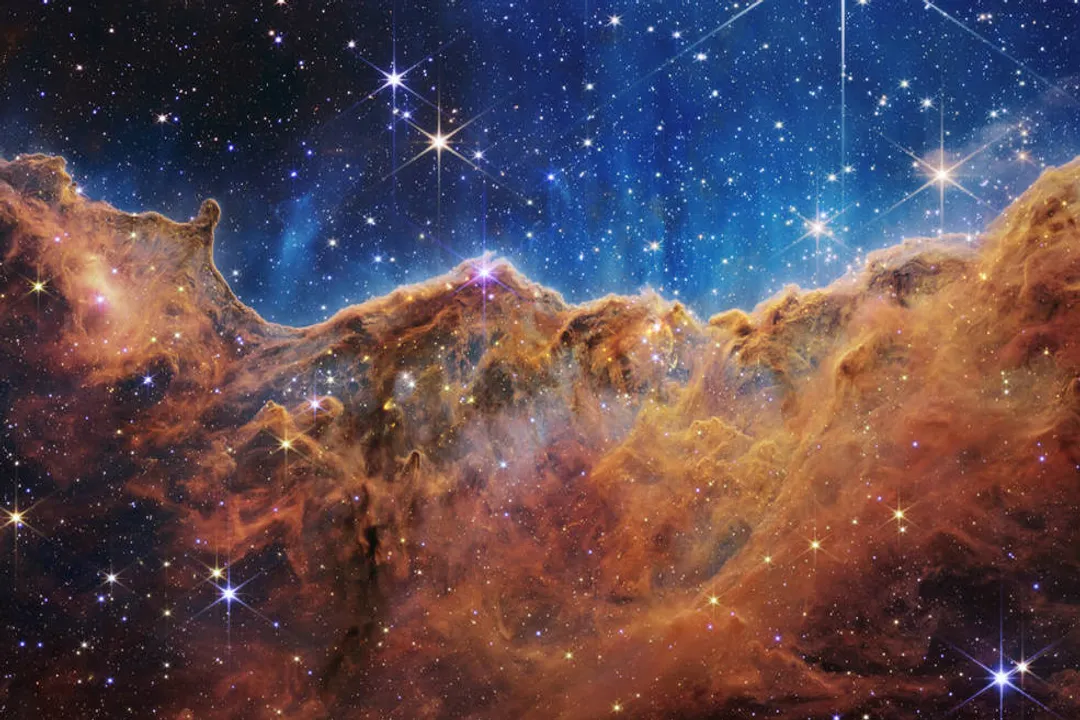
The process doesn't simply start randomly; something usually needs to trigger the initial gravitational collapse of this massive, dispersed material. [1] While the exact trigger is sometimes debated, common theories involve a shockwave from a nearby supernova—the explosive death of a massive star—compressing regions within the cloud. [1][2] Once a region becomes dense enough, gravity takes over, pulling the material inward toward a central point. [2]
# Spinning Disk
As the vast cloud begins to contract due to gravity, the law of conservation of angular momentum becomes highly influential. [1][6] Imagine a figure skater pulling their arms in; they spin faster. Similarly, as the nebula shrinks, its rate of rotation increases significantly. [2][6] Because the material is rotating, the collapse isn't perfectly uniform toward the center; instead, centrifugal forces cause the cloud to flatten into a spinning, pancake-like structure called a protoplanetary disk. [1][2][4] This disk structure is critical because it dictates the geometry of the resulting solar system.
The flatness of this protoplanetary disk directly explains why all the major planets orbit the Sun in nearly the same plane—the ecliptic. If the initial nebula had zero angular momentum (a theoretical impossibility in a dynamic universe), the result would be a system where planets orbit randomly above and below the Sun's equator. The observed alignment strongly validates the necessity of that initial spin and subsequent flattening dictated by the conservation of angular momentum during the contraction phase. [2]
# Sun Formation
At the center of this rapidly spinning disk, the majority of the mass—over 99%—accumulates. [4][6] As this central mass grows, the pressure and temperature at the core increase tremendously due to the enormous weight of the overlying material. [6] Eventually, conditions become extreme enough—temperatures reaching millions of degrees—for nuclear fusion of hydrogen into helium to ignite, marking the birth of a star, in this case, our Sun. [2][4]
# Building Blocks
While the Sun forms at the center, the surrounding protoplanetary disk continues to cool and condense. [1] This is where the building blocks of the planets originate. In the hotter, inner regions—closer to the newly formed Sun—only materials with high melting points, like silicates (rock) and metals (like iron and nickel), can condense into solid grains. [2][8] This explains why the inner planets—Mercury, Venus, Earth, and Mars—are primarily rocky, often called terrestrial planets. [2][8]
# The Ice Boundary
Moving outward in the disk, there is a critical boundary known as the frost line or ice line. [2][8] Beyond this distance, it is cold enough for volatile compounds, such as water ice, methane ice, and ammonia ice, to condense into solid particles alongside rock and metal. [2][8] This introduction of abundant ice drastically increases the amount of solid material available for planet building in the outer solar system. [8]
# Accretion Process
Planet formation proceeds via accretion. [1] Small dust grains stick together electrostatically, forming pebbles, which then aggregate into larger bodies called planetesimals, perhaps a few kilometers across. [1][2] These planetesimals then collide and merge gravitationally, growing into protoplanets. [2]
In the inner system, this resulted in the terrestrial worlds. In the outer system, the greatly increased supply of solid material allowed protoplanets to grow much larger, faster. [8] Once these cores reached a critical mass (perhaps 10 to 15 Earth masses), their gravity became so intense they could rapidly sweep up vast amounts of the remaining light gases (hydrogen and helium) directly from the nebula, leading to the formation of the gas giants like Jupiter and Saturn. [4][6]
The primary difference between inner and outer planet formation isn't just composition, but rate of growth. The terrestrial planets relied on the slow accumulation of rock and metal grains, a process that took tens of millions of years to form Mars-sized bodies. In contrast, the outer planets, once they secured enough icy/rocky cores beyond the frost line, entered a runaway gas accretion phase. This means Jupiter likely formed its massive gaseous envelope in only a few million years—a blink of an eye cosmologically—whereas Earth took much longer to reach its final mass, highlighting a fundamental timeline difference inherent to the nebular model. [8]
# Clearing Out
The process concludes when the central star fully ignites and begins emitting intense radiation and a powerful solar wind. [1][4] This outflow of charged particles blasts away the remaining light gases and dust from the protoplanetary disk, effectively ending the construction phase for the planets. [1][4] The planets that had already formed are left behind, orbiting the newly stabilized star. [2]
# Historical Models
The Nebular Hypothesis is not a new concept; it has evolved significantly over time. [1] Its foundations can be traced back to Immanuel Kant in the mid-18th century and Pierre-Simon Laplace shortly thereafter, who proposed that the Sun and planets formed from a rotating nebula. [1][8] Early versions faced challenges, particularly regarding the conservation of angular momentum, as the Sun holds almost all the mass but the planets hold most of the spin. [6] Modern modifications, such as incorporating the role of magnetic fields and the mechanics of the initial disk flattening, have addressed many of these historical objections. [1][6]
The theory elegantly explains multiple observed characteristics of our Solar System. [2] For instance, the general pattern of smaller, rocky worlds close to the Sun and large, gaseous/icy worlds farther out is a direct consequence of the temperature gradient established in the disk. [2][8]
# Zone Differences
The temperature gradient across the disk dictates what material can solidify, creating distinct zones for planetary types:
| Zone | Location Relative to Sun | Condensing Materials | Resulting Bodies |
|---|---|---|---|
| Inner System | Inside the Frost Line | Metals, Rock (Silicates) | Terrestrial Planets |
| Outer System | Beyond the Frost Line | Metals, Rock, Ice (Volatiles) | Giant Planet Cores |
| Outer Reaches | Far Past Giant Planets | Ice, Low-density materials | Dwarf Planets, Comets |
| [2][8] |
The nebular theory remains the standard working model for understanding the formation of star systems, including our own. [8] While refinements continue—such as accounting for planetary migration after formation or understanding the exact timing of accretion—the basic mechanism involving a collapsing, spinning, flattening cloud leading to a central star and a surrounding disk of planet-forming material stands as the most scientifically accepted explanation. [1][2] The theory successfully bridges the gap between the chaotic initial state of interstellar gas and the highly organized structure of planets orbiting a star. [2]
#Videos
Formation of the Planets - YouTube
Related Questions
#Citations
Nebular hypothesis - Wikipedia
8.2: Origin of the Solar System—The Nebular Hypothesis
Video: Nebular Theory | Definition, Development & Problems
[PDF] The Nebular Theory
[PDF] Lecture 7 Formation of the Solar System Nebular Theory
Formation of the Planets - YouTube
Nebular theory and the formation of the solar system - OpenGeology
What Is a Nebula? | NASA Space Place – NASA Science for Kids