What are two differences between the Kuiper Belt and the Oort Cloud?
The outer reaches of our solar system are not empty voids but vast, dark frontiers populated by countless icy relics, remnants from the chaotic birth of the Sun and planets $4.6$ billion years ago. [2][7] These two primary reservoirs of ancient material are the Kuiper Belt and the Oort Cloud. While both regions serve as cosmic storage lockers for comets, they are distinct worlds separated by immense distances and fundamentally different origins. Understanding these two major zones requires looking closely at where they reside and how their orbits are governed.
# Spatial Separation
The first, and perhaps most immediately staggering, difference between the Kuiper Belt and the Oort Cloud lies in their sheer scale and location relative to the Sun and the planetary region. They occupy entirely different neighborhoods of the solar system. [5]
# The Disk of Debris
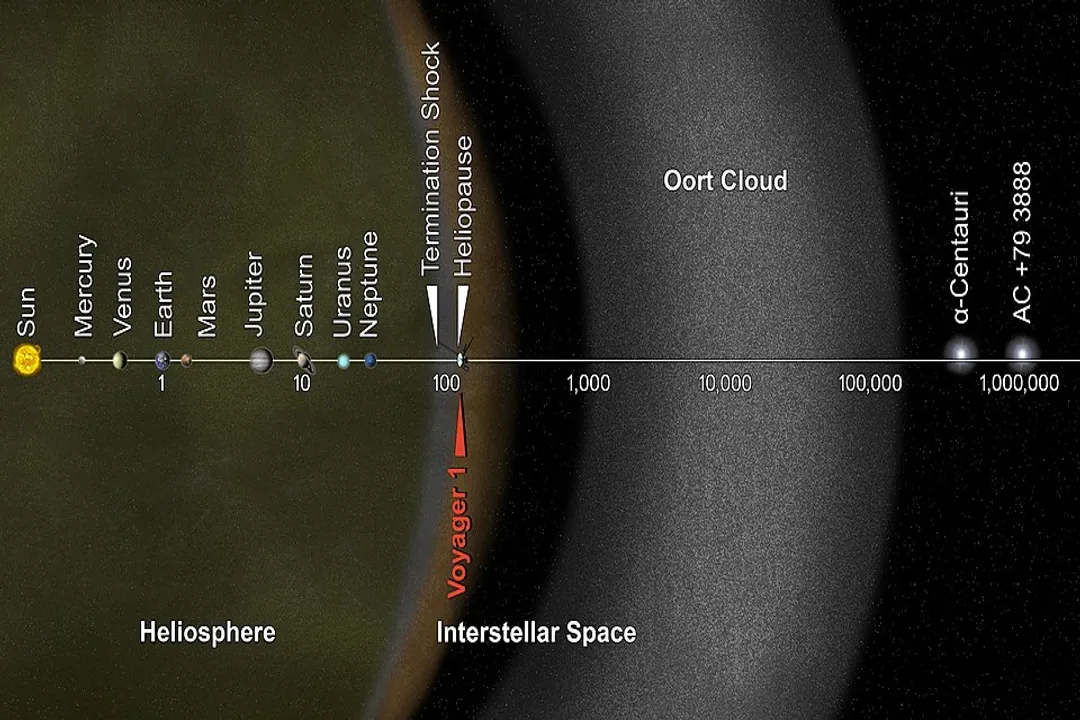
The Kuiper Belt (KB) is the closer of the two structures. It begins beyond Neptune’s orbit, which averages about from the Sun. [4][7][8] Astronomers typically define its inner edge around and its outer edge around , though some models extend it out to or more, encompassing the Scattered Disc population. [4][7][8] Critically, the Kuiper Belt is shaped like a donut or a disk. [4] Its objects, known as Kuiper Belt Objects (KBOs), orbit in a relatively flat plane, much like the major planets—this plane is known as the ecliptic. [3][8] This relatively confined, planar structure is a direct consequence of where these bodies formed: within the primordial, flat protoplanetary disk. [3][4]
# The Spherical Halo
In stark contrast, the Oort Cloud (OC) is not a disk but a hypothesized vast, spherical shell that completely surrounds the entire solar system. [2][5][8] Its inner boundary is many times farther out than the Kuiper Belt’s outer reaches. The inner edge of the Oort Cloud is placed somewhere between $2,000$ and from the Sun. [2][8] From there, this colossal structure extends outward to distances of , or even as far as $100,000$ to . [2][7] For perspective, is roughly $1.6$ light-years, placing the outer boundary near the interface where the Sun’s gravitational dominion starts to yield to the gravity of other stars in the Milky Way. [2]
The difference in proximity is profound. If an object in the Kuiper Belt is away, it is relatively accessible compared to the Oort Cloud. For example, the Voyager 1 probe, humanity’s most distant spacecraft, will not reach the inner Oort Cloud for about another $300$ years. [2][4] It would then require an estimated $30,000$ years just to pass through the cloud itself. [2] While a KBO might be reached by a future probe within years or a decade of a flyby mission, an Oort Cloud object could take decades just to traverse a fraction of its orbital path, assuming it even had a stable orbit near the ecliptic. This disparity in scale—a local, flattened structure versus a vast, encompassing sphere—is the most dramatic organizational distinction. [5]
# Orbital Dynamics
The second critical difference lies in the dynamics governing these reservoirs, which directly reflects their distinct formation histories—specifically, how the giant planets shaped their final orbits. [3][4]
# Formed in Place
The bodies of the Kuiper Belt are generally considered to have coalesced from material that remained in situ—that is, they formed relatively close to where they reside today, in the outer reaches of the original solar nebula. [4][8] While the migration of Neptune likely perturbed many of these Trans-Neptunian Objects (TNOs) into slightly different, sometimes eccentric, orbits (like those in the Scattered Disc region), [4][8] they remain largely confined to the ecliptic plane. [8] Their orbits are, by solar system standards, quite stable, allowing for a long-term reservoir of objects like Pluto. [4][7]
# Ejected and Scattered
The objects populating the Oort Cloud, however, are believed to have experienced a far more violent early life. [2][4] The prevailing hypothesis suggests that these icy planetesimals formed much closer to the Sun, perhaps near the orbits of Uranus and Neptune. [4][8] During the early, unstable phase of the solar system, close gravitational interactions with the massive gas giants—especially Jupiter—kicked these bodies out onto extremely wide, highly elliptical, or even parabolic orbits. [2][4][8]
This gravitational scattering means that Oort Cloud objects are not confined to the plane of the planets; rather, they are isotropically distributed, meaning they appear to come from every direction in the sky. [2][3] Although galactic tides from passing stars or the Milky Way itself later helped make these orbits more circular and stable (preventing them from simply flying away), the initial scattering event gave the cloud its distinctive, enveloping spherical shape. [2][4]
# Inner Reservoir
The Kuiper Belt serves as the primary, observable source for one type of object we routinely see: short-period comets. [4][7] These are comets that complete an orbit around the Sun in less than $200$ years and maintain orbits near the ecliptic plane. [7][8] Objects within the KB, especially those in the more dynamically active Scattered Disc beyond the classical boundary, can be nudged inward by planetary encounters to become these familiar visitors. [8] The region is rich enough that we have discovered over $1,300$ KBOs, including dwarf planets like Pluto, Eris, Haumea, and Makemake. [7]
# A Failed Giant
One compelling view of the Kuiper Belt is that it represents the core material that failed to become a planet. [4] If the gravitational influence of Neptune had been weaker, the material in this region might have aggregated into a fifth ice giant similar to Uranus or Neptune. Instead, Neptune’s dominant gravity scattered much of the available material out of the system entirely (via the Nice model), leaving behind the lighter population we now observe. [4] The remaining material is still substantial, estimated to hold hundreds of thousands of bodies larger than across. [7]
# Outer Shell
The Oort Cloud is the source reservoir for long-period comets, those that take more than $200$ years, sometimes millions of years, to complete a single trip around the Sun. [4][7][8] These comets enter the inner solar system on highly inclined, eccentric orbits. [2][7] The very existence of these long-period comets is the strongest, though indirect, evidence for the Oort Cloud itself, as their orbits suggest they were placed into those extreme distances early on. [2][7]
# Compositional Inference
Because the Oort Cloud objects formed closer to the Sun before being flung out, their composition is primarily icy—water, methane, ethane, and carbon monoxide ices—though some analysis suggests a small percentage might be asteroidal material. [2] The most distant objects, residing in the outer shell, are only weakly bound to the Sun, making their orbits susceptible to gravitational nudges from passing stars, which sends the occasional body plummeting inward as a visible comet. [2]
The structure is often modeled as having two parts: the denser, torus-shaped inner Oort Cloud (or Hills Cloud), and the much larger, sparser, spherical outer Oort Cloud. [2] The inner cloud may act as a crucial buffer, preventing the entire Oort Cloud from being depleted over the age of the solar system. [2]
# Key Differences Summary
To clearly delineate these two frontier regions, we can summarize the core distinctions in structure and dynamics:
| Feature | Kuiper Belt (KB) | Oort Cloud (OC) |
|---|---|---|
| Shape | Disk-shaped, like a flattened donut [4] | Vast, spherical shell surrounding the Sun [2][8] |
| Inner Edge (AU) | (starting beyond Neptune) [7][8] | to [2][8] |
| Outer Edge (AU) | to (and beyond for Scattered Disc) [4][7] | Up to $100,000$ or [2][7] |
| Orbital Plane | Aligned near the ecliptic plane (the pancake) [3][8] | Nearly random; orbits are isotropic [2][3] |
| Origin | Formed in situ in the outer solar nebula [4] | Scattered outward from the inner/mid-solar system by giant planets [2][4] |
| Comet Source | Short-period comets (period $< 200$ years) [7][8] | Long-period comets (period $> 200$ years) [7][8] |
Considering the formation mechanism, one can see a logical reason for the compositional differences hinted at in discussions: Kuiper Belt objects are icy remnants that stayed relatively close to their birth environment, while Oort Cloud objects are material that survived the close, heating, and scattering effects of the giant planets before being moved to the deep freeze. [3] The KB is where planet formation was stalled; the OC is where planet formation ejected the building blocks.
# Future Exploration
Directly observing the Oort Cloud remains far beyond current technological capabilities due to the extreme distances and the resulting faintness of the objects. [2][7] Missions like New Horizons are currently probing the Kuiper Belt, which at least gives us tangible data points like those related to Pluto and Eris. [7] While no object in the Oort Cloud has ever been directly observed, the statistical analysis of comet arrival times, influenced by galactic tides, provides the primary evidence that the reservoir is indeed there. [2][7] It serves as the outermost boundary of the Sun’s gravitational influence, a final, cold frontier before the interstellar medium begins to dominate. [2]
#Videos
Kuiper Belt And Oort Cloud Explained - YouTube
Related Questions
#Citations
The Kuiper Belt and the Oort Cloud: What to know - Ad Astra
What is between the Kuiper Belt (30 to 50 AU) and the Oort Cloud ...
Relationship of the Kuiper Belt to the Oort Cloud | ESA/Hubble
Comets, the Kuiper Belt and the Oort Cloud
[PDF] Kuiper Belt and Oort Cloud - NASA
Kuiper Belt And Oort Cloud Explained - YouTube
Oort cloud - Wikipedia
[PDF] Kuiper Belt and Oort Cloud - ESO.org