What are gas clouds in space?
Space clouds are vast, often enormous collections of gas and dust found in the space between the stars, a region known scientifically as the Interstellar Medium (ISM). [1][3] These are not like the familiar clouds in Earth's atmosphere; they are enormous structures, sometimes spanning hundreds of light-years, that dictate the cycles of matter and the birth of new stars in a galaxy. [1][4] They represent the raw material from which stars, planets, and even the chemical components necessary for life originate. [9]
# Defining Clouds
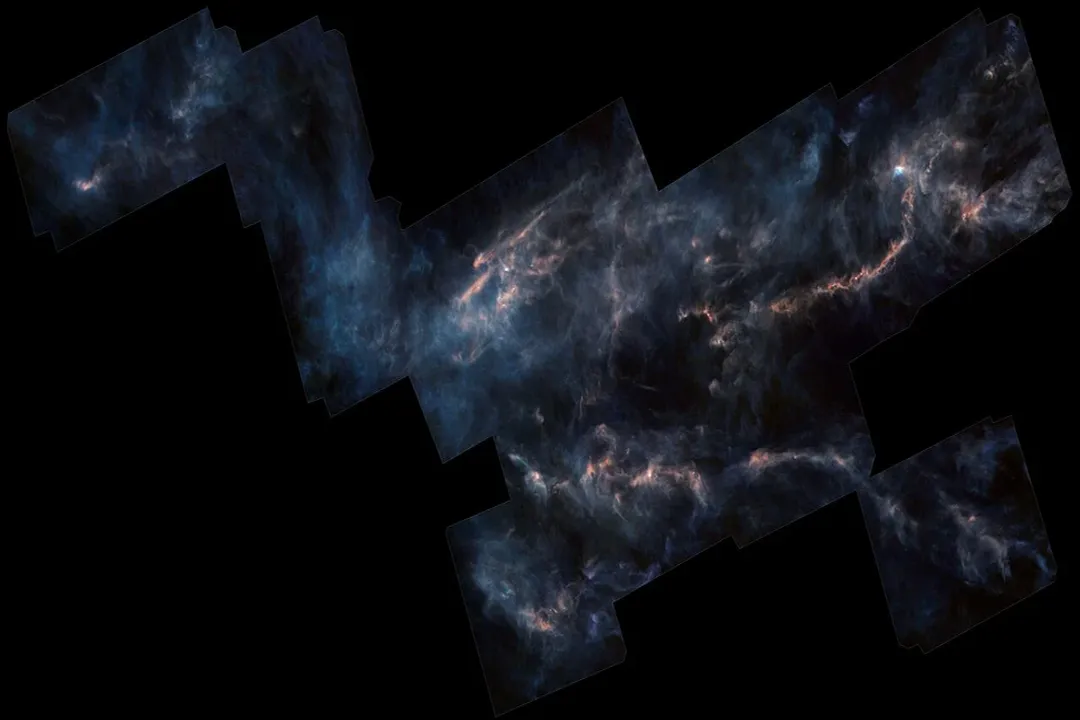
These massive structures are formally called interstellar clouds. [1] In the larger context of galactic ecology, they are integral components of the ISM, which itself is a mixture of gas and dust distributed throughout the space separating star systems. [4] The ISM is dynamic, existing in various states of temperature and density, and these clouds represent the denser, cooler concentrations within that medium. [6]
An interstellar cloud's state depends heavily on its temperature and density. For instance, the ISM can exist as very hot, diffuse gas with temperatures reaching millions of degrees Kelvin, or as much colder, denser material. [6] The clouds we often focus on, particularly those where stars form, are typically the cold phases of the ISM. [1][5]
# Cloud Ingredients
The primary constituent of any interstellar cloud is gas, which is overwhelmingly composed of the lightest elements: hydrogen and helium. [1][6] Hydrogen atoms can exist in various forms, from individual atomic hydrogen (HI) to molecular hydrogen (). [1][6]
However, it is the presence of dust that often makes these clouds visible or gives them their distinct character. [4] This dust isn't like terrestrial dust; it consists of microscopic solid grains, often composed of heavier elements like carbon, silicon, and iron, sometimes bound up in compounds such as silicates or carbon compounds. [1][8] The ratio of gas to dust is generally high, with dust making up only about one percent of the total mass of the ISM, but it is proportionally more important in certain processes. [4]
The chemical complexity within these clouds is staggering. They are not merely static reservoirs of basic elements; they act as chemical factories. [9] In the cold, dense regions, complex molecules form on the surfaces of the dust grains, creating everything from simple molecules like carbon monoxide () to complex organic molecules, which are seen as the building blocks of life elsewhere in the universe. [9]
# Nebula Classifications
Astronomers categorize these clouds based on how they interact with starlight, leading to several distinct types of nebulae. [8]
- Dark Nebulae: These are clouds so dense with dust that they effectively block the light from stars lying behind them, causing them to appear as dark silhouettes against a brighter background star field or emission nebula. [8][1] The Bok globule is a prime, small example of a dark nebula. [1]
- Emission Nebulae: These clouds are composed of gas (often ionized by nearby hot, young stars) that emits its own light as the electrons recombine with the atoms. [8] The most famous example is the reddish glow of hydrogen gas, which is characteristic of many star-forming regions. [8]
- Reflection Nebulae: Unlike emission nebulae, these clouds do not emit their own visible light. Instead, they scatter or reflect the light from nearby stars, often appearing blue due to the way shorter wavelengths of light are scattered more efficiently, similar to why Earth’s sky is blue. [8]
- Molecular Clouds: These are the coldest and densest types of clouds, where temperatures can drop below . [5][1] The low temperature allows hydrogen atoms to combine into molecular hydrogen (). [1] These massive clouds are the primary sites of star formation. [3]
A useful way to organize the physical states, contrasting the extreme environments, is to look at temperature ranges in the ISM, though not every temperature necessarily corresponds to a discrete cloud structure:
| Phase | Approximate Temperature (K) | Density (Particles/) | State |
|---|---|---|---|
| Hot Ionized Medium | Extremely thin, highly energetic plasma [6] | ||
| Warm Neutral Medium | Atomic gas [6] | ||
| Cold Neutral Medium/Molecular Clouds | to $10^6$ | Dense gas and dust, star formation occurs here [5][6] |
# Stellar Nurseries
The most critical function of these interstellar clouds, particularly the large, cold molecular clouds, is their role as stellar nurseries. [3] Gravity acts upon slightly denser regions within these clouds, causing them to contract. [1] As the cloud material collapses, the core heats up, eventually reaching the conditions required to ignite nuclear fusion, thus forming a new star. [3]
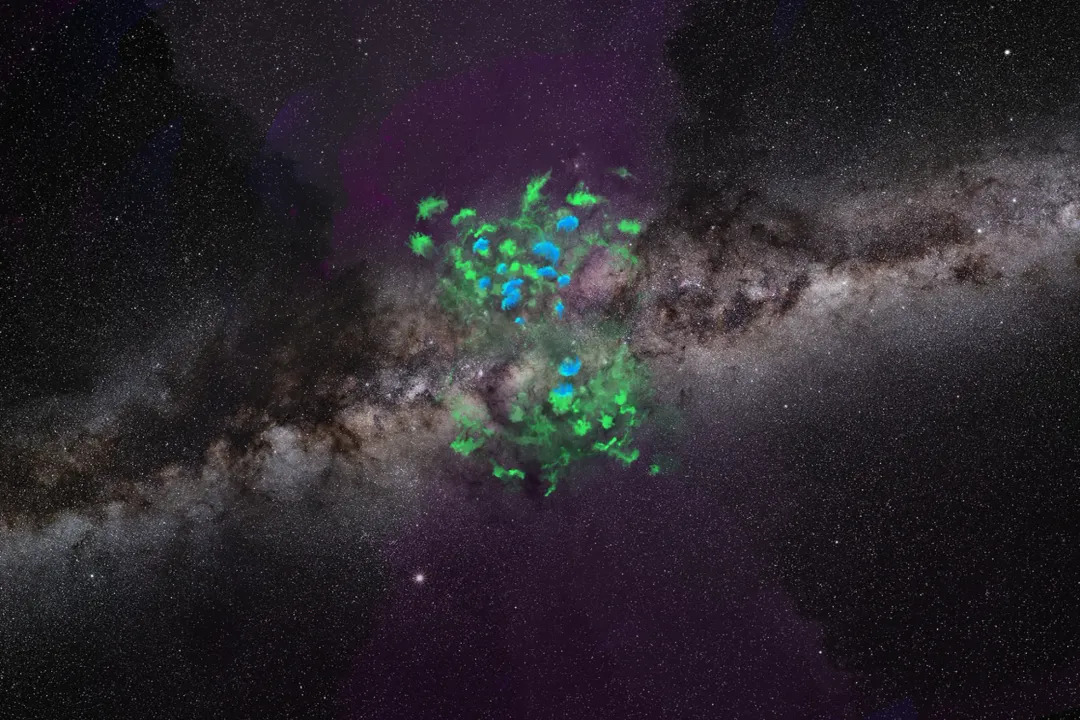
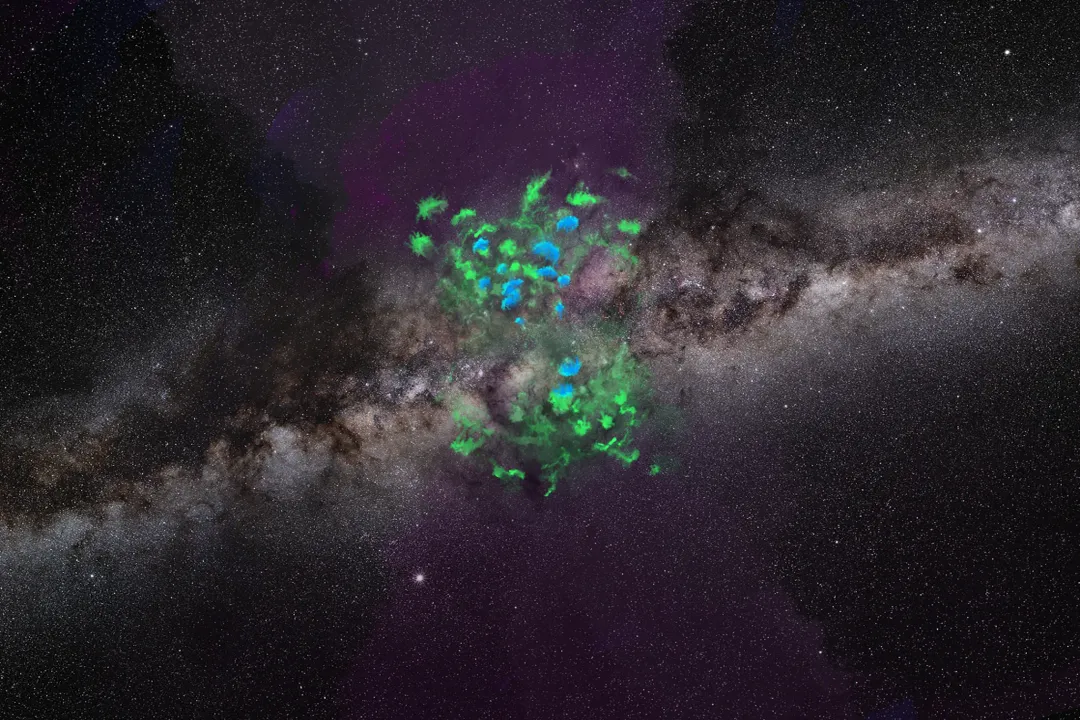
The sheer scale of these events is hard to grasp. For instance, the Milky Way galaxy hosts massive gas clouds, some of which are actively escaping the galactic center. [7] Observations have detected vast clouds of gas, millions of times the Sun's mass, moving away from the core of our galaxy. [7] Understanding the dynamics of these clouds helps astrophysicists map the overall galactic ecology and the flow of material throughout the galaxy. [4]
# Low Density Puzzle
A fascinating aspect of these clouds is their environment. If you were to take a sample from what we consider a very dense molecular cloud, the particle density would still be incredibly low by terrestrial standards. [2] A cubic centimeter of air on Earth contains about molecules. [2] In contrast, even the densest parts of an interstellar cloud might only contain $10^3$ to $10^6$ particles per cubic centimeter. [6]
It sometimes seems counterintuitive that in the near-perfect vacuum of space, structures like these clouds can maintain their integrity rather than immediately dispersing. [2] The secret lies in the balance of forces. While the particle number density is minuscule, the cloud is vast. [2] Gravity works over these immense distances to pull the material together, counteracting the tendency of gas particles to move apart due to thermal motion. [2] The very cold temperatures associated with molecular clouds are key; when the gas is cold, the random thermal motion of the individual particles is very slow, giving gravity a significant advantage in holding the structure together over cosmic timescales. [5]
If we consider an average molecular cloud core collapsing to form a star, the process is highly sensitive to initial conditions. A common factor that seems to influence the efficiency of this star birth is the presence of magnetic fields, which can either support the cloud against collapse or help channel the infalling material along preferred paths. [1] The interplay between gas pressure, gravity, turbulence, and magnetic fields creates a complex physical system that we are still working to fully model. [1] The sheer volume of these clouds means that even if only a small percentage of the mass ultimately forms stars, it results in continuous galactic renewal. Observing the cold, non-luminous hydrogen within these clouds requires specialized instruments, like radio telescopes, which can detect the faint spectral lines emitted by the gas itself, offering a window into the dark, star-forming hearts of these cosmic structures. [1]
Related Questions
#Citations
Interstellar cloud - Wikipedia
How can there be gas clouds in interstellar space? - Reddit
Interstellar Medium and Molecular Clouds | Center for Astrophysics
Gas and Dust Clouds - Astronomy - The University of Alabama
Gas clouds Definition - Astrophysics I Key Term | Fiveable
Interstellar Gas | Astronomy - Lumen Learning
Massive Gas Clouds Escape Center of Milky Way - Green Bank ...
Space Clouds | Definition, Formation & Types - Study.com
Space Clouds Are Chemical Factories Making the Building Blocks of ...