What can trigger the initial collapse of a gas cloud within a nebula to start star formation?
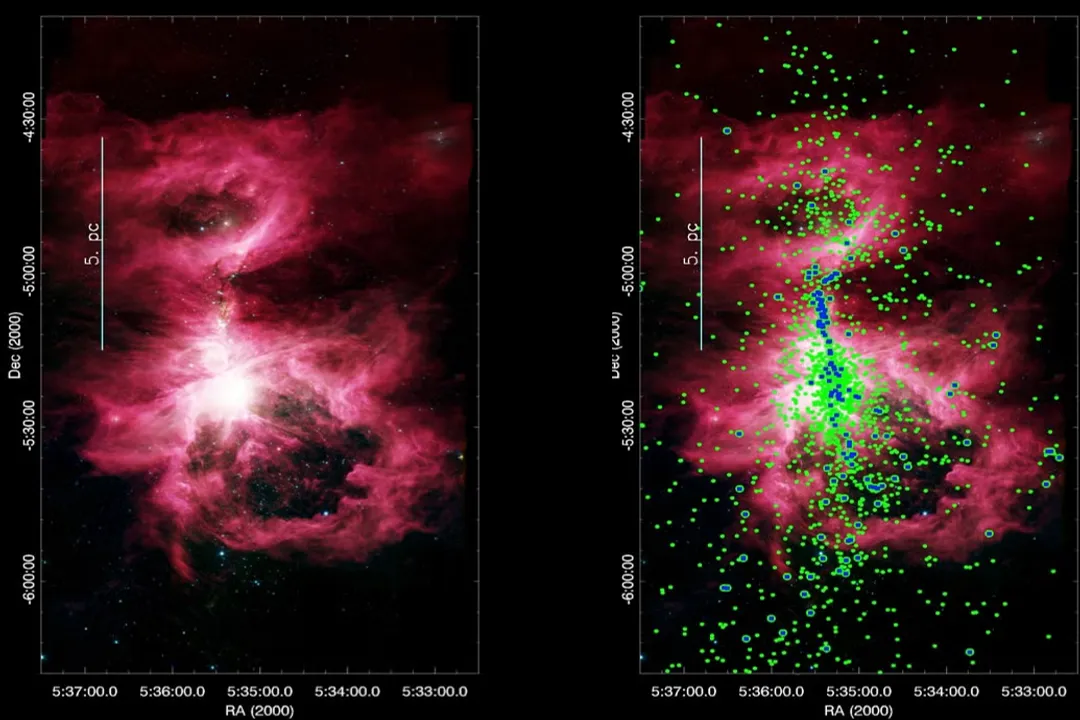
Stars ignite from the slow, inexorable pull of gravity within the vast, cold expanses of interstellar gas and dust known as nebulae. These stellar nurseries, often cataloged as Giant Molecular Clouds (GMCs), are the birthplace of stars. But for a cloud, which can span hundreds of light-years and hold millions of solar masses of material, to transition from a diffuse state to a point of collapse requires overcoming the internal resistance of the gas itself. The core question for understanding star formation is not if gravity can pull things together—it always can—but what provides the crucial, localized push to initiate the contraction that leads to a protostar.
# Molecular Nurseries
Interstellar space contains a diffuse material called the interstellar medium (ISM), composed of roughly 70% hydrogen and 28% helium, along with trace heavier elements produced by previous stellar generations. Within spiral galaxies like the Milky Way, denser regions of the ISM form clouds, or nebulae, where this process can take hold. These star-producing nebulae are specifically called molecular clouds because much of the hydrogen exists in the molecular () form.
These environments are extremely frigid. The average interior temperature of a GMC is typically around (or ). While their density is considerably higher than the average ISM, it remains orders of magnitude lower than the pressure found in Earth's atmosphere at sea level. This combination of low temperature and relatively low density means the gas has very little internal thermal pressure to resist the pervasive gravitational attraction exerted by its own mass.
# Gravitational Balance
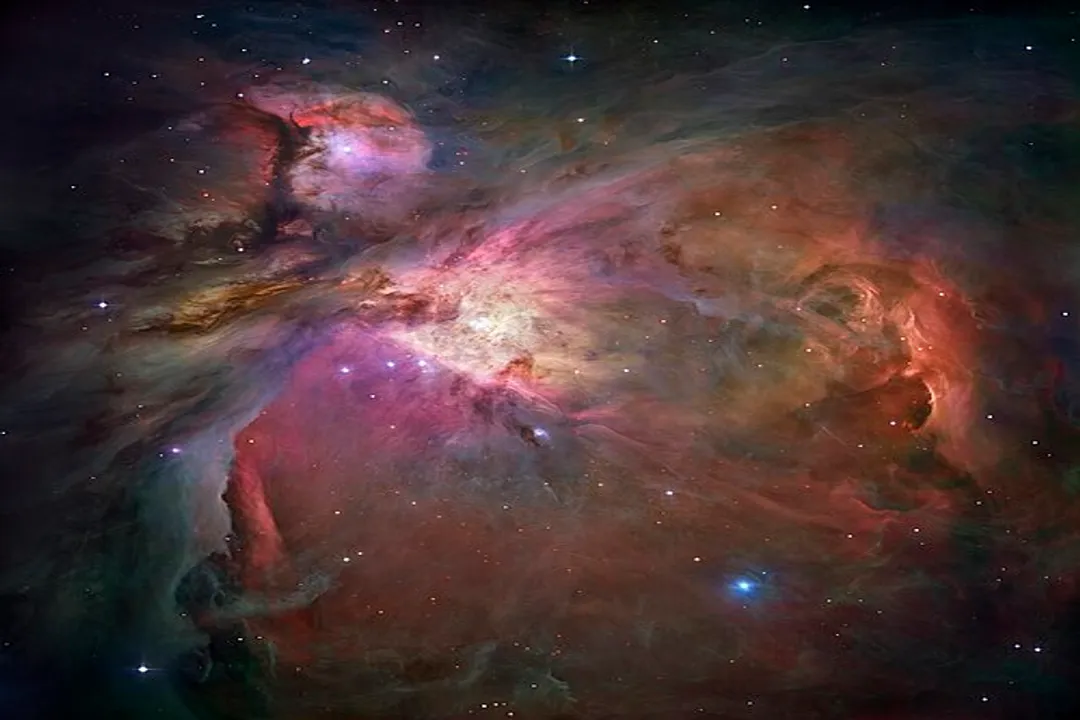
Before a star can truly begin forming, the gas cloud must be unstable. An isolated cloud of gas and dust exists in a precarious state known as hydrostatic equilibrium. This means that the outward push generated by the kinetic energy, or gas pressure, within the cloud is perfectly balanced by the inward pull of its own internal gravitational force. The mathematical relationship describing this balance is the virial theorem, which essentially states that for equilibrium, the gravitational potential energy must equal twice the internal thermal energy.
If the cloud is not massive enough, this thermal pressure—even at —can effectively resist gravity, preventing any permanent collapse. The system must tip this delicate scale; gravity must become the dominant force.
# Jeans Instability
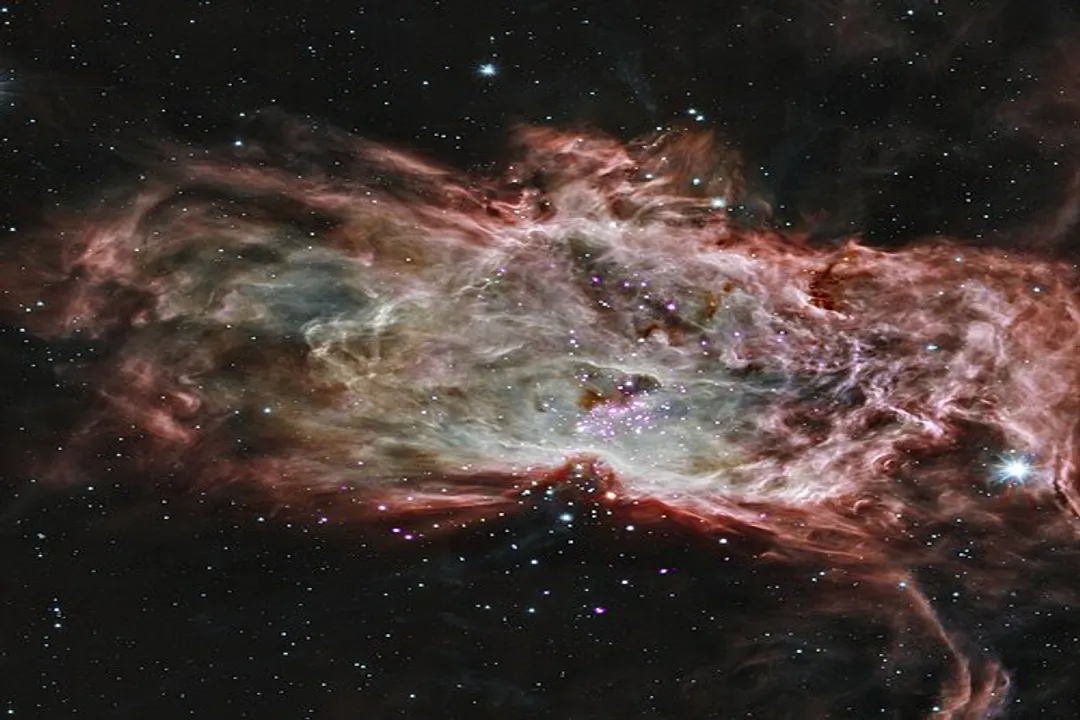
The condition that determines whether a cloud will spontaneously collapse under its own weight is quantified by the Jeans Mass (). If a region within a cloud has a mass greater than the Jeans Mass appropriate for its current temperature and density, the gas pressure proves insufficient to support it against gravity, and the cloud must undergo gravitational collapse.
The Jeans Mass is not a fixed value; it is highly dependent on the cloud's internal properties. A denser, colder cloud will have a lower Jeans Mass, meaning smaller clumps can collapse, whereas a warmer, more diffuse cloud requires a much larger total mass to initiate collapse. While the Jeans Mass for typical GMC fragments can be in the range of thousands to tens of thousands of solar masses, the initial stages of star formation often rely on processes that enhance local density or reduce the effective pressure, initiating the collapse even if the entire cloud system is not globally supercritical.
It is a key point that gravity is overwhelmingly dominant in the cosmos where mass scales are galactic, which is why we observe this process in space but cannot replicate it in a laboratory setting. Even the entire mass of Earth's atmosphere is heavy enough to exert one atmosphere of pressure, yet the gravitational forces between small terrestrial masses are so weak they are easily overwhelmed by thermal motion. To achieve stellar collapse conditions on Earth would require a volume of gas so immense—light-years across—that it is currently impossible to engineer.
# External Shocks
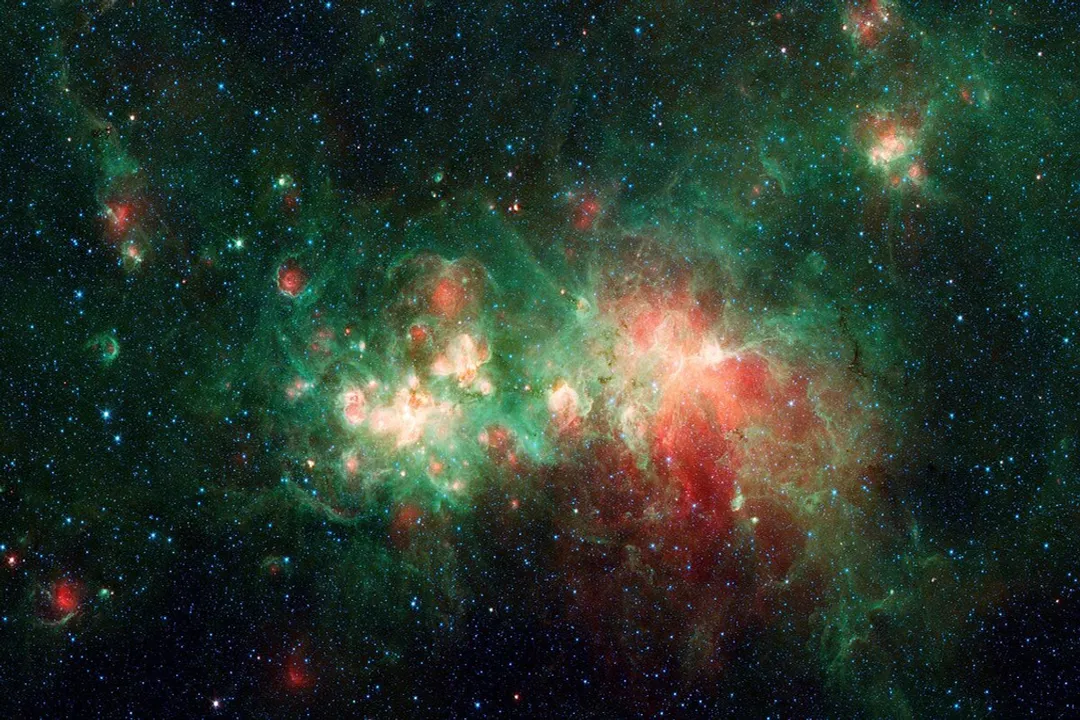
When the internal conditions are near equilibrium, or the Jeans Mass is just slightly too high for spontaneous collapse, an external impetus is often required to compress the cloud and push it past the threshold into runaway contraction. These external triggers act by rapidly increasing the local density or momentarily decreasing the local kinetic energy, thereby lowering the local Jeans Mass.
Several astrophysical events can provide this necessary compression:
- Supernova Explosions: The shockwave generated by a nearby star exploding as a supernova can strike a molecular cloud, sending high-speed, compressed matter into the cloud material. This sudden external pressure can compress regions enough to trigger gravitational instability.
- Cloud Collisions: When two molecular clouds physically collide, the impact zone experiences massive compression, providing the necessary impetus for collapse across a wide area.
- Galactic Dynamics: On the grandest scales, galactic collisions create tidal forces that agitate and compress gas clouds across entire galaxies, leading to what are termed "starbursts" of rapid star formation. Spiral density waves, large-scale features in spiral galaxies, can also contribute to this compression mechanism.
- Stellar Winds: On smaller scales, the powerful winds emanating from pre-existing massive, bright stars in a region can sweep up and compress ambient gas, acting as local triggers for new star formation.
It is becoming clear from modern observations that the story isn't one-sided; while many star-forming regions show evidence of these external shocks, observations also reveal collapse occurring in the absence of obvious supernova remnants or intense radiation fields from massive stars. This suggests a more pluralistic model where the environment dictates the primary trigger mechanism.
# Cloud Dynamics
While external shocks provide clear, violent initiations, the internal structure and dynamics of the cloud itself are intimately involved in where the collapse happens and how efficiently it proceeds. The notion that a collapse is "sudden" is relative; it is a process that unfolds over long timescales, often resembling a slow approach to bankruptcy followed by a rapid plunge.
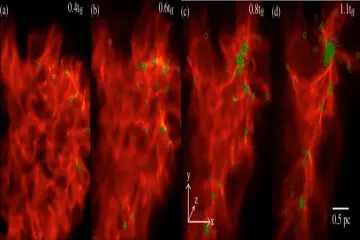
Within GMCs, turbulence—random, macroscopic motions in the gas—is nearly ubiquitous. This turbulence creates density and velocity fluctuations. When these fluctuations are strong enough, the localized over-dense regions can begin to collapse under their own self-gravity much faster than the entire cloud structure collapses. Furthermore, the geometrical shape of the collapsing cloud plays a role; an initial elliptical shape, for instance, naturally evolves into the filamentary structures observed throughout star-forming regions.
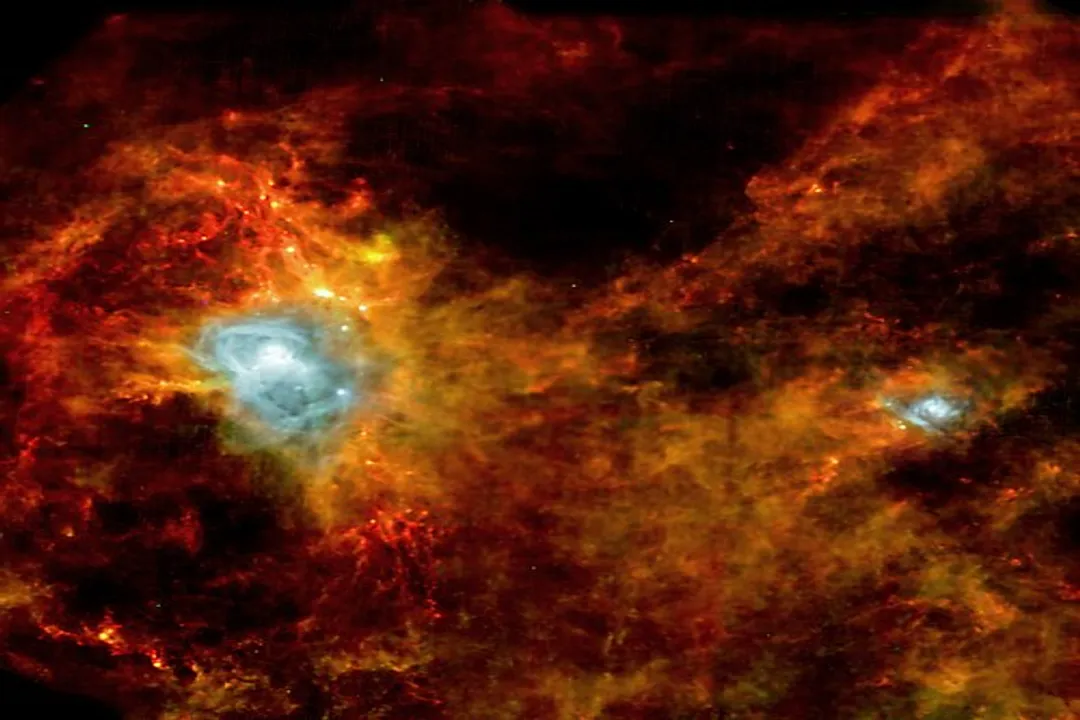
Observations from missions like the Herschel Space Observatory emphasize that these filaments are not incidental; they appear to be the ubiquitous initial conditions for star formation. Filaments act as pathways, accumulating gas and dust along their length, which then fragments into pre-stellar cores. The local line mass along a filament, rather than its average mass, dictates its capacity to fragment at that specific location.
This internal structure relates to another crucial factor: the cloud's ability to cool. As a core begins to contract, the gravitational energy released heats the gas, creating outward thermal pressure that resists collapse. In the earliest stages of a core’s collapse, the gas is still transparent enough for photons generated by the warming material to escape, allowing the core to shed energy and cool. In environments rich in carbon monoxide (), this molecule can emit photons in the radio wave range that escape the cloud more easily than other wavelengths, thus efficiently cooling the gas as it shrinks. This cooling mechanism is vital; if a dense region cannot shed gravitational energy effectively, its temperature rises too quickly, and the resulting pressure halts the collapse before a protostar can form. This explains why the very first stars (Population III stars), lacking the necessary metals like carbon to form , needed to be vastly more massive to overcome thermal pressure purely through their overwhelming gravitational force.
Considering this, a fascinating interplay arises between external triggers and cloud physics. A supernova shock might provide the initial compression (the trigger), but the resulting fragments can only proceed to form a star if their internal thermal state allows them to continue radiating away the gravitational heat they generate as they shrink. Therefore, the trigger merely sets the stage; the cooling efficiency determines the final cast of characters—the protostars.
# Collapse Progression
Once the critical Jeans Mass is overcome in a fragment, the collapse accelerates, operating on timescales comparable to free-fall velocities. The cloud does not form a single star; it breaks into smaller and smaller pieces in a hierarchical fashion until those fragments reach stellar mass scales.
As a fragment contracts, its core becomes optically thick—opaque to its own internal radiation—when the density reaches a certain critical point (around ). This trapping of heat causes a rapid temperature increase, effectively halting the initial free-fall collapse to form what is called the first hydrostatic core. The material still falling inward collides with this core, creating shock waves that further heat the center.
When the temperature in this embryonic core reaches about , molecular hydrogen () dissociates, absorbing a great deal of the contraction energy and allowing the collapse to continue on a slower timescale. Later, as the core gets even hotter, hydrogen and helium atoms ionize, absorbing more energy. Once the density drops to about , the material becomes transparent enough for the radiation from the building star to escape, allowing the object to shrink further until the pressure from core heating can finally support it against gravity—achieving true hydrostatic equilibrium—and it becomes a recognized protostar. This entire chain of events, triggered by either a gentle compression or a violent shock, transforms a diffuse nebula into a cluster of stellar embryos.
Related Questions
#Citations
What causes a nebula - a very diffuse cloud of Hydrogen to ... - Reddit
How do star-forming clouds and star clusters arise? | Lee Hartmann
how a star is born? - The Physics of the Universe
Star Formation - THE INFRARED UNIVERSE - IPAC/Caltech
Star formation - Wikipedia
The Process of Star Formation | ASTRO 801