What triggers the gravitational collapse of a molecular cloud?
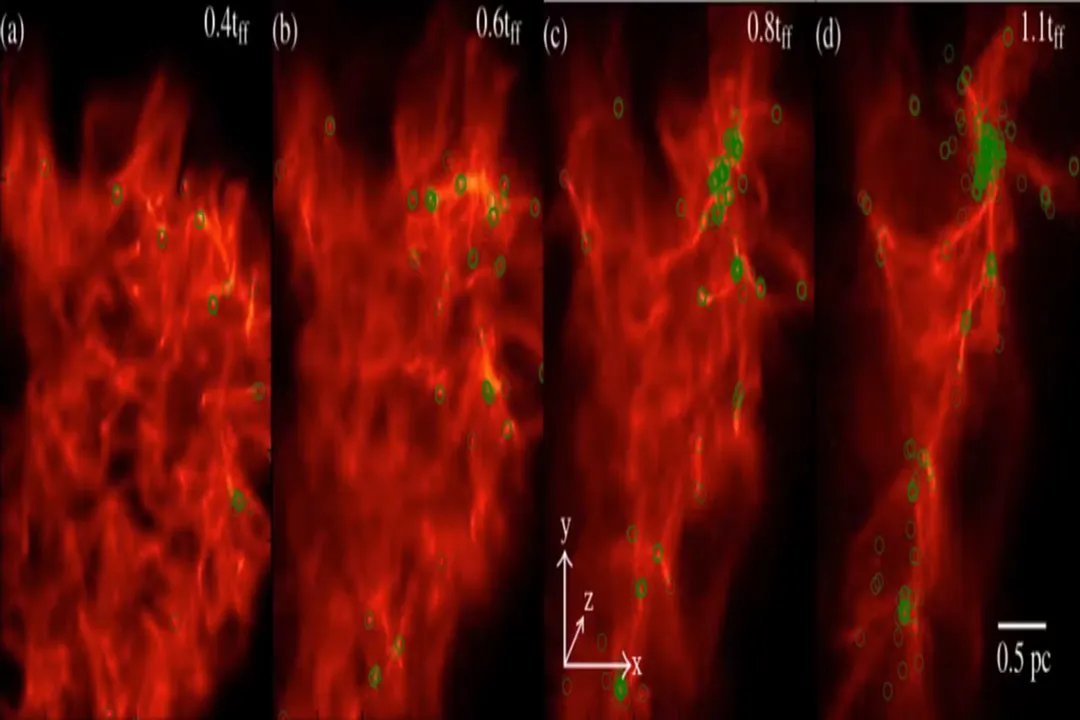
The initiation of a star, that massive burst of light and heat, requires the precise conditions for a vast, cold molecular cloud to give way to its own immense weight. These clouds, primarily composed of hydrogen and helium, exist in a delicate, long-lasting state of near-equilibrium, suspended between the inward tug of self-gravity and the outward push of internal energy. [1][3] For the grand, slow dance toward stellar birth to begin, this equilibrium must be broken, tipped irrevocably in favor of gravity's dominance. [3][5]
# Cold Densities
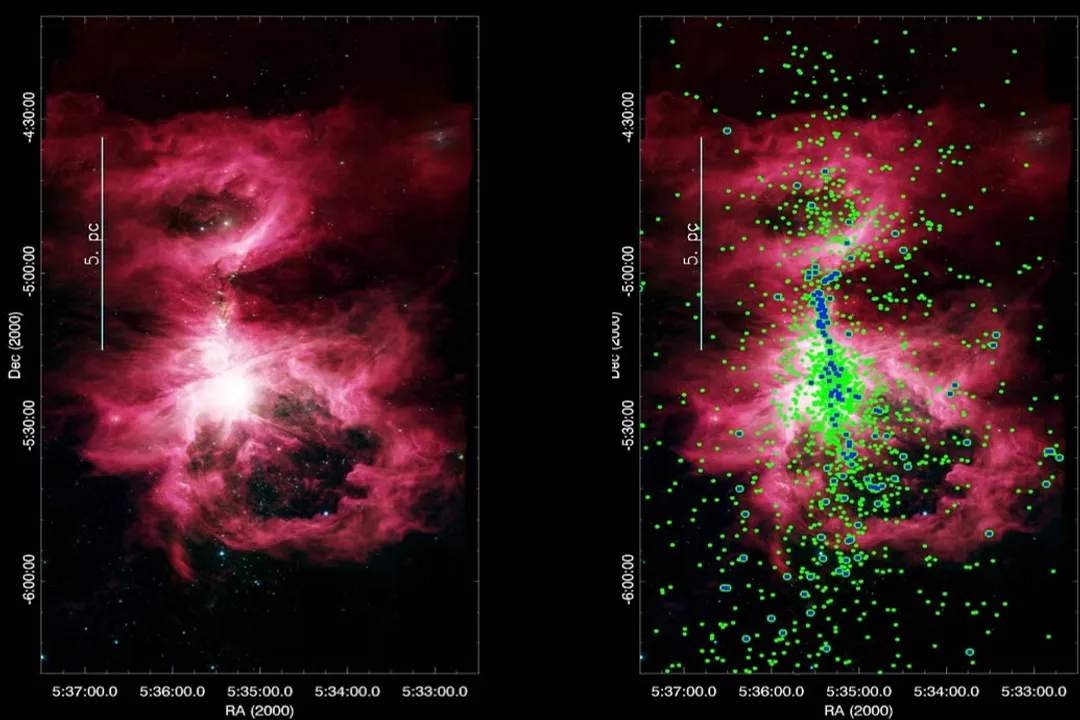
Molecular clouds are the coldest, densest regions of the interstellar medium available for star formation. [7] Their temperatures hover just above absolute zero, typically in the range of $10$ to $30$ Kelvin. [7] This extreme cold is essential because it keeps the thermal pressure—the kinetic energy of the gas particles moving about—very low. [3][7] A cloud that is too warm has gas particles moving too fast, and this high-speed motion generates enough outward pressure to easily counteract even significant gravitational attraction. [3]
However, temperature isn't the only factor keeping these massive structures afloat. They are also inherently diffuse compared to even the best laboratory vacuum on Earth. While they are dense relative to the surrounding interstellar space, the actual number density might only be a few hundred or a few thousand particles per cubic centimeter. [4] This means that for a region to begin collapsing, it needs a localized increase in density, or it needs to be so physically large that its sheer mass generates sufficient gravity regardless of its moderate density. [4]
# Opposing Forces
Understanding what triggers the collapse means understanding what resists it. In these cosmic nurseries, gravity is not the only force acting on the gas; several opposing pressures vie for control. [3]
The first resistance comes from thermal pressure, as mentioned, arising from the internal temperature of the gas. [3] The second is magnetic pressure. The clouds are permeated by magnetic fields inherited from the interstellar medium. These fields can resist compression, especially if the field lines are oriented perpendicularly to the direction of potential collapse. [3] The third, and often most significant, resisting force in large, active clouds is turbulent pressure. [3][7] Star-forming regions are far from static; they are churning environments driven by energetic events like previous supernovae or stellar winds, creating chaotic, random motions within the gas. [3] This turbulence effectively provides an additional, velocity-dependent outward pressure that must be overcome. [7]
The trigger for collapse, therefore, is the condition where the gravitational binding energy of a specific region exceeds the combined kinetic energy (thermal and turbulent) and magnetic energy that works to keep it dispersed. [3][1]
# Critical Mass
The primary theoretical condition governing this tipping point is known as the Jeans Instability. [1] This concept defines the critical threshold—the minimum mass or size required for a self-gravitating cloud or section of a cloud to overcome its internal pressure and begin an unstoppable collapse. [1][3]
This threshold is quantified by the Jeans Mass () and the Jeans Length (). [1] If a patch of gas has a mass less than (or is smaller than ), the internal pressure forces will cause it to disperse or remain stable. [1] Conversely, if the mass of a localized region exceeds the Jeans Mass for that specific temperature and density, gravity wins, and collapse ensues. [1][3]
Consider how this manifests across scales. A vast, relatively diffuse cloud might be stable because its total mass, while immense, is spread out too thinly to reach based on its low average density. [4] However, through internal motions or external compression, a small, localized region within that cloud might become dense enough that its local mass easily surpasses the Jeans Mass calculated for that higher density, initiating fragmentation. [1][3] This means the trigger isn't always the whole cloud collapsing at once; often, the initial trigger occurs in the densest knots inside the larger structure. [4]
If we compare a scenario where thermal pressure is the primary counter-force versus one where turbulence dominates, we see a difference in the resulting critical mass. Turbulence generally requires a higher mass concentration to be overcome compared to just thermal pressure alone, because turbulent motions add significant kinetic energy to the system. [3]
# External Shocks
While some clouds might naturally achieve supercritical conditions simply through slow, internal accumulation of mass, external events often provide the necessary 'kick' to push an already marginally stable cloud over the edge. [5] These external triggers act by rapidly increasing the local density or by compressing the cloud geometry, effectively lowering the local Jeans Mass. [3]
One powerful candidate for such a trigger is the shockwave from a nearby supernova explosion. [3][5] A supernova sends a blast wave of rapidly expanding, superheated gas outward. As this shell sweeps up the ambient interstellar material, it compresses the gas it encounters, briefly creating a region of much higher density. [3] If this compression pushes a molecular cloud past its threshold, collapse begins almost immediately, localized to the compressed region. [5]
Another large-scale trigger mechanism relates to the structure of the galaxy itself. As molecular clouds pass through the spiral arms of the Milky Way, the increased density of matter within these arms can gravitationally compress the clouds as they orbit through them. [5] This external gravitational influence provides the needed nudge to initiate gravitational fragmentation and subsequent collapse in regions that might otherwise have remained stable for far longer. [5]
It is important to note that in systems where the cloud is already highly turbulent, the shock from a supernova or spiral arm passage might momentarily increase the turbulence before it settles, potentially creating a temporary delay in the collapse if the compression doesn't raise the density high enough to immediately overwhelm the resulting turbulence. [3]
# Fragmentation Start
Once the gravitational collapse begins in a specific region—be it a massive cloud reaching its total or a localized core crossing its own Jeans Mass—the process is rapid relative to the cloud's lifetime. As a region contracts, its density increases, which, in turn, causes its Jeans Mass to decrease further. [1] This positive feedback loop drives runaway collapse, where smaller and smaller pieces begin to collapse independently within the initial collapsing volume. [1]
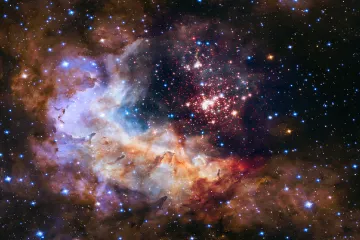
This is why star formation rarely results in a single, gigantic star consuming all the available mass; instead, one large collapse often fragments into dozens or hundreds of smaller cores, each destined to become a star or a small stellar system. [1] The initial trigger allows the larger structure to gain gravitational dominance, and the subsequent fragmentation dictates the final stellar population. [1][4] The ability of the cloud to cool efficiently is central to maintaining this cascade. As the core collapses, gravitational energy is converted into heat; if this heat cannot be radiated away quickly enough, the rising thermal pressure will halt the collapse locally, sometimes preventing the formation of smaller stars or leading to larger, less dense stellar remnants. [7] The environment must be efficient at radiating away energy, primarily through molecular line emission, to allow gravity to keep winning. [7]
If we observe the comparison between a core that collapses to form a single, isolated star versus one that fragments into a binary or multiple system, the difference lies almost entirely in the stiffness of the initial collapse and the magnetic field strength. [3] A stronger magnetic field or slower initial contraction might allow the larger mass to fragment before it becomes optically thick and traps too much heat, leading to multiple closely spaced star seeds rather than one monolithic core. [3] The initial trigger sets the stage, but the cloud's physical characteristics—cooling rate, magnetic structure, and initial turbulent profile—determine the final outcome of the resulting stellar cluster. [3][7]
#Videos
What Initiates Molecular Cloud Collapse? - Physics Frontier - YouTube
Related Questions
#Citations
Gravitational collapse - Wikipedia
What Initiates Molecular Cloud Collapse? - Physics Frontier - YouTube
molecular cloud collapse
How do star-forming clouds and star clusters arise? | Lee Hartmann
Molecular Cloud Collapse - The Astrophysics Spectator
In the context of the formation of stars, how is a gravitational collapse ...
Astronomy 1144: Lecture 13 - The Ohio State University
Astronomy Chapter 11 Flashcards | Quizlet
Gravitational Collapse