How does the shockwave from a nearby supernova explosion trigger star formation?
Answer
It compresses the gas, briefly creating a region of much higher density.
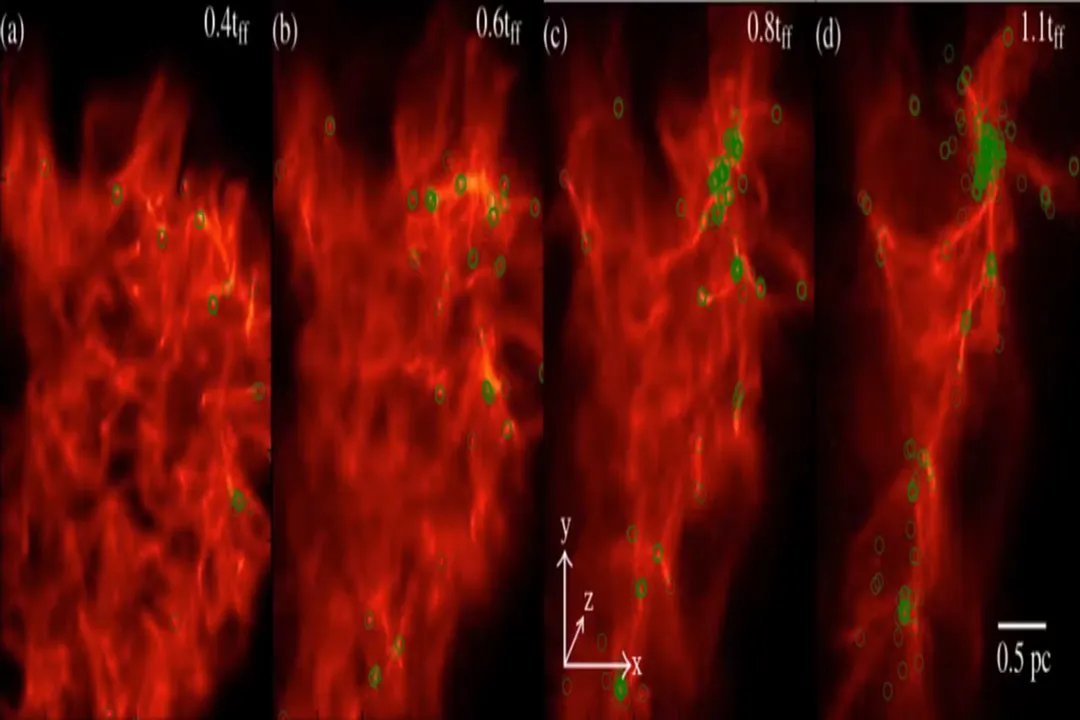
A supernova explosion generates a massive blast wave of rapidly expanding, superheated gas that sweeps through the interstellar medium. As this shell moves outward, it encounters and sweeps up the ambient molecular gas. This sweeping action results in severe, albeit temporary, compression of the gas clouds in its path, drastically increasing their local particle density. If this rapid compression elevates the local density sufficiently so that the region's mass surpasses its localized Jeans Mass threshold ($M_J$), gravitational collapse begins almost immediately within that highly compressed zone.
#Videos
What Initiates Molecular Cloud Collapse? - Physics Frontier - YouTube
Related Questions
What temperature range do molecular clouds hover within, just above absolute zero?What are the three primary forces resisting gravitational collapse in molecular clouds?What theoretical concept defines the minimum mass or size required for collapse initiation?What consequence occurs if a localized region's mass is less than the Jeans Mass ($M_J$)?What is the general requirement for overcoming turbulent pressure compared to only thermal pressure?How does the shockwave from a nearby supernova explosion trigger star formation?What particle number density range characterizes molecular clouds relative to surrounding space?What happens to the Jeans Mass ($M_J$) as a collapsing core contracts and its density increases?What adverse effect occurs if a collapsing core cannot efficiently radiate away converted gravitational energy?How do the spiral arms of the Milky Way provide an external trigger for gravitational collapse?