What icy bodies mostly originate in the Oort Cloud before being flung toward the Sun?
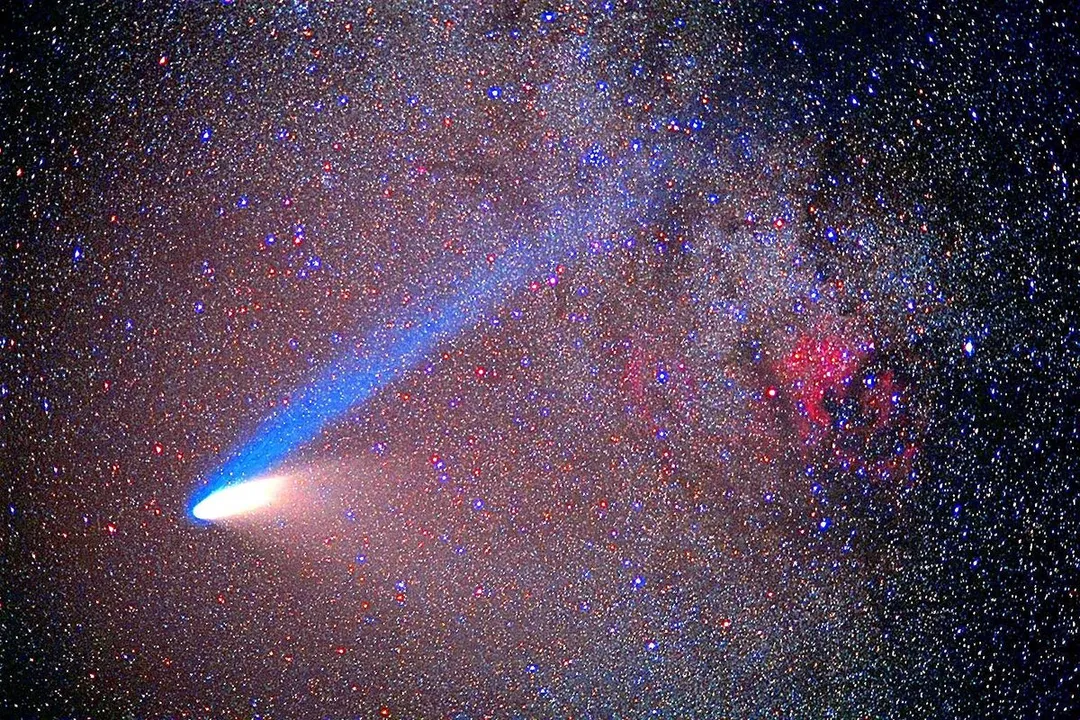
The icy bodies that make their dramatic, fiery visits to the inner solar system—the long-period comets—are believed to have their distant, frozen origins deep within the Oort Cloud. This hypothesized reservoir, a vast, spherical shell surrounding our Sun, acts as a deep-freeze storage unit for the remnants of the solar system's birth four and a half billion years ago. These objects are not mere space dust; they are collections of ice, dust, and small rocky particles, often popularly described using Fred Whipple’s famous "dirty snowball" moniker. They consist primarily of frozen volatiles like water, methane, ethane, carbon monoxide, and hydrogen cyanide. While the vast majority are these icy remnants, the occasional sighting of a rocky object in a typical long-period comet orbit suggests the cloud population isn't entirely uniform.
# The Spherical Frontier
The primary characteristic separating the Oort Cloud from other outer solar system zones, like the Kuiper Belt, is its sheer scale and geometry. The Kuiper Belt, which is the source of short-period comets, exists as a relatively confined, donut-shaped disk orbiting roughly in the same plane as the planets, extending out to about $30$ to $50$ Astronomical Units (AU) from the Sun. The Oort Cloud, however, begins where the Kuiper Belt wanes, starting somewhere between $2,000$ and $5,000$ AU. Its outer edge may stretch as far as $100,000$ or even $200,000$ AU, possibly reaching halfway to the nearest star, Proxima Centauri. This immense distance means the cloud forms a massive, three-dimensional sphere surrounding the entire solar system, like a thick shell or bubble.
This spatial separation is not trivial; it represents a fundamental difference in the environments these objects have experienced. Consider the scale: if the distance from the Earth to the Sun ($1$ AU) is the length of a football field, the Kuiper Belt might end about $50$ football fields away. The Oort Cloud, by contrast, starts $2,000$ football fields away and extends out for miles. This incredible gulf means that material residing in the outer Oort Cloud has been almost entirely isolated from the solar wind and the thermal fluctuations caused by proximity to the Sun for eons. In essence, the objects there are more pristine than those in the Kuiper Belt, which has been periodically stirred by Neptune’s gravity. This deep isolation makes the Oort Cloud the ultimate time capsule of primordial solar system materials.
Within this massive spherical boundary, astronomers theorize two primary regions exist:
- The Inner Oort Cloud (Hills Cloud): A denser, torus-shaped region situated between about $2,000$ and $20,000$ AU. Models suggest this inner area holds the majority of the cloud’s cometary nuclei—perhaps tens or even hundreds of times more than the outer region. It is more strongly bound to the Sun.
- The Outer Oort Cloud: The more expansive, spherical region extending outward toward the solar system’s true gravitational boundary, or Hill sphere. Its contents are only very loosely bound to the Sun.
# Ancient Ice: Origin and Seeding
The icy bodies currently inhabiting this distant shell were not born there. The consensus is that these planetesimals coalesced much closer to the Sun, concurrent with the formation of the planets from the rotating protoplanetary disk, likely near the current orbits of the ice giants, Uranus and Neptune.
The process that relocated them involved gravitational chaos during the solar system's youth, around $4.6$ billion years ago. As the massive gas and ice giants formed, their substantial gravity acted like celestial slingshots. Any smaller icy body, or planetesimal, that drifted too close had its orbit severely perturbed, kicking it out of the planetary region. Some were ejected entirely from the solar system, while a significant fraction were sent on incredibly wide, elliptical, or near-parabolic orbits, eventually settling into the stable, spherical confines of the Oort Cloud.
This scattering process, driven by Jupiter's immense gravitational influence, is the widely accepted mechanism for seeding the cloud. However, recent simulations introduce an even more fascinating possibility: that a large percentage, perhaps exceeding $90%$ of the Oort Cloud’s population, may not be native to our solar system at all. In the Sun’s early history, it was part of a dense cluster of hundreds of stars. It is hypothesized that the Sun captured these icy planetesimals from the protoplanetary discs of its stellar siblings as they drifted apart, making many of our comets truly interstellar travelers by origin.
# The Gentle Nudge: Inward Perturbations
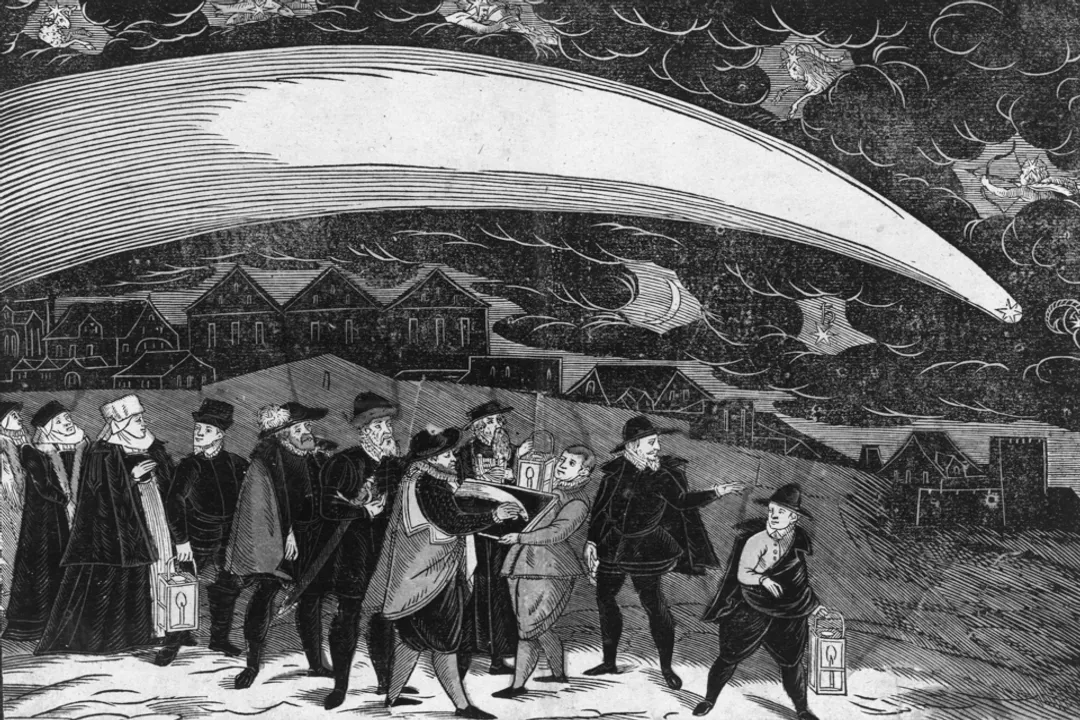
If the Oort Cloud is a permanent reservoir, why do we see comets now? The objects in the outer cloud are only weakly tethered to the Sun’s gravity, making them susceptible to subtle external influences that can shift their orbits inward, transforming them into inbound comets.
The two main triggers that dislodge these icy relics are:
- Stellar Perturbations: The Sun slowly migrates through the plane of the Milky Way galaxy. As it passes near other star systems or encounters the gravitational fields of giant molecular clouds, these external gravities can tug on the Oort Cloud bodies, slightly changing their orbits. For instance, the star Scholz’s Star is theorized to have passed close enough to perturb the outer cloud around $70,000$ years ago.
- The Galactic Tide: This is the cumulative, gentle gravitational distortion exerted by the entire Milky Way galaxy itself. Where the Sun’s gravity dominates in the inner system, the gradient of the galaxy’s gravity exerts a measurable pull far out in the Oort Cloud, compressing the sphere along two axes. Statistical models suggest this galactic tide may be the primary driver for up to $90%$ of the long-period comets we observe today.
When an object’s orbit is perturbed just right—slowing it down enough—it falls from its distant, nearly circular resting state into the highly eccentric, elongated ellipses characteristic of comets heading for the inner solar system. This explains why long-period comets—those taking over $200$ years, sometimes millions of years, to complete an orbit—appear to come from every direction in the sky, as their orbits are not confined to the plane of the planets.
# The Comet's Fate
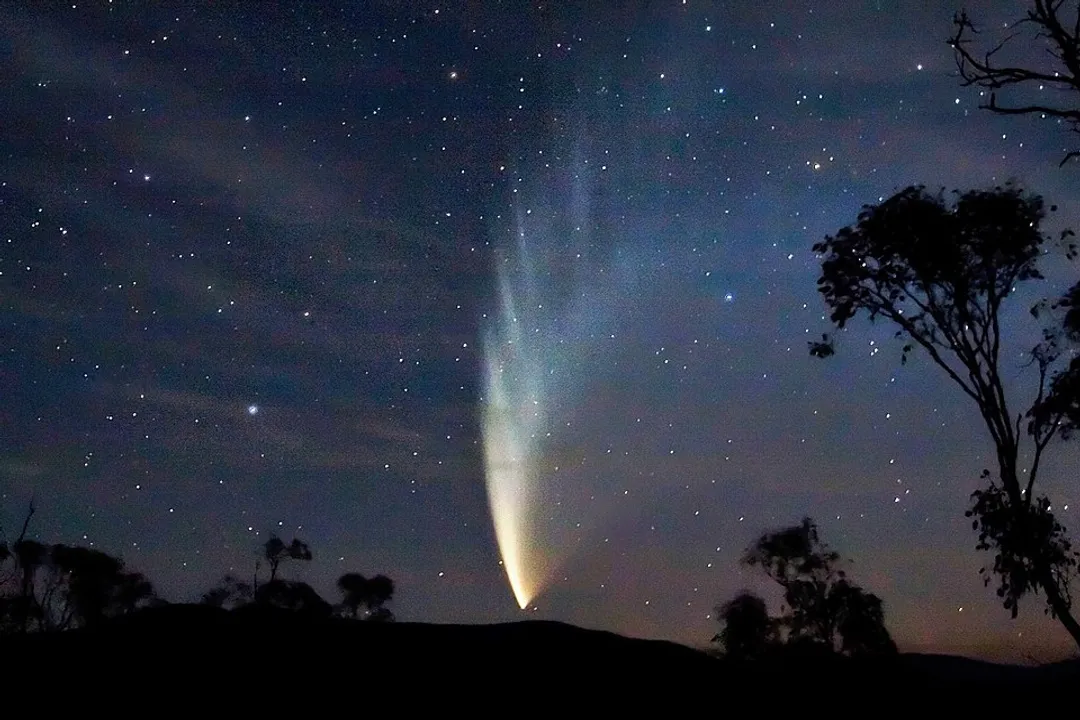
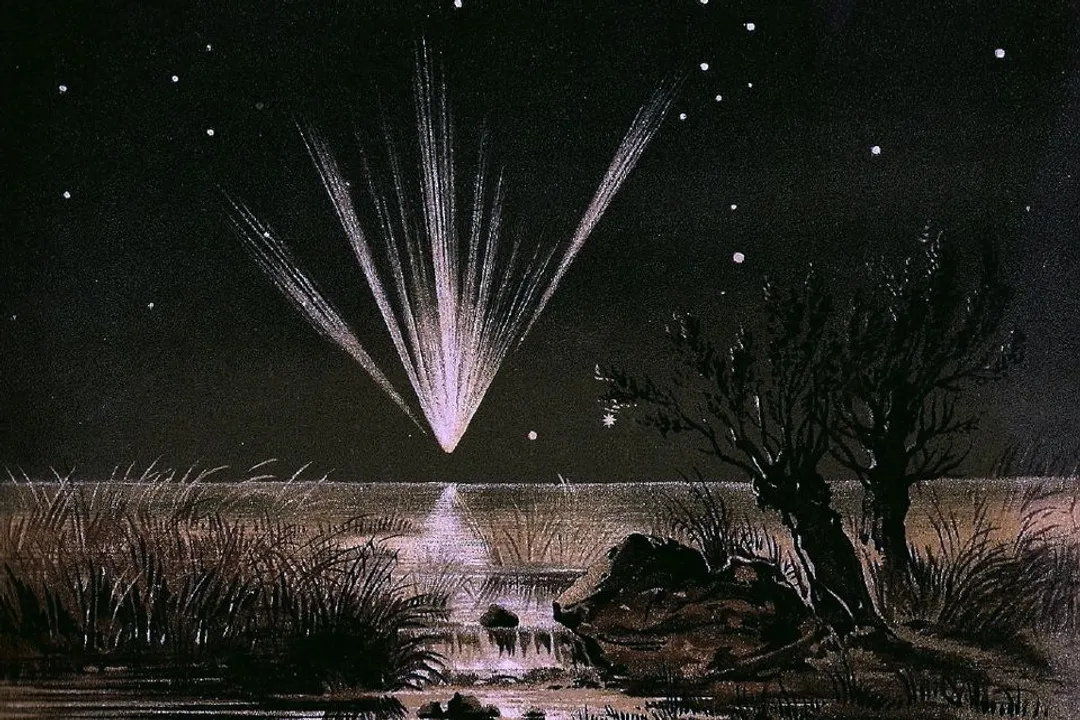
When an Oort Cloud object is nudged inward, it becomes a true comet. As it crosses the orbit of Neptune and approaches the inner solar system, the Sun’s heat begins the process of outgassing. The ices vaporize, releasing gas and dust to form the spectacular coma and the trailing ion and dust tails that always point away from the Sun.
It is important to distinguish these visitors from their closer cousins. Short-period comets are generally thought to originate from the Kuiper Belt or the Scattered Disc beyond Neptune. While the gravity of the giant planets can capture a long-period Oort Cloud comet and wrench its orbit into a shorter, more familiar path—creating what are sometimes called Halley-family comets—the truly ancient, directionally random visitors are the long-period ones.
However, repeated close passes near the Sun are fatal for these icy travelers. Each pass strips away volatile material; over thousands of orbits, the comet can lose almost all its ice, leaving behind only a dark, inert lump of rock or rubble that physically resembles an asteroid. This process, known as cometary fading, is what Jan Oort originally sought to explain with his cloud theory: the cloud constantly replenishes the supply of fresh comets to replace those that have burned out or been ejected from the solar system entirely. The discovery of objects like the dwarf planet Sedna (with an orbit far beyond Pluto) suggests that we may be viewing the very edge of the inner Oort Cloud population today.
Whether they become a spectacular, once-in-a-lifetime sight like Comet Hale-Bopp, or simply fall into the Sun or a planet, the icy bodies originating in the Oort Cloud represent the raw, unaltered building blocks of our entire planetary neighborhood, preserved at temperatures near absolute zero for billions of years.
#Videos
The Oort Cloud: Crash Course Astronomy #22 - YouTube
Related Questions
#Citations
Oort cloud - Wikipedia
What is the Oort cloud and where is it located? - Space
Oort Offers a Theory of Comets | Research Starters - EBSCO
The Oort Cloud: Crash Course Astronomy #22 - YouTube
Oort Cloud - NASA Science
Comets, the Kuiper Belt and the Oort Cloud