What comes from the Oort Cloud and Kuiper Belt?
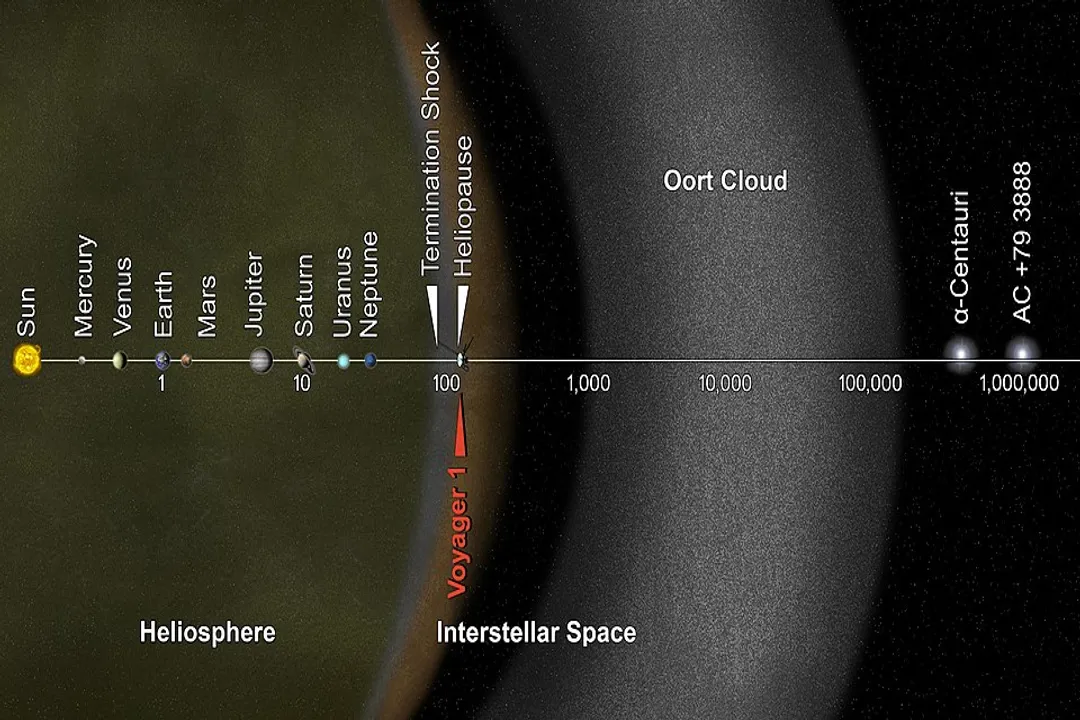
The far reaches of our solar system, places shrouded in perpetual cold and darkness, hold reservoirs of primordial material from the Sun’s birth. These distant realms, the Kuiper Belt and the Oort Cloud, are the primary sources for the spectacular comets that occasionally grace our night skies. [1][2] While often grouped together conceptually as the solar system’s deep freeze, they are distinct domains separated by unimaginable gulfs of space, each with its own characteristics and originating inhabitants. Understanding what comes from these zones requires a closer look at their geography and contents.
# Distant Realms
The structure of the outer solar system is best envisioned as nested spheres and disks. The Kuiper Belt is the first significant frontier past the orbit of Neptune. [1][4] It is generally described as a vast, doughnut-shaped region situated between approximately and Astronomical Units () from the Sun. [4] One Astronomical Unit is the average distance between the Earth and the Sun, making this region several tens of times farther out than our home planet. [4]
The Oort Cloud, by contrast, is not a flat disk like the Kuiper Belt; rather, it is a theoretical, spherical shell that envelops the entire solar system. [2][5][7] Its inner edge might begin near the Kuiper Belt, but its outer limits are staggeringly distant, potentially extending to or even . [2][5][7] To put this into perspective, Neptune orbits at about . [4] Objects in the Oort Cloud are so far out that they are only loosely gravitationally bound to the Sun, almost merging with the interstellar medium. [5][7]
# Kuiper Belt Contents
The Kuiper Belt is home to a collection of small, icy bodies, often referred to as Kuiper Belt Objects (). [1] These objects are essentially remnants left over from the solar system’s formation about billion years ago. [9] They are composed primarily of frozen volatiles—ices of methane, ammonia, and water—mixed with rock and carbonaceous material. [1]
This region is famous for harboring several dwarf planets, most notably Pluto, but also Eris, Makemake, and Haumea. [1] Unlike the nearly circular orbits of the major planets, KBOs typically have more eccentric, or oval-shaped, orbits, and many are significantly inclined, meaning they do not orbit in the same flat plane as the planets. [1]
When these icy bodies are disturbed from their stable orbits, they begin their inward plunge toward the Sun, transforming into what we recognize as short-period comets. [1][2] Short-period comets are those that take less than years to orbit the Sun. [2] Many of these comets actually originate within the Kuiper Belt, perhaps having their orbits perturbed by the gravitational influence of Neptune over vast timescales. [1]
Consider the dynamical environment: the Kuiper Belt is a relatively crowded neighborhood compared to the Oort Cloud, and the gravitational influence of Neptune is a primary sculptor of KBO orbits. [1] This close interaction results in distinct sub-populations, like the scattered disk objects, which have more highly eccentric and inclined orbits than the main belt population. [1]
# Oort Cloud Material
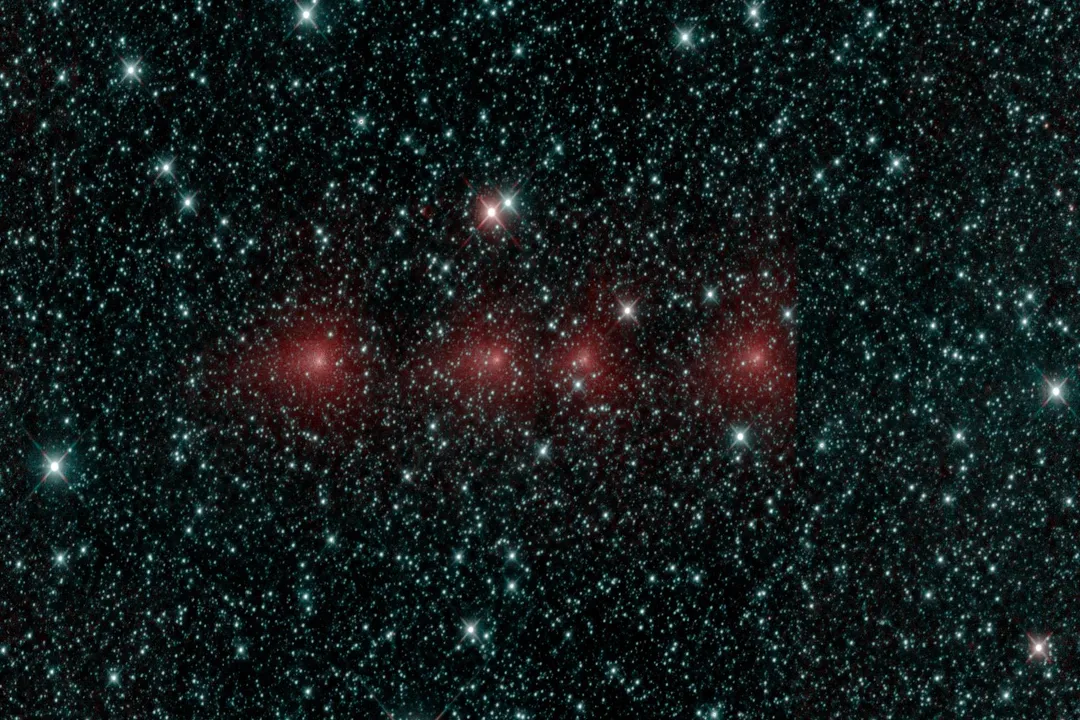
If the Kuiper Belt is the solar system’s icy attic, the Oort Cloud is the vast, dark shell encompassing the entire house. The objects originating here are responsible for long-period comets. [2][7] These comets take hundreds, thousands, or even millions of years to complete a single orbit around the Sun. [2]
The origin story of the Oort Cloud population is arguably more dramatic than that of the Kuiper Belt objects. Most material in the Oort Cloud is thought to have formed much closer to the Sun, inside the orbits of the giant planets, during the chaotic early stages of solar system assembly. [9] Gravitational scattering events involving Jupiter and Saturn flung these icy planetesimals outward, deep into space. [7][9] Over time, these ejected bodies settled into the distant, immense spherical cloud that now encircles us. [7]
Because the Oort Cloud objects are so loosely bound, their orbits can be disrupted by minor external forces. While the gravitational influence of Jupiter and Saturn set them on their path, subsequent nudges from passing stars or even the tidal forces exerted by the Milky Way galaxy itself are significant enough to send an Oort Cloud object inward towards the inner solar system. [7]
The distinction in the source region suggests a subtle but important difference in composition. Objects that formed closer to the Sun, yet were still ejected far enough to reside in the Oort Cloud, might have retained a slightly different mix of ices and rock compared to objects that formed further out, like those in the main Kuiper Belt. [9] For instance, one might hypothesize a very slight enrichment in heavier, less volatile materials in the inner Oort Cloud population originating from the region where the gas giants formed, versus the purely volatile-rich population from the absolute farthest reaches of the system. The Oort Cloud is generally believed to contain trillions of objects, dwarfing the estimated one hundred thousand KBOs. [7]
# Cometary Visitors
The principal "product" we see from both reservoirs is, without a doubt, the comet. These celestial snowballs are comprised of dust, rock, and frozen gases. [8] As they approach the Sun, the ice sublimates, releasing gas and dust, which forms the characteristic coma and tails. [8] The type of comet arriving offers a clue about its birthplace.
| Comet Type | Orbital Period | Primary Source Region | Perturbing Force |
|---|---|---|---|
| Short-Period | Less than years | Kuiper Belt | Neptune/Planetary Resonance |
| Long-Period | Hundreds to millions of years | Oort Cloud | Passing Stars/Galactic Tides |
The comets from the Oort Cloud are often considered the pristine archives of the early solar system because they have spent their entire existence far from the heat of the Sun and the influence of the major planets. [7] They are thought to represent the raw building blocks from which the terrestrial planets formed. [9] Comets observed from the Kuiper Belt, being closer to the planetary zone, might have experienced more gravitational interaction, potentially leading to slight compositional alterations or orbital excitement even before they become visible as comets. [1]
# Observational Challenges
Detecting objects in these regions presents enormous technical hurdles. The Kuiper Belt is already distant and dark, but objects there orbit somewhat predictably, generally remaining in a plane near the ecliptic. [1] Surveys are designed to scan this relatively thin plane, making discovery feasible, though challenging. [1]
The Oort Cloud presents a far greater observational problem. Its objects are spread out in all directions, creating a vast, near-invisible sphere. [5] Furthermore, they are so far away and move so slowly relative to the background stars that distinguishing a faint, moving object from a distant, fixed star requires extended observation times and highly sensitive telescopes. [5] Direct observation of Oort Cloud objects is practically impossible with current technology; our knowledge of the cloud is largely inferred from the orbital statistics and composition of the long-period comets that occasionally deviate from that volume. [7]
We must remember that the boundary between the two regions is not a sharp line; it is a dynamic gradient. Some objects in the scattered disk, a population beyond Neptune but gravitationally influenced by it, might have orbits that occasionally overlap with the inner boundary of the Oort Cloud structure, blurring the exact demarcation line. [4]
When we look at the physics of their paths, the difference in distance dictates their vulnerability. An object at (Kuiper Belt) is significantly more influenced by the Sun’s gravity than an object at (Oort Cloud). [5] This means that a relatively small nudge, perhaps from Jupiter’s gravity when the object was younger, had a massive and permanent effect on the Oort Cloud body, ejecting it nearly to the edge of the solar system's sphere of influence, whereas a similar nudge for a closer might only result in a temporary shift within the main belt or the scattered disk. This difference in gravitational binding strength explains why Oort Cloud comets arrive on such wildly varied and often highly inclined trajectories, while Kuiper Belt comets tend to follow paths more aligned with the planets. [2][7]
The study of these distant populations, though difficult, is fundamental to understanding the solar system's history. The Oort Cloud represents the massive, pristine material that was rejected by the early planetary system, while the Kuiper Belt represents the material that remained in the vicinity of the outer ice line, slowly accreting into the KBOs we see today. [9] Both regions are vital time capsules, preserving the original chemical conditions present before planets formed, offering clues about the material that eventually formed Earth and its neighbors.
#Videos
Kuiper Belt And Oort Cloud Explained - YouTube
Related Questions
#Citations
Comets, the Kuiper Belt and the Oort Cloud
The Kuiper Belt and the Oort Cloud: What to know - Ad Astra
Oort Cloud - NASA Science
What is between the Kuiper Belt (30 to 50 AU) and the Oort Cloud ...
Relationship of the Kuiper Belt to the Oort Cloud | ESA/Hubble
Kuiper Belt And Oort Cloud Explained - YouTube
Oort cloud - Wikipedia
Comets - | The Schools' Observatory
Small body - Origins, Kuiper Belt & Oort Cloud, Comets & Asteroids