What objects are found in the Oort Cloud?
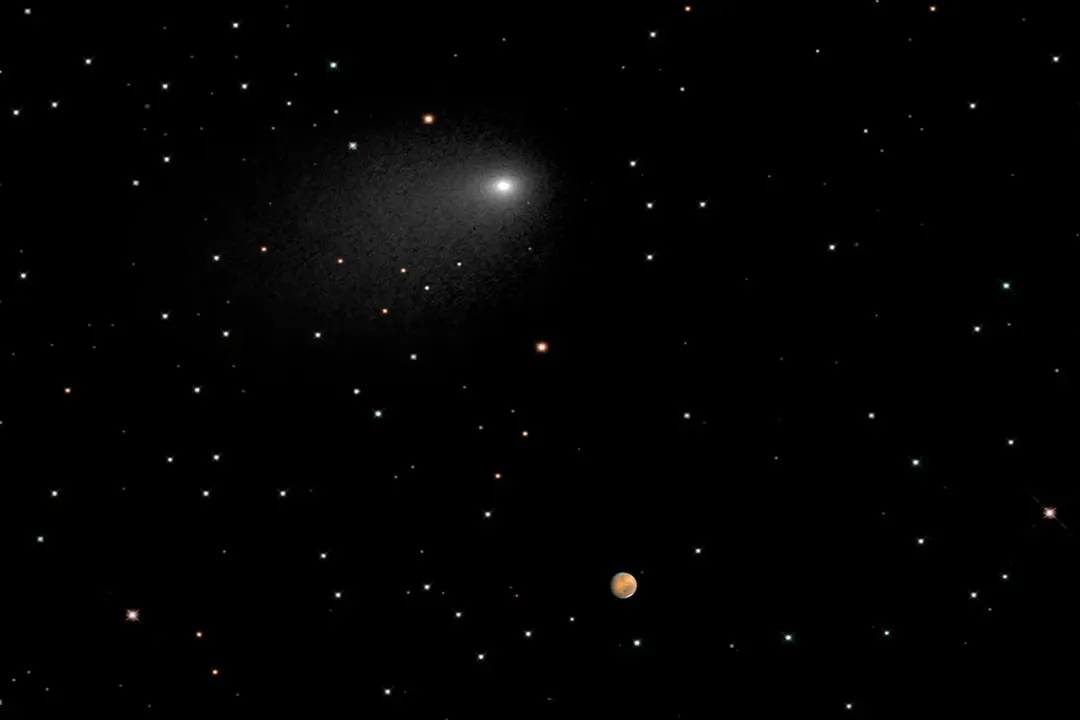
The objects residing in the Oort Cloud are fundamentally the most ancient and distant debris remaining from the solar system's birth, acting as a colossal, spherical reservoir of icy material surrounding our Sun. [2][6] While we cannot see this region directly—it is far too distant and faint for current instruments to resolve—our understanding of what populates it comes primarily from studying the long-period comets that occasionally plunge inward toward the Sun. [3][6] These comets are considered the direct emissaries from the Oort Cloud, carrying the chemical signatures of the system's primordial past. [1]
# Icy remnants
The primary constituents of the Oort Cloud are a vast collection of icy planetesimals. [9] These are essentially the building blocks of planets that never accreted into larger bodies, having been ejected from the warmer, denser inner and middle regions of the early solar nebula. [6] The material composition is heavily weighted toward volatile substances, often referred to collectively as "ice" in astronomical terms. [2] This includes not just water ice, but also frozen methane, ammonia, and carbon monoxide. [2][6]
These objects represent the deep-frozen storage of the original solar nebula. [6] Unlike bodies closer to the Sun or those that have suffered gravitational sculpting, Oort Cloud material has remained largely untouched by significant heating or radiation for billions of years. [9] If we think of the materials that formed the giant planets—Jupiter, Saturn, Uranus, and Neptune—as enormous ice-and-gas mixtures, the Oort Cloud objects are akin to the tiny, solid, icy seeds that were scattered before they could grow into something grander. [1] The sheer volume of this icy matter is staggering, estimated to contain trillions upon trillions of individual bodies. [2][6]
# Size spectrum
The size distribution within the cloud spans an enormous range, which contributes to the challenge of ever directly imaging them. [6] At the low end, these objects are simply small, icy fragments, perhaps only a few meters across. [6] Moving upward, they scale up to objects the size of mountains. [6] Astronomers hypothesize that the largest objects could be comparable to dwarf planets, perhaps the size of Ceres or even Pluto, though these larger bodies would be exceedingly rare. [1][6]
It is this sheer variety in size, coupled with their incredible distance, that dictates the observable effects we attribute to the cloud. While a small fragment might be vaporized quickly upon entering the inner system as a faint meteor shower, a larger body creates the spectacular, long-lived comets we watch with telescopes. [3] If one were to catalogue the population, perhaps $90$ percent or more of the mass would reside in bodies larger than a kilometer across, with the truly massive ones being statistical anomalies. [6]
# Distinguishing features
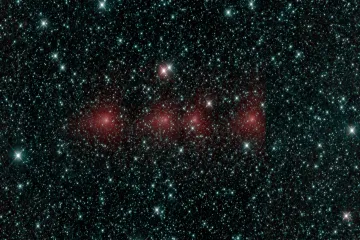
It is helpful to draw a clear line between the Oort Cloud and its closer neighbor, the Kuiper Belt, as their objects, while both icy, have different histories and locations. [3][9] The Kuiper Belt is a relatively flat disk extending beyond Neptune, home to dwarf planets like Pluto. [3][9] Its objects are thought to be the leftovers from the formation of the outer giant planets, remaining relatively close to their original orbits. [9]
The Oort Cloud, conversely, is a nearly spherical shell extending far beyond the Kuiper Belt, perhaps out to $100,000$ times the distance between the Earth and the Sun. [1][2] The objects found here were ejected from the inner solar system—likely flung outward by the gravitational influence of the massive young planets, especially Jupiter and Saturn, during the solar system's chaotic early history. [6][9] This difference in orbital history is key: Kuiper Belt Objects are often seen as the original inhabitants of the outer solar system, while Oort Cloud inhabitants are refugees from the inner regions, surviving in deep freeze due to their extreme isolation. [9] For an object to reside in the Oort Cloud, it had to have experienced a trajectory that flung it into a vast, high-inclination orbit, far removed from the ecliptic plane where the planets reside. [1]
# Evidence and Inferences
Since the Oort Cloud is currently beyond the detection threshold for direct observation, all established facts about its contents are based on statistical models derived from the comets we do observe. [5] This presents an interesting analytical challenge: we are reconstructing a massive population based only on the tiny fraction that happens to be perturbed into an observable path. [4]
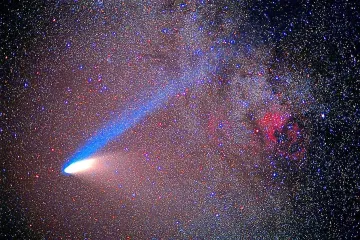
The primary objects detected are the source comets themselves. These are bodies that, having been gravitationally nudged by passing stars or galactic tides, change their orbit and begin a slow fall toward the inner solar system. [2][5] When these bodies cross the orbit of Jupiter or Mars, solar heat begins to vaporize their surface ices, creating the signature coma and tail that defines a comet. [3]
One might wonder if the absence of any larger, detected bodies proves the cloud is mostly empty or composed only of very small things. The counter-argument, supported by orbital dynamics, is that the cloud's sheer remoteness makes detection nearly impossible. [5] To put this into perspective: if the inner edge of the Kuiper Belt is around $30$ AU (with Pluto orbiting at an average of $39.5$ AU), the inner Oort Cloud begins around $2,000$ to $5,000$ AU, and its outer boundary is estimated to be about $50,000$ to $100,000$ AU away. [1][2] If a typical object in the Oort Cloud is $100$ times farther away than Pluto, its reflected sunlight is $100^2$ ($10,000$) times fainter. Current powerful telescopes can detect objects in the Kuiper Belt, but pushing sensitivity further by a factor of ten thousand to reliably spot a kilometer-sized object in the Oort Cloud is a monumental technical hurdle. [5] Therefore, the objects are there, defined by the cometary orbits they generate, even if their physical presence remains inferred rather than seen. [4]
# Current status
The current consensus is that the Oort Cloud objects are inert, frozen relics, primarily ice and rock. [6] They are not actively forming planets or undergoing significant chemical change because they are too far from the Sun's heat and radiation pressure. [2] Their orbital paths are dictated not just by the Sun, but by the extremely weak, long-term gravitational influences of the Milky Way galaxy itself and the occasional near-pass of a neighboring star. [1][5] These external forces are what occasionally "stir up" the cloud, sending a fresh batch of icy visitors toward the inner planets for us to study. [2] The objects themselves are the material legacy of the earliest days of planetary formation, preserved in the solar system's coldest attic.
#Videos
Exciting Discoveries About the Oort Cloud and the Edge of the Solar ...
Related Questions
#Citations
Oort cloud - Wikipedia
Oort Cloud - NASA Science
Comets, the Kuiper Belt and the Oort Cloud
Is there any other evidence for the oort cloud? : r/space - Reddit
Oort cloud (exo)planets - planetplanet
Exciting Discoveries About the Oort Cloud and the Edge of the Solar ...
Does the Oort cloud have any large holes in it and if not does this ...
9.2: The Oort Cloud and Kuiper Belt - Physics LibreTexts
Inner solar system material discovered in the Oort cloud - PMC - NIH