Is the Oort Cloud made of ice?
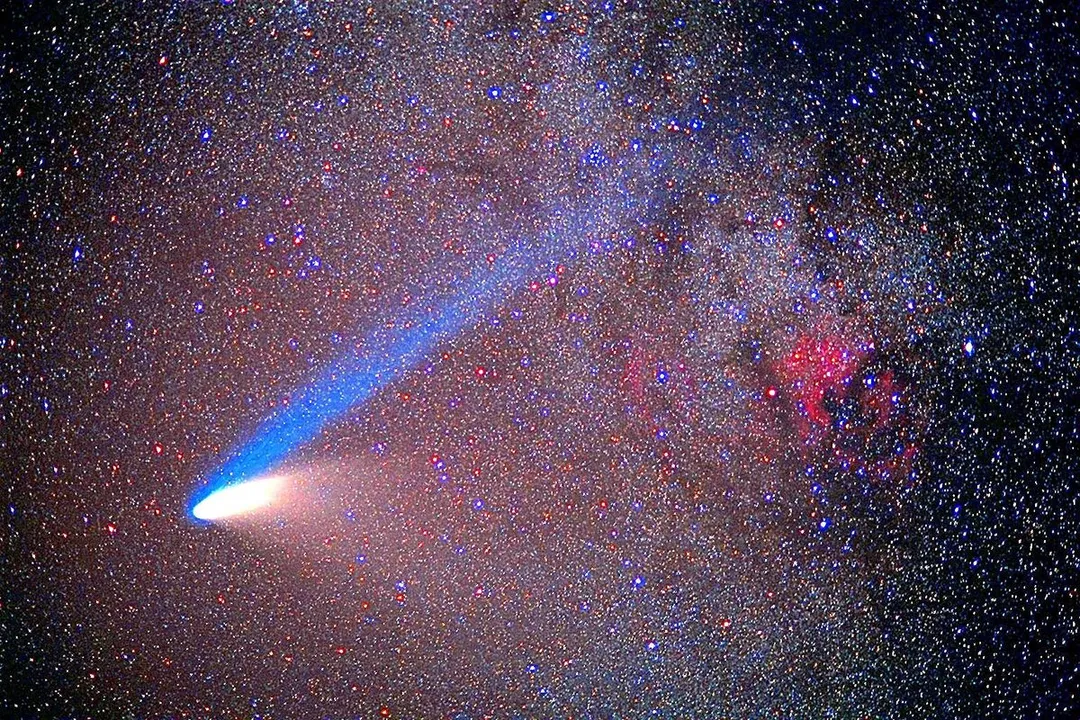
The vast, spherical reservoir surrounding our Sun, known as the Oort Cloud, is often described as the extreme edge of our solar system, a distant frontier marking the transition to true interstellar space. [1][5] The question of its makeup is fundamental to understanding the origin of many comets, and the answer leans heavily toward frozen material: yes, the Oort Cloud is overwhelmingly made of ice. [5][6]
# Icy Composition
The objects within this distant shell are thought to be remnants from the solar system's turbulent early history, essentially pristine building blocks that never coalesced into planets. [1][5] These are not simply rocks; they are comprised of frozen volatiles—the materials that turn into gas when they approach the Sun. [5] This icy inventory includes water ice, but also frozen methane, ammonia, and carbon monoxide. [5] Because the Oort Cloud resides so far from the Sun, where temperatures plummet to extreme lows, these substances remain solidly frozen, locked away for billions of years. [1] It is this volatile-rich nature that confirms their identity as the source of long-period comets. [6] When gravity from a passing star or a passing giant planet nudges one of these icy bodies inward, it warms up, releases gas, and becomes the spectacular celestial visitor we observe from Earth. [1][5]
# Vast Distances
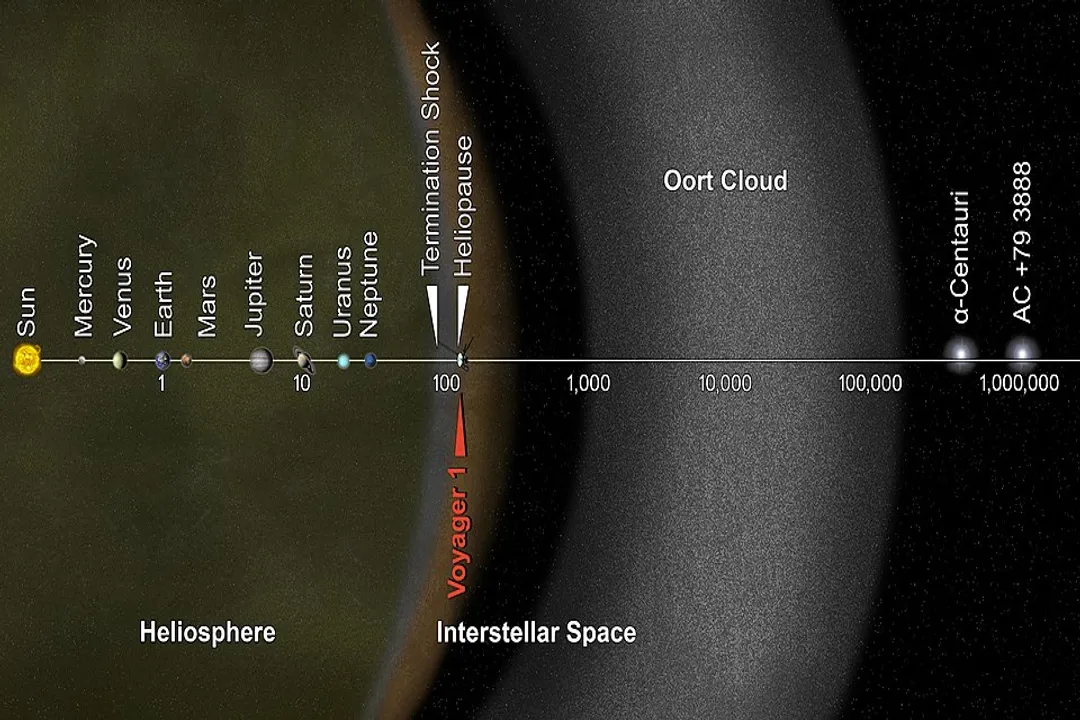
To grasp why these objects are ice, one must appreciate the sheer scale of the Oort Cloud. While the Kuiper Belt, the region home to Pluto, extends out to about 50 Astronomical Units (AU), the Oort Cloud begins much further out, estimated to start around 2,000 to 5,000 AU away from the Sun. [1][5] Its outer boundary is far more speculative, potentially stretching as far as 50,000 to 200,000 AU. [1][5] For context, this means the outer edge of the Oort Cloud could be nearly a quarter to a third of the distance to Proxima Centauri, the nearest star system. [1]
The resulting environment is one of incredible isolation and cold. A useful way to visualize this is to consider the diminishing power of sunlight. At the orbit of Neptune, sunlight is already faint, requiring specialized cameras to view objects. [5] By the time you reach the main Oort Cloud region, the Sun would appear as merely the brightest star in the sky, offering negligible thermal energy. [1] Because the solar energy received is so minimal, any volatile compound, even those with relatively low freezing points, remains firmly frozen solid. [1]
This immense spatial separation leads to an interesting realization about the nature of the cloud itself. If the cloud were densely packed, it would act as an opaque barrier, but it is anything but. [4] The objects are spread across immense volumes of space. Imagine a single marble placed in a cubic mile of empty volume; the Oort Cloud objects are even more sparsely distributed than that analogy suggests. [3] This low density is precisely why the cloud does not block the light from background stars. [4]
# Planetary Scattering

The origin story of the Oort Cloud is intrinsically linked to the gravitational dynamics of the early solar system. [1] Scientists hypothesize that these icy planetesimals formed much closer to the Sun, perhaps near or beyond the orbits of the modern gas giants: Jupiter, Saturn, Uranus, and Neptune. [5] As these giant planets gravitationally matured, their immense mass acted like a cosmic slingshot, kicking the smaller icy bodies onto highly eccentric, long orbits that carried them far out to the fringes of the Sun’s gravitational dominion. [1][5]
This gravitational scattering event was relatively short-lived in cosmic terms, perhaps only a few million years after the solar system formed. [1] The key point is that these objects were ejected rather than forming in situ at that distance. [5] The objects that escaped the solar system entirely likely became rogue interstellar objects, while those trapped in the vast, loosely bound Oort Cloud now remain in near-static orbits, occasionally perturbed by galactic tides or the passage of nearby stars. [1]
# Comet Delivery
The primary evidence we possess for the Oort Cloud's existence comes not from seeing the cloud itself, but from observing its infrequent, spectacular inhabitants: the long-period comets. [6] Objects originating from the Kuiper Belt usually have orbital periods of less than 200 years, whereas those originating from the Oort Cloud can take thousands or even millions of years to complete a single circuit around the Sun. [1] When one of these distant, icy reservoirs is gravitationally disturbed—perhaps by a passing molecular cloud or the differential pull of the Milky Way’s gravity—it is sent plunging inward toward the Sun. [1] As these comets approach the inner system, the solar heat sublimates their frozen ices, creating the characteristic glowing coma and tail that astronomers observe. [5] Observing the trajectories and chemical compositions of these comets provides the necessary indirect data to map out the expected location and composition of their source, the Oort Cloud. [6]
# Temperature Thresholds
One interesting analysis arises when considering what constitutes "ice" in this environment. While we usually think of water ice, the Oort Cloud contains a much wider variety of frozen compounds. [5] At distances of 5,000 AU and greater, the solar flux drops off by a factor of , meaning the heat received is drastically lower than at Pluto's orbit. If we consider that water ice remains solid well beyond Neptune, the temperature at 5,000 AU is profoundly cold, likely dropping to just a few degrees above absolute zero, perhaps around 20 to 50 Kelvin. [1] At these temperatures, materials we consider gases at room temperature—like nitrogen, carbon monoxide, and even some heavier hydrocarbons—condense into hard ices. Therefore, the Oort Cloud is not just a collection of frozen water, but a vast storage locker for nearly every volatile substance that existed when the solar system first assembled. [5] This mixture of ices provides critical clues about the chemical makeup of the original solar nebula before the Sun ignited.
# Observational Limits
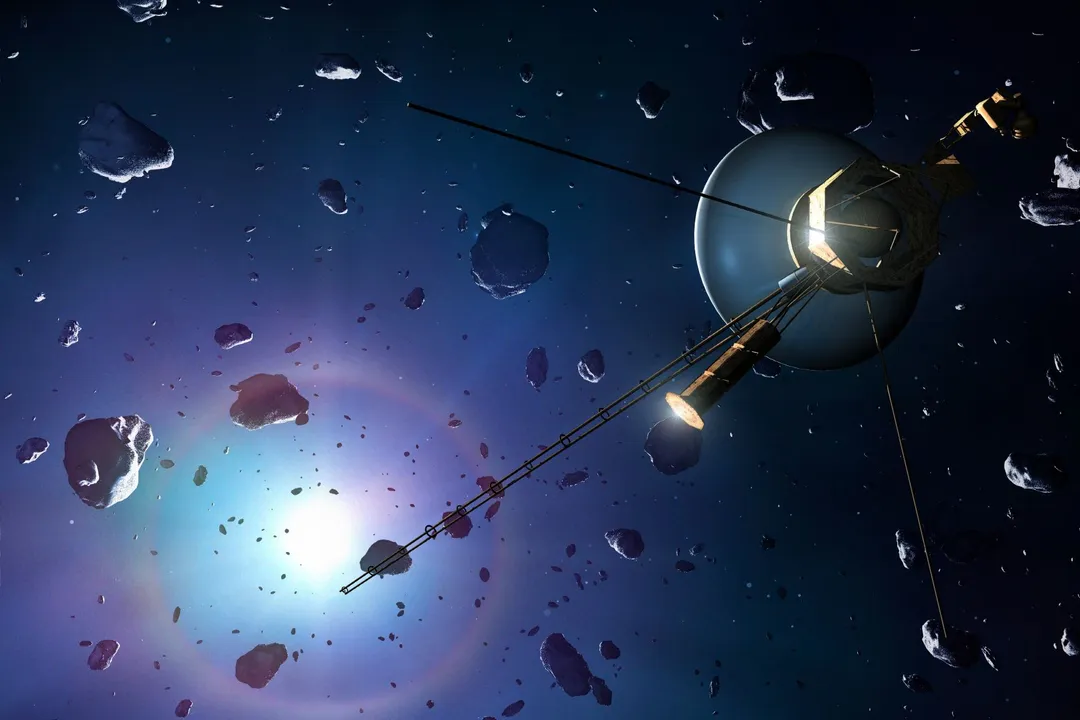
Despite the confirmed composition of its hypothetical inhabitants, the Oort Cloud remains the most inaccessible region of our solar system, creating a unique challenge for astrophysics. While we have sent probes like Voyager 1 and Voyager 2 far past the Kuiper Belt and into the boundary region known as the heliosheath, they have only just begun to approach the inner edge of where the Oort Cloud is supposed to begin. [1] To reach the main, dense sphere of objects at 20,000 AU would require a massive increase in travel time and propulsion capability that currently exceeds our reach. [1]
This gap in direct observation is crucial. We are inferring the shape (a sphere) and composition (ice) based on the orbital characteristics of the comets that reach us, which are only those that have been scattered inward. [6] It is entirely possible that the outer shell of the cloud has a different distribution or composition due to long-term gravitational stripping by the galaxy, but we have no way to verify this directly with current technology. [1] This situation presents a fascinating paradox: the furthest confirmed object we have studied closely is the Sun itself, whose influence defines the cloud's edge, yet the objects that define the cloud’s structure remain forever out of reach for direct sampling. [5]
#Videos
The Oort Cloud - YouTube
Related Questions
#Citations
Oort Cloud - NASA Science
Oort cloud - Wikipedia
ELI5: What is an oort cloud? : r/explainlikeimfive - Reddit
The Oort Cloud: a vast region of ice and dust - Facebook
What is the Oort cloud and where is it located? - Space
Comets, the Kuiper Belt and the Oort Cloud
If the Oort cloud is a 'thick bubble' of icy objects, how come it doesn't ...
The Oort Cloud - YouTube
Oort cloud Facts for Kids