What is a ball of ice and dust?
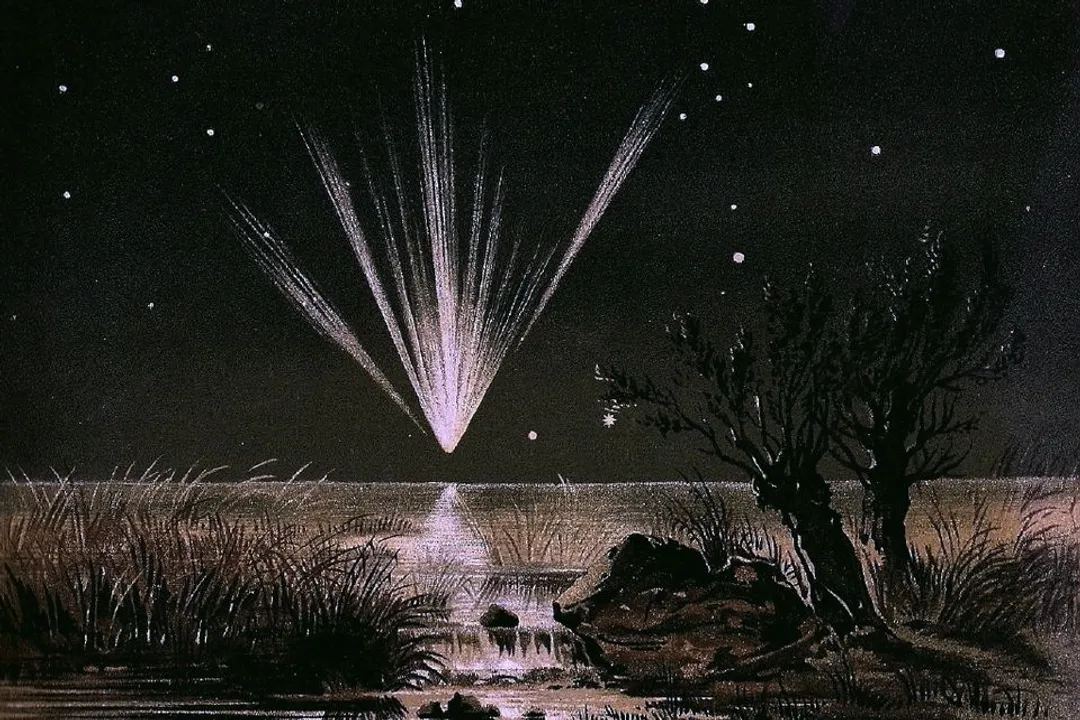
This cosmic object, often described simply as a ball of ice and dust, is scientifically known as a comet. These are small, airless bodies that orbit the Sun, remnants left over from the formation of our solar system about $4.6$ billion years ago. Though they may appear small, they are sometimes referred to as "dirty snowballs" because of their composition. When far from the Sun, a comet is essentially an inert chunk of material, but as it draws closer, solar energy transforms it, creating the spectacular display of gas and dust that makes them famous.
# The Nucleus
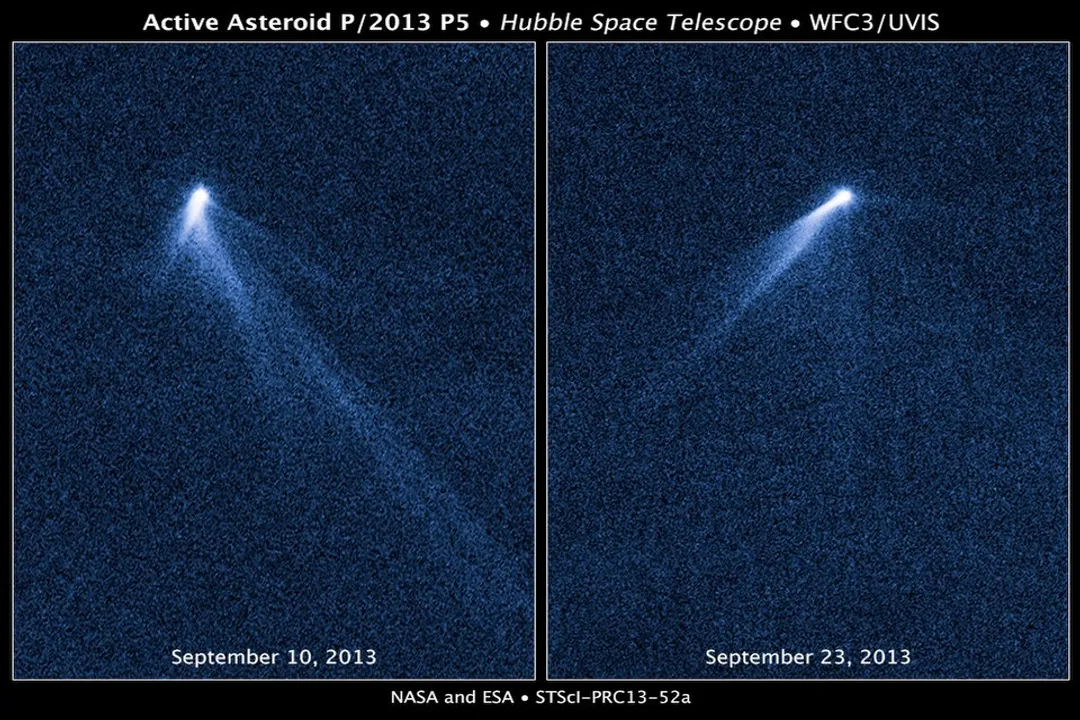
The heart of any comet is its nucleus. This solid core is surprisingly small, often only a few kilometers across. It is a composite structure, best imagined as a mixture of frozen gases, rock, and dust cemented together.
The "ice" component isn't just water ice, which is certainly present, but also frozen volatiles like carbon dioxide, carbon monoxide, methane, and ammonia. These are the materials that readily turn into gas when heated. The "dust" component consists of rocky materials and organic compounds mixed throughout the ice. This mixture is loosely packed, and the material making up the nucleus is thought to be pristine, meaning it has remained largely unchanged since the early days of the solar system's birth.
It is interesting to consider how fragile this structure must be. If we imagine an object a few kilometers wide held together mostly by weak inter-molecular forces between frozen gases and dust, it's clear why comets often break apart or lose mass rapidly as they pass near the Sun. Unlike the dense, rocky surfaces of planets or the Moon, the surface of a comet nucleus can be quite dark, absorbing a high percentage of the light that hits it, sometimes appearing as dark as coal.
# Solar Orbit
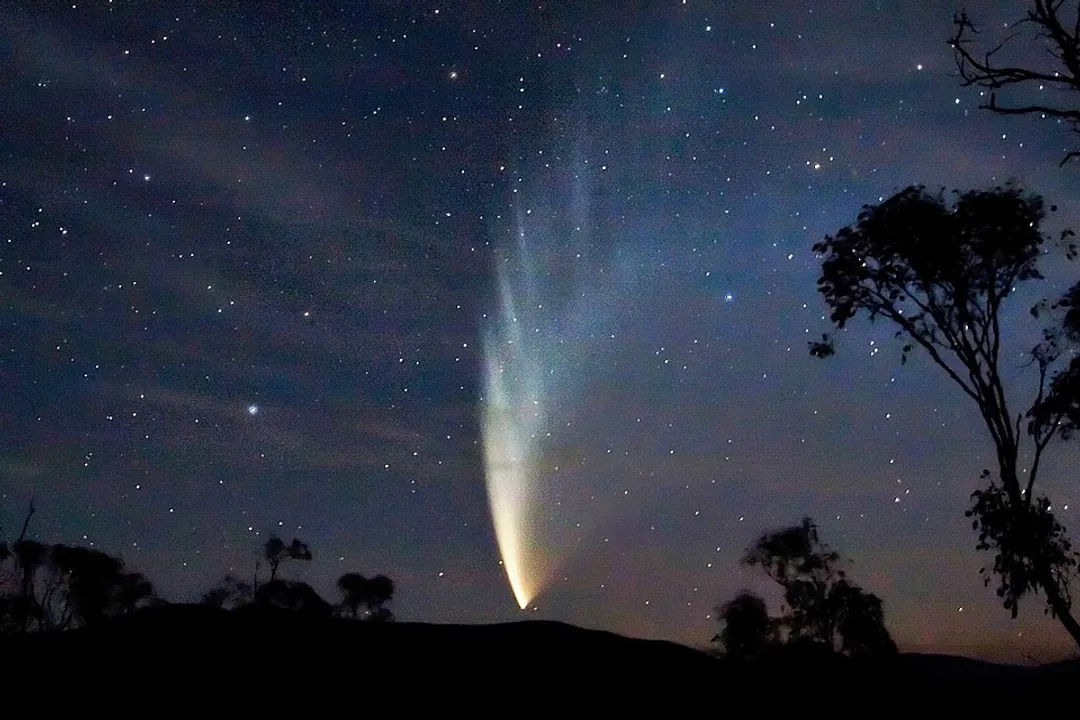
Comets follow highly elliptical paths around the Sun, meaning their orbits are very elongated rather than nearly circular like those of the planets. This path brings them extremely close to the Sun at one point, their perihelion, and sends them soaring back out to the far reaches of the solar system for their aphelion.
Where do these travelers originate? Astronomers generally group their origins into two main regions: the Kuiper Belt and the Oort Cloud.
The Kuiper Belt lies beyond the orbit of Neptune. Comets originating here are typically short-period comets, meaning their orbits take less than $200$ years to complete.
The Oort Cloud, in contrast, is a vast, spherical shell thought to surround the entire solar system, extending perhaps a light-year from the Sun. Comets from this distant reservoir are known as long-period comets, sometimes taking thousands or even millions of years for a single orbit. A gravitational nudge from a passing star or a galactic tide can sometimes send one of these icy wanderers plunging inward toward the Sun, initiating a new, visible orbit.
# Transformation Near Sun
The dramatic change in a comet's appearance happens only when its highly elongated orbit brings it into the inner solar system, close enough for the Sun’s heat to take effect.
# Sublimation and the Coma
As the comet approaches the Sun, the ice on its surface begins to sublimate—turning directly from a solid to a gas without passing through a liquid phase. This escaping gas carries dust particles with it, forming a vast, glowing cloud around the nucleus called the coma. This temporary atmosphere can grow much larger than the planet Jupiter, though it is extremely diffuse. The coma is essentially the visible "head" of the comet.
# Tail Formation
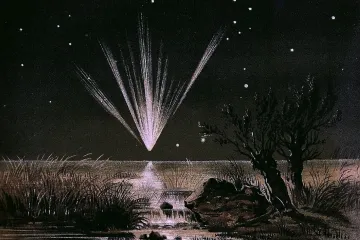
The solar wind—a stream of charged particles flowing out from the Sun—and the pressure of sunlight interact with the material in the coma, pushing it away from the Sun to form the characteristic tails. A comet usually develops two distinct tails, though occasionally, observers might only notice one or a combination of features:
- Dust Tail: This tail is composed of dust particles pushed away by the Sun's radiation pressure. It is generally curved, tracing the comet's orbital path because the larger dust particles are slower to be swept away and lag behind the comet's nucleus.
- Ion Tail (or Gas Tail): This tail consists of ionized gas, which is strongly affected by the Sun's magnetic field and solar wind. It is usually straighter and points almost directly away from the Sun, regardless of the comet's path.
It's a fascinating characteristic that when a comet is moving away from the Sun, its tails often appear to lead the nucleus in its direction of travel, as the solar wind always pushes the material outward from the Sun. The viewing experience can vary wildly depending on the comet's specific trajectory relative to Earth. For instance, Comet / $2023$ A$3$ (ATLAS) was one such object that drew significant attention, offering researchers and sky-gazers a chance to study these processes firsthand.
# Comet Characteristics Table
To better compare the features of a comet, one can look at how its size and visibility relate to its distance from the Sun.
| Feature | Location Relative to Sun | Appearance | Composition Focus |
|---|---|---|---|
| Nucleus | All parts of orbit | Solid, dark core | Ice, rock, dust |
| Coma | Inner Solar System (approaching) | Fuzzy, glowing atmosphere | Sublimated gas and dust |
| Tails | Inner Solar System (near perihelion) | Streamers pointing away from Sun | Dust (curved) and Ions (straight) |
| Dormant State | Outer Solar System | Inactive, icy body | Primarily frozen materials |
One analytical point to consider when looking at historical records or even modern amateur photography is the concept of effective surface temperature. While we think of the Sun's heat as constant, the intensity follows the inverse square law. A comet passing $1$ AU (Earth-Sun distance) from the Sun receives $4$ times the energy per unit area as one passing at $2$ AU. This means the transition from a quiet, icy rock to a spectacular display is not gradual but accelerates sharply as it crosses an invisible boundary, often leading to dramatic, last-minute brightening or, conversely, early disintegration if the nucleus is too fragile for the heat shock.
# Related Icy Phenomena
While the "ball of ice and dust" primarily refers to a comet, it is worth noting that ice and dust exist elsewhere in the solar system and even on Earth, though under very different circumstances. For example, on Earth, under specific, cold atmospheric conditions, one can observe diamond dust. This phenomenon consists of tiny ice crystals suspended in the air near the ground in very cold weather. However, unlike the mixture of dust and frozen volatiles orbiting the Sun, diamond dust is composed of hexagonal ice crystals, sometimes with dust particles adhering to them, forming near the surface rather than in the vacuum of space as part of a celestial body. The defining difference remains the orbit and the volatiles—comets are large, icy bodies orbiting the Sun, which dictates their behavior when heated.
Comets, therefore, are dynamic travelers. They are not static planets but changing celestial bodies whose brilliance depends entirely on their proximity to our star, providing scientists with direct samples of the ancient solar nebula as they pass by. Observing them is like looking back in time at the materials that originally clumped together to form everything else we see orbiting the Sun today.
Related Questions
#Citations
Comet - Wikipedia
What Is a Comet? | NASA Space Place – NASA Science for Kids
Comets: Everything you need to know - Space
You can still see comet 3I/ATLAS in the night sky. Here's how.
A ball of ice, rocks, dust, and gas that orbits the sun is called a(n) A ...
What is a ball of frozen dust and rock that orbits the sun and has a ...
Comets as halloween ghosts in space - Facebook
Streaking ball of ice and dust Crossword Clue - Wordplays.com