Is there dust floating in space?

The vast emptiness of space, as often depicted, is anything but truly empty. While the idea of "dust" might conjure images of settled, fuzzy layers coating furniture in an unused attic, the reality of cosmic dust is infinitely more complex and significant. These minute particles are suspended everywhere, from the thin reaches between planets in our own Solar System to the immense gulfs separating stars in our galaxy and others. [1][7] Understanding this interplanetary and interstellar debris is key to understanding where the elements that make up everything around us—including ourselves—actually originated. [4]
# Material Size
Cosmic dust particles are fundamentally defined by their scale. They are incredibly small, generally categorized as solid matter ranging in size from micrometers up to a few millimeters. [1][7] To put that into perspective, a micrometer is one-millionth of a meter, making many of these grains far smaller than the width of a human hair. [1] These particles are not uniform; they are composed of various materials, often categorized as silicate-based, which generally means they contain oxygen and elements like magnesium, iron, and silicon, or carbon-based materials. [1] They represent the smallest solid component found throughout the cosmos. [7]
# Stellar Origins
The origins of this pervasive material are directly tied to the lifecycle of stars. Much of the dust floating around is the remnant material cast off as stars age and expire. [3][4] Specifically, Asymptotic Giant Branch (AGB) stars, which are late-stage, large, luminous stars, shed their outer layers, enriching the interstellar medium with dust grains. [3] Furthermore, the most violent stellar deaths—supernovae—also spew enormous amounts of processed material into space. [4] These events act as cosmic foundries, creating the heavy elements that eventually clump together to form dust particles. [3]
This process isn't just about recycling; it's about creation. The dust we find today, both in our solar system and beyond, contains the very building blocks that aggregated billions of years ago to form the Sun, the planets, and eventually, life. [5] The chemistry within these tiny specks can carry vital, complex organic molecules necessary for the formation of life, making their study a high priority for astrobiologists.
# Cosmic Distribution
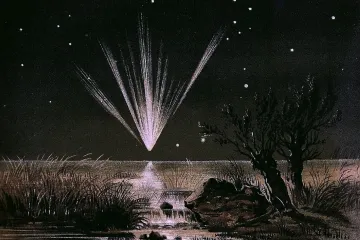
The presence of dust varies dramatically depending on the location. In the space between the planets—the interplanetary medium—dust is constantly present. [7] This material is responsible for a faint glow visible near the horizon on very dark nights, known as the Zodiacal Light, which is sunlight scattered off these near-Sun particles. [7] The dust found within our own Solar System is largely composed of debris ejected from asteroids and the icy material vaporizing off comets as they near the Sun. [3][5]
However, the dust that exists between star systems—the interstellar medium—is thought to be older and more pristine, having survived epochs of star formation and stellar processing. [1] This interstellar dust is sometimes so concentrated that it obscures the light from distant galaxies, acting as a cosmic curtain. [1] When we consider other stellar systems, dust discs are often observed orbiting young stars, signifying that planet formation is actively occurring around them, continuing the cycle that created our own world. [1]
# Vacuum Density
It is easy to imagine space as a thick, hazy fog if you focus too much on the word "dust," but this creates a misleading picture of density. Space, even within our solar system, is an extreme vacuum far emptier than any vacuum achievable in a laboratory on Earth. [2] If you could hold up a teaspoon volume of space near Earth, it would contain perhaps a few grains of this cosmic dust. [2] In the emptier interstellar medium, the density drops even further, sometimes equating to only one particle per cubic meter. [1]
This sparsity leads to a strange reality: you are not constantly being peppered by space grit. The concept of "dusting" in space is fundamentally flawed when compared to terrestrial experience. [2] For an astronaut or a spacecraft, the risk comes not from sheer quantity, but from the velocity of impact. These tiny specks strike spacecraft at incredibly high speeds, often exceeding tens of kilometers per second. [2] At those speeds, even a grain a fraction of a millimeter wide carries enough kinetic energy to cause significant damage, akin to being hit by a high-velocity projectile rather than gently settled dust. [2]
Considering the average distance between particles in the interplanetary medium, which, based on the few grains per teaspoon metric, translates to a spacing of many meters in any direction, it becomes clear that a human body or a spacecraft would pass through vast tracts of near-absolute nothingness between impacts. [2] The danger lies in the rare, high-energy collision, not a constant abrasive environment.
# Solar Story
The significance of cosmic dust extends far beyond its presence; it acts as a pristine historical record of the Solar System's formation. [5] When these particles reach Earth—either through atmospheric entry or by being collected directly by spacecraft—scientists can analyze their atomic structure and chemical composition. [4][5] This analysis allows researchers to work backward, tracing the dust's source material, the temperature history of the region where it formed, and the specific chemical reactions it underwent before becoming incorporated into planets. [5]
One leading researcher in this field, for instance, uses techniques to analyze the isotopic ratios within these grains to reconstruct the chronological narrative of solar system development, treating the dust as tangible samples of early solar nebula material. [5] By understanding the source of the dust, we gain insight into the mechanisms that governed the accretion of larger bodies like asteroids and planets. [5] The presence of certain inclusions, such as presolar grains—particles that predate the Sun’s formation—offers direct evidence of processes occurring in other stars before our Sun even ignited. [4]
# Sample Collection
Gaining direct knowledge about these particles requires physically capturing them. This is far more technologically challenging than simply sweeping up terrestrial dust due to the velocity issue mentioned earlier. [2] Missions like NASA's Stardust were specifically designed to intercept these fast-moving grains. [4] The Stardust spacecraft used a specialized collector made of aerogel, a substance that is mostly empty space, allowing the particle to slow down gradually within the collector material rather than instantly vaporizing upon impact. [4]
The collection process itself requires immense precision. Because the impact velocities are so high, the resulting crater or track left in the collector material often contains more chemical information about the impact event than the captured dust grain itself. [4] Recovering these minuscule targets from the aerogel matrix without contaminating or destroying them demands careful, often microscopic, forensic work in specialized laboratories. [4] This level of care emphasizes that the dust is not just present in space; it is a fragile, high-velocity archive waiting to be decoded by extremely patient scientists. [5] Understanding the history of accretion, from interstellar clouds to the formation of Earth, depends on successfully retrieving and analyzing these scattered remnants.
#Videos
How Cosmic Dust Reveals the Secrets of the Universe - YouTube
Related Questions
#Citations
Cosmic dust - Wikipedia
Be Glad You Don't Have to Dust in Space! - NASA Science
Clearing up the mystery of where space dust comes from - CORDIS
ELI5: With all of these debris like dust loating around in space, how ...
What Dust From Space Tells Us About Ourselves - Quanta Magazine
How Cosmic Dust Reveals the Secrets of the Universe - YouTube
Dust in space: 10 cool things to know - EarthSky
Relax Everybody — We're Living on a Speck of Dust Floating in Space
What is space dust, and can it create life? | World Economic Forum