Do rockets use fuel in space?
The simple answer to whether rockets still need fuel once they are already in the vast emptiness of space is an emphatic yes. While the dramatic visual of a launch vehicle battling Earth’s thick atmosphere is over, the vacuum of space presents a different, though equally demanding, set of challenges that can only be overcome by expelling mass at high velocity—the very definition of rocket thrust. [4][7] Once past the gravity well, a spacecraft doesn't just cruise forever on its initial momentum; it needs propellant to change direction, to correct its flight path over months-long journeys, or to actively maintain its orientation.
# Thrust In Vacuum
Rockets work by creating a reaction force based on Newton's third law: for every action, there is an equal and opposite reaction. [5][7] On Earth, many propulsion systems, like jet turbines or propellers, rely on air from the atmosphere as their "working fluid," which they accelerate backward to push the vehicle forward. [7] A rocket, however, carries both the fuel and the source of oxygen required for combustion—the oxidizer—meaning it carries its own working fluid. [4][7]
This fundamental difference explains why rockets function perfectly well, and in fact better, in the vacuum of space. [7] Without external air pressure pushing back on the engine nozzle, the exhaust gases can expand more fully, maximizing the efficiency of converting the thermal energy of combustion into directed kinetic energy. [4] Any maneuver in space—a course correction on a trajectory to Mars, a delicate orbit insertion around Jupiter, or simply pointing a satellite toward the Sun for power—requires firing the engines, which means consuming propellant. [1]
For example, a six-month trip to Mars involves a massive initial burn to leave Earth orbit, but the subsequent interplanetary cruise is largely "coasting." However, even this coast requires small, periodic expenditures of fuel, often referred to as attitude control or station-keeping maneuvers, to keep the craft pointed precisely where it needs to go. [1][3] For tasks like adjusting a satellite’s orientation, small thrusters often use a monopropellant like hydrazine, which decomposes to produce the necessary impulse, reliable for hundreds of tiny adjustments over years of service. [3]
# Propellant Defined
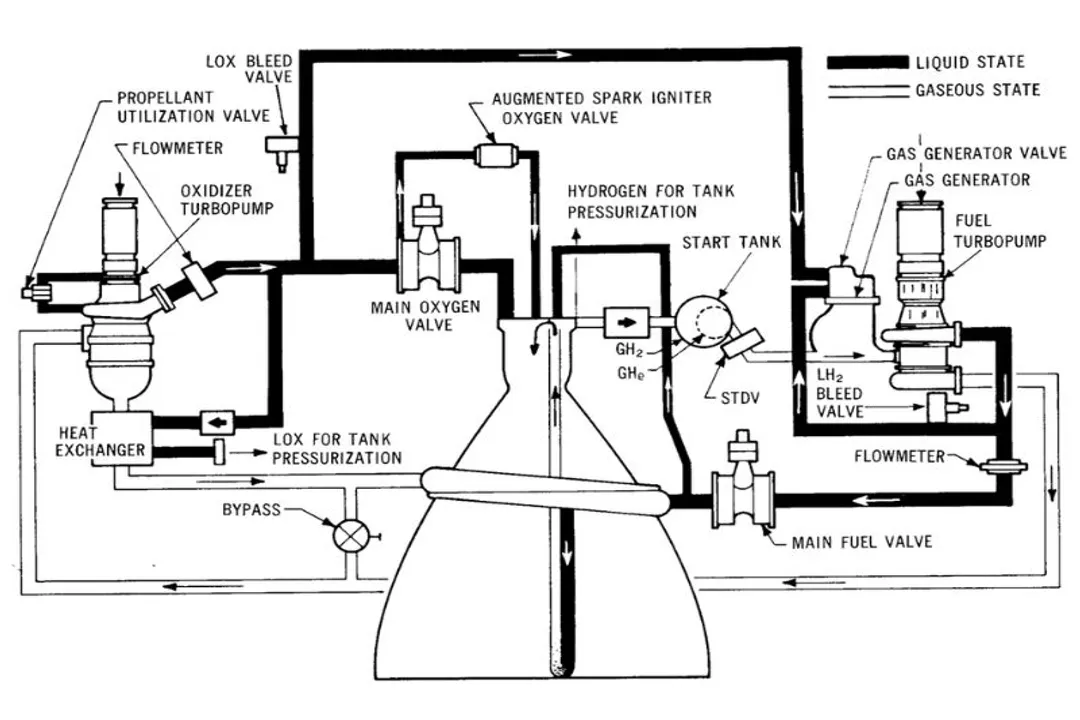
Rocket propellant is the reaction mass ejected from the engine to generate thrust. [4] In the most common type of propulsion system, the chemical rocket, the propellant mixture consists of a fuel (the reducing agent) and an oxidizer. [4][5] These are introduced into a combustion chamber, exploded, and the resulting hot, high-pressure gas is accelerated out of a nozzle. [4][7] The thrust generated is directly proportional to the propellant’s mass flow rate multiplied by its exhaust velocity, a measure closely related to specific impulse (), which quantifies propellant efficiency. [4]
The choice of what to burn is dictated by the mission. Chemical rockets use redox chemistry for energy release. [4] For launch vehicles lifting off from Earth, the lower stages often prioritize density and high thrust, even if efficiency () is slightly lower, because minimizing tank size helps overcome gravity drag early on. [4][8] Conversely, upper stages operating exclusively in the vacuum often select high-performance, low-density propellants like liquid hydrogen and liquid oxygen (LOX/LH2) because achieving high exhaust velocity is paramount once gravity is no longer the main adversary. [4]

# Fuel Varieties
The palette of rocket propellants is diverse, often grouped by the physical state of the fuel and oxidizer: solid, liquid, or hybrid. [4]
# Cryogenic Liquids
Liquid hydrogen () and liquid oxygen () are the champions of performance, offering the highest specific impulse. [8] The primary advantage is hydrogen's extremely low molecular weight. [5] However, this efficiency comes at a severe logistical cost: both components must be kept extremely cold (cryogenic) to remain liquid—hydrogen at and oxygen at . [5] This requires heavy, elaborate insulation and leads to boil-off, where the fuel naturally warms up and vaporizes over time, a significant challenge for long-duration missions like a trip to Mars. [8] Furthermore, hydrogen's low density means tanks must be enormous, increasing the dry mass of the vehicle. [4][8]
# Storable Liquids
Rocket-grade kerosene, known as , burned with (), is a historical workhorse. [3][5] It is liquid at room temperature and much denser than hydrogen, simplifying storage and allowing for smaller tanks. [5][8] While less efficient than , its ease of handling made it popular for early stages and reliable boosters like the Saturn V and Falcon 9. [8] A newer contender in this category is liquid methane (), often paired with (). Methane offers better performance than and burns cleaner, which is highly beneficial for designing reusable engines that must withstand multiple firings without soot fouling. [5][8]
# Hypergolics and Monopropellants
For maneuvering systems where long-term storage and reliability are more important than sheer power, hypergolic propellants are used. [3][8] These combinations, such as unsymmetrical dimethylhydrazine () and dinitrogen tetroxide (), ignite spontaneously upon contact, requiring no external ignition source. [8] This simplicity is ideal for orbital maneuvering systems that must fire reliably after years of dormancy, though they are notoriously toxic, a danger underscored by accidental astronaut exposure during an Apollo mission. [8] Simpler still are monopropellants like hydrazine, which decompose over a catalyst bed to produce thrust, often used for basic station-keeping thrusters due to their simplicity. [3][8]
# Inert Propellants
Rockets don't always have to rely on chemical explosions for energy. Ion thrusters utilize inert propellants, most commonly xenon gas. [4][3] These systems ionize the gas and accelerate the resulting ions using electric or magnetic fields. [4] They produce only a minuscule amount of thrust—think of the gentle pressure of a feather landing on your arm—but they do so with immense efficiency () over very long periods. This is perfect for fine orbital adjustments or long-duration, low-thrust interplanetary cruises, but completely inadequate for escaping a planet's gravity. [3]
# Engineering Nuances in Thrust Generation
It is easy to assume that the goal of a rocket engine is always to maximize the heat energy released, but the reality of performance in space involves a fascinating chemical trade-off. Rocket engineers rarely run a perfect stoichiometric mixture where the fuel and oxidizer are balanced for complete consumption. [4] Instead, most chemical engines are deliberately run fuel-rich. [4]
This might seem counterintuitive, as it means some fuel is ejected unburned, representing lost chemical potential energy. However, the reason this pays off lies in the exhaust molecular weight. [4] When a rocket engine nozzle converts the thermal energy of the combustion chamber into kinetic energy, it works most effectively on molecules that have fewer internal ways to store that heat (like rotation or vibration) and thus must convert more of it into forward motion (translation). [4] Combustion products like carbon monoxide () and diatomic hydrogen (), resulting from a fuel-rich burn, are much lighter than the fully oxidized products like carbon dioxide () and water (). [4] The large efficiency gain from having a lighter exhaust stream outweighs the penalty of unburned fuel, making a fuel-rich mixture the practical choice for maximizing exhaust velocity in the engine’s short passage through the nozzle. [4]
This optimization highlights a deeper engineering consideration when planning deep space missions. The choice between high-performance fuels like and more manageable fuels like methane isn't just about values on a chart; it’s about the physical volume they occupy. [8] For a mission requiring a large change in velocity (), the rocket equation dictates that the fuel mass fraction must be very high. [1] If we choose the high- liquid hydrogen, the required tanks become so large that the added structural mass of the tankage itself begins to negate the performance benefit, a demonstration of the equation’s tyranny. For a crewed mission requiring habitat mass and long-term reliability in transit, a slightly less efficient but significantly denser propellant like methane, which demands smaller, lighter tanks, often becomes the superior engineering choice, provided the mission profile allows for the slight penalty in exhaust speed. [4][8]

# Space Refueling
Given that missions require propellant for maneuvering, and that initial launches consume enormous quantities just to escape Earth, the concept of refueling in space becomes essential for long-term exploration and sustainability. [1] If a vehicle uses its main fuel supply to reach Mars orbit, it needs a new supply to return or to move elsewhere in the solar system.
The challenge is significant, particularly for the high-performance cryogenic fuels like and . Storing these fuels for extended periods is plagued by boil-off, where the fuel heats up and vents away, or requires heavy, power-consuming refrigeration systems to keep the fuel liquefied. [8] While ground crews can top up tanks right before launch, direct tank-to-tank transfer of cryogenic propellant between spacecraft in orbit has not yet been fully demonstrated or tested in real-world conditions, though NASA has tested the necessary tools and thermal management systems, such as those used in the Robotic Refueling Mission and Zero Boil-off Tank (ZBOT) experiments.
# Long Term Use
The question of whether humanity will eventually exhaust the Earth’s supply of fuel by launching rockets also pertains to in-space operations. When a rocket burns propellant during Earth ascent, most of the mass is converted into atmospheric exhaust products, like water vapor, which essentially returns to the Earth system. [1] The mass lost to deep space is only the small fraction used for course corrections and maneuvers after achieving orbit. [1]
The true long-term solution for sustainable space exploration does not rely solely on resupplying from Earth. Instead, it focuses on In-Situ Propellant Production (). [4] This strategy involves manufacturing propellant from local resources found off-world. [7][8] For example, water ice is abundant on the Moon, on Mars, and in comets. Electrolyzing water separates it into liquid hydrogen () and liquid oxygen (), the most efficient chemical propellants. [3][7] Methane, another highly regarded propellant, can be synthesized on Mars using atmospheric carbon dioxide and hydrogen via the Sabatier process. [8] By establishing propellant depots in orbit or on other celestial bodies, spacecraft can be fueled for return trips or further exploration without having to haul all that reaction mass off Earth’s surface every time. [1][5] This utilization of extraterrestrial resources is considered a prerequisite for powerful, ongoing space exploration because it shifts the logistical burden off-planet. [7][8] Ultimately, while rockets do use fuel in space, where that fuel comes from—and whether it can be regenerated—will define the limits of our reach into the solar system. [1]
#Videos
What Do Rockets Use As Fuel? | Neil deGrasse Tyson Explains...
Demonstrating Rocket Fuel Transfer in Space - YouTube
Related Questions
#Citations
Rocket propellant - Wikipedia
What is rocket fuel and how do we get it? : r/askscience - Reddit
A Quick Guide to Rocket Fuel - Rexarc
What Do Rockets Use As Fuel? | Neil deGrasse Tyson Explains...
Rocket Propulsion
Rocket Physics, Extra Credit: Rocket Fuels
fuel - Sending rockets to space will eventually consume all of our ...