What are the units used in space?
The vastness of space necessitates a language of measurement far beyond the familiar feet, miles, and pounds of daily life. While the International System of Units (SI) provides the universal bedrock for science, the sheer scales involved in astronomy—from planetary orbits to intergalactic voids—demand specialized units that make the numbers manageable and meaningful. [1][3] To discuss the cosmos coherently, astronomers employ a system built upon fundamental physical standards, but adapted for cosmic convenience. [4]
# Metric Basis

Even when dealing with the colossal, the standard SI units remain the foundation. For length, the base unit is the meter (), defined originally based on the distance from the Earth's pole to the equator through Paris. [1] Mass uses the kilogram (), historically linked to the mass of one liter of water, and time uses the second (). [1] From these base units, derived units like the meter per second () for speed or the Newton () for force are established. [1]
However, using these base units for space travel or distant objects quickly leads to unwieldy strings of zeros. [3][5] For instance, the distance from the Earth to the Sun, a relatively short span in cosmic terms, becomes $149,597,870,660$ meters or approximately $150$ million kilometers (). [2][7] Expressing the distance to Neptune in kilometers would involve numbers that hinder quick comprehension. [1]
# Solar System Yardstick
To simplify measurements within our own solar neighborhood, astronomers rely on a unit derived directly from our cosmic address: the Astronomical Unit (). [3][5]
# Defining the AU
The Astronomical Unit () is formally defined as the average distance between the Earth and the Sun. [2][6][7] Since $2012$, the IAU has set this unit as an exact value: $149,597,870,700$ meters. [7] Before this precise definition, it was based on the radius of an unperturbed circular orbit for a hypothetical infinitesimal mass particle around the Sun. [7] The is incredibly handy because it anchors all other solar system distances to Earth's orbital path, making relative distances immediately intuitive. [2][3] For example, if Jupiter orbits at , we instantly know it orbits about five times farther out than we do. [2][4]
Planetary distances are thus compressed nicely:
- Mercury is about from the Sun. [1]
- Pluto (out past the main planetary zone) averages about . [2]
- Neptune orbits at roughly . [1]
Even the extent of the solar system, where the Sun's gravitational influence dominates, can be summarized in s—estimates place this boundary around . [1] While a light-minute (the distance light travels in one minute) is also sometimes used for solar system scales, the remains the conventional reference for planetary orbits. [9]
# Interstellar Measures
When we cross the gulf between stars, the begins to generate large numbers again, prompting the adoption of units based on the speed of light. [1][9]
# Light Travel Distance
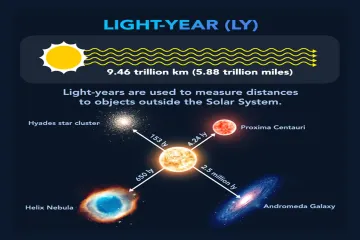
The Light-Year () is defined as the distance light travels in a vacuum over the span of one Earth year. [2][3][9] It is a unit of distance, not time, despite its name—a crucial distinction many people miss. [4][9] A light-year equates to approximately $6$ trillion miles, or about . [1][2]
This unit becomes practical immediately when observing the nearest star system outside our own:
- Proxima Centauri is roughly $4.25$ light-years away. [1] This means the light we see from it left the star over four years ago, offering a glimpse into the past. [4]
The scale shift is significant. Using the figure of for Proxima Centauri seems abstract, but communicates the vast, time-delayed reality of interstellar space more directly. [1]
# Parallax and Parsecs
For professional astronomers charting the structure of our galaxy and beyond, another unit often takes precedence: the parsec (). [1][4] The word itself is a contraction of parallax and arcsecond. [1]
Parallax is the apparent shift in a star's position against more distant background stars as the Earth moves in its orbit around the Sun. [1][8] An arcsecond is an extremely small angular measurement—one-sixtieth of a degree across the sky, making it th of the sky's total width. [1] A parsec is defined as the distance to a star that exhibits a parallax shift of exactly one arcsecond over six months. [1][8] This definition links the unit directly to observational geometry, making it indispensable for triangulating stellar distances. [2][4]
The relationship between these interstellar units is:
While the definition of the parsec is mathematically linked to geometry, which some find cumbersome compared to the conceptual ease of a light-year, it is mathematically popular among researchers. [1] For example, Proxima Centauri, at $1.3$ parsecs, is a slightly smaller number than its $4.25$ light-year equivalent. [1]
# Galactic and Intergalactic Scales
When moving beyond nearby stars to measure distances across the Milky Way or to other galaxies, astronomers use larger multiples of the parsec:
The center of our own Milky Way is roughly $30,000$ light-years away, translating to about $9,200$ parsecs or . [1] For intergalactic separation, such as the distance to the Andromeda Galaxy (about $2.5$ million light-years), the megaparsec becomes the unit of choice—Andromeda is about $0.766$ megaparsecs away. [1] For the most distant objects, like the edge of the observable universe, distances reach , or $46.5$ billion light-years, though these extreme scales often lead to measurements expressed via redshift, which relates to the expansion of spacetime itself. [4]
# Mass and Time Equivalents
The necessity for specialized units isn't limited to distance; mass and time measurements also require astronomical calibration. [4][7]
# Astronomical Mass
On Earth, we use kilograms or pounds, but these are utterly impractical for comparing stars or galaxies. [1]
- Earth Mass ( or ): This unit, representing the mass of our home planet (), is excellent for sizing rocky exoplanets. [4][1] A hypothetical world is easy to conceptualize relative to Earth. [1]
- Jupiter Mass ( or ): Used for gas giants and massive exoplanets, one Jupiter mass is about $318$ times that of Earth. [1][4]
- Solar Mass (): This is the standard unit for measuring stars and larger structures. [1][7] One solar mass is approximately $333,000$ times Earth's mass. [4] The Sun itself represents . Astronomers describe the supermassive black hole at the Milky Way's center as being about $4.3$ million . [1]
It strikes one as slightly odd that astronomers have readily defined units based on the Earth and the Sun for mass, yet stop at the Sun's mass () as the standard reference, never creating a "Milky Way Mass" unit, likely due to the difficulty in measuring the galaxy's total mass accurately from our internal vantage point. [1]
# Astronomical Time
In the formal Astronomical System of Units, the base unit of time adopted is the day (), defined as exactly $86,400$ seconds. [7] This leads to the Julian year, defined as $365.25$ days. [7] The light-year is a distance derived from this temporal measure—the distance light travels in one Julian year. [7] This choice of the day as the fundamental unit simplifies celestial mechanics calculations compared to constantly converting between seconds and Earth years. [7]
# Comparative Scale Summary
To grasp how these units stack up, it is helpful to see their ratios—the trade-off between the convenience of the number and the standardization of the unit is always present. [1][8]
Here is a comparison of the major distance units, keeping the Astronomical Unit () as the base reference:
| Unit | Abbreviation | Approximate Value in | Context of Use |
|---|---|---|---|
| Astronomical Unit | $1$ | Solar System distances | |
| Light-Minute | N/A | Light-travel time from Sun to Earth is light-minutes | |
| Light-Year | Interstellar distances | ||
| Parsec | () | Stellar/nearby galactic distances (based on parallax) |
It is worth noting that while the is defined by Earth's orbit, the parsec is derived from geometric observation of that same orbit. This means the parsec is inherently tied to the Earth's perspective, much like the , even though it describes distances far outside the Solar System. [1] This reliance on Earth's orbital parameters for defining units across different scales, from the inner planets to nearby stars, reveals a practical, though perhaps anthropocentric, approach to charting the universe. [1] When we see a distance quoted in , we get an immediate, if vague, sense of "Solar System scale," whereas a light-year instantly signals "interstellar scale," even if the exact conversion is momentarily forgotten. [8] This utility of scale reference often trumps strict adherence to only SI units for general astronomical communication. [5]
#Videos
Units in Astronomy: Explained! - YouTube
Related Questions
#Citations
Basics of Spaceflight: Units of Measure - NASA Science
Units for Distance and Size in the Universe
Astronomical system of units - Wikipedia
Units in Space - Museum of Science
Units in Astronomy: Explained! - YouTube
What is an Astronomical Unit? | Cool Cosmos
0.3: Special Units Used in Astronomy - Physics LibreTexts
What is the Astronomical Unit? | Science Guys - Union University