Why do astronomers use astronomical units AU instead of kilometers/km?
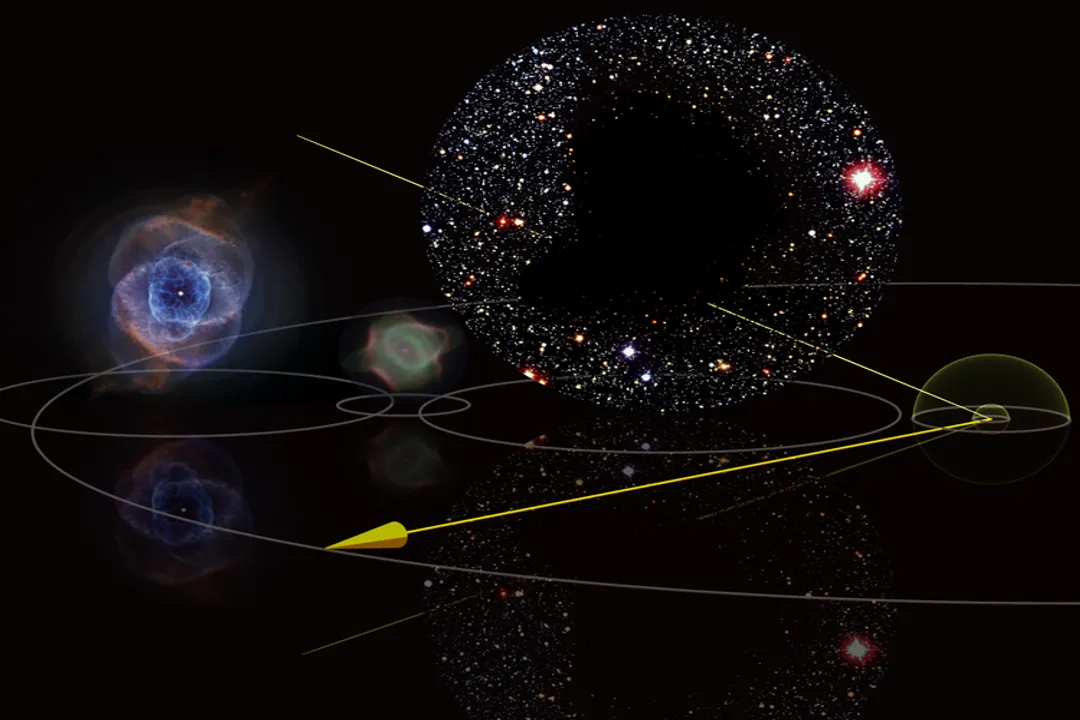
The sheer scale of the cosmos forces scientists, especially astronomers, to adopt specialized measuring sticks for distances. When we talk about the gap between Earth and the Sun, or between the Sun and Jupiter, quoting the separation in kilometers quickly becomes cumbersome and frankly, unhelpful for grasping the true scale involved. [2][8] Imagine trying to describe the distance to the next city not in miles or kilometers, but in millimeters—it just clouds the picture. This is precisely why the Astronomical Unit (AU) exists as the preferred yardstick within our own solar system. [2][9]
# Defining the AU
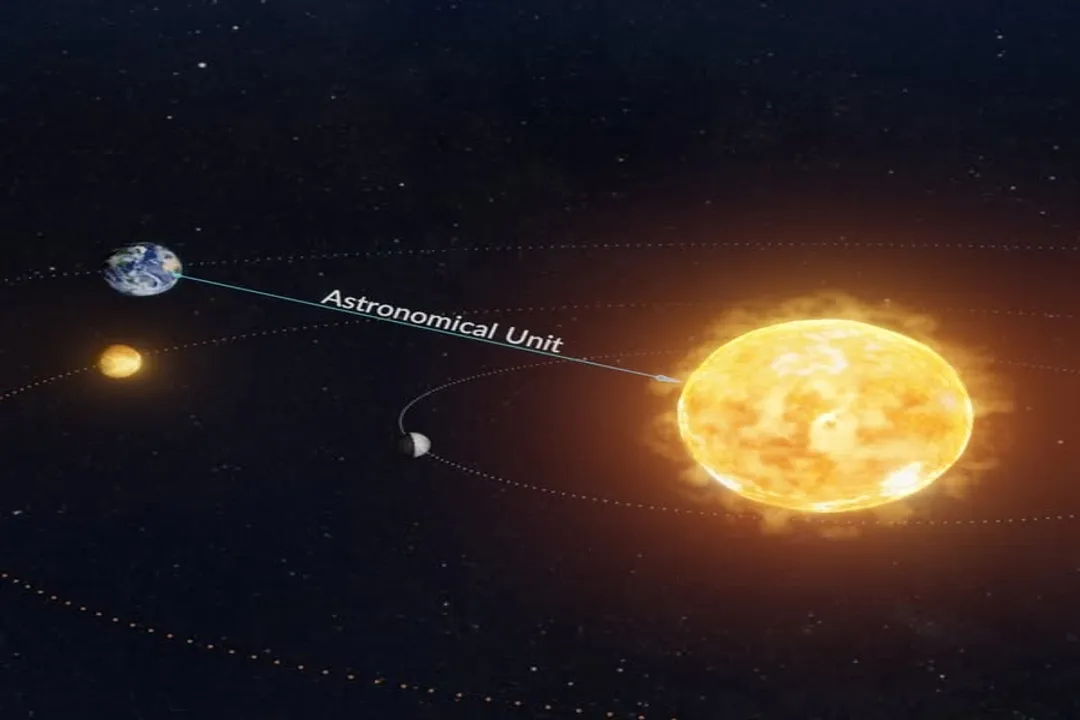
At its heart, the Astronomical Unit is a unit of length based on a familiar, fixed point in our celestial neighborhood: the Earth-Sun separation. [7][9] Specifically, one AU is defined as the average distance between the center of the Earth and the center of the Sun. [6][7] This average is critical because planetary orbits are not perfect circles; they are ellipses. [6] Earth gets slightly closer to the Sun during part of its orbit (perihelion) and slightly farther away at its furthest point (aphelion). [6] The AU smooths out these variations, providing a stable, easily referenced baseline for mapping our solar system. [9]
Historically, the precise value of the AU was determined through painstaking observational geometry, often involving tracking transits of Venus across the Sun's face. [6] Today, our measurements are far more accurate, leading to an internationally agreed-upon, fixed value. The International Astronomical Union (IAU) has set the modern definition to be exactly 149,597,870,700 meters. [6] This number, being a defined constant, eliminates the tiny, unavoidable uncertainties that came from relying purely on observational estimates of Earth’s orbit. [6]
# Kilometer Clutter
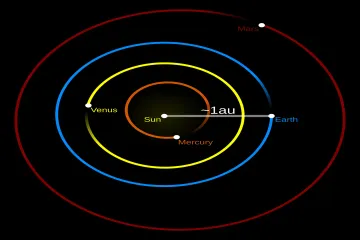
To truly appreciate the shift to AU, one must confront the numbers involved when using kilometers. The distance from the Earth to the Sun—that one perfect AU—is approximately 149.6 million kilometers. [5][9] That's a number with eight digits before the decimal point. When we look outward, the numbers just balloon. Mars is roughly $1.5$ AU away, which translates to about $228$ million km. Jupiter sits further out, averaging about $5.2$ AU, equating to over $778$ million km. [5] Saturn follows at over $1.4$ billion km away. [5]
If every textbook, every calculation, and every spoken reference to these distances had to include strings of zeros like , communication would become slow, error-prone, and frankly, difficult to memorize. [3] Think about a researcher trying to quickly compare the orbital radius of a newly discovered Kuiper Belt object to that of Neptune. Reading out "$4.5$ billion km" versus "$30.1$ AU" immediately shows the relative distance from the Sun in a far more intuitive way. [2] The AU simplifies scale perception.
It’s similar to why we use the speed of light () instead of quoting everything in meters per second. When dealing with interstellar distances, even the AU becomes too small; we switch to light-years or parsecs, just as we switch from kilometers to AU for interplanetary travel. [4][10]
# Conceptual Simplification
The benefit of the AU extends beyond avoiding long strings of digits; it creates a standardized, scale-aware system for the solar neighborhood. [2] Consider this comparison:
| Celestial Body | Distance from Sun (AU) | Distance from Sun (Million km) |
|---|---|---|
| Mercury | ||
| Earth | ||
| Jupiter | ||
| Pluto (dwarf planet) |
Look at the relationship between Jupiter and Earth using the AU column. Jupiter is about five times farther from the Sun than Earth is (). [8] To get that same ratio using kilometers, you’d calculate , which requires carrying out the division every single time you want to compare scales. [8] The AU allows for direct ratio comparison by simply looking at the numbers. [2] This immediate insight into relative distance is invaluable for quick checks and for teaching basic solar system structure. [3]
# Precision and Evolution
While the AU is primarily a tool for convenience and conceptual comparison, its modern definition also speaks to the increasing need for precision in space exploration. [6] Early astronomers could only estimate the Earth’s distance. Now, with techniques like radar ranging to Venus and Mars, we can measure interplanetary distances with incredible accuracy. [6] By defining the AU as an exact integer number of meters (), astronomers ensure that any measurement expressed in AU carries the same level of fundamental accuracy, regardless of when the measurement was taken or by whom. [6]
This fixed definition is crucial for missions like those sent to the outer planets or asteroids. When calculating a trajectory for a probe needing a precise arrival window millions of kilometers away, using a fixed, defined base unit like the AU ensures all parts of the navigation calculation start from the same, unvarying foundation. [3]
# Contextual Scaling
The AU is fantastic for the inner and middle solar system—out to the orbit of Neptune or perhaps a bit further into the Kuiper Belt. [10] However, when we cross the heliopause and start examining distances to other stars, even the AU becomes too small to manage effectively. [4][10] For example, Proxima Centauri, the nearest star to our Sun, is about $4.24$ light-years away. If we converted that distance to AUs, we would need a number roughly 268,000 AU. [4]
This illustrates a fundamental principle in scientific measurement: you always choose the unit that results in a manageable number, typically between $0.1$ and $100$. Using AU for Proxima Centauri would be like using inches to measure the distance between continents—technically correct but absurdly impractical. [4][10] Astronomers seamlessly shift from kilometers to AU for planets, then from AU to light-years or parsecs for stars and galaxies. [10]
If you ever look at a diagram showing the solar system, try this mental exercise: Imagine the Earth is located at the $1$-mile marker on a road trip. The Sun would be right next to you at the $0$-mile marker. Mars would be sitting around the $1.5$-mile marker. But Saturn would be out near the $9$-mile marker, and Pluto would be roughly $39$ miles away. Suddenly, the solar system feels less like an infinite expanse and more like a very large, but navigable, neighborhood measured in "Earth-to-Sun-lengths". [5]
Ultimately, the Astronomical Unit is a prime example of applied scientific pragmatism. It turns unwieldy, massive kilometer figures into concise, relative numbers that mirror the very structure of our solar system, making the math easier, the concepts clearer, and the immense distances understandable. [2][3]
Related Questions
#Citations
Why do astronomers use astronomical units (AU) instead of ... - Brainly
Why do astronomers use astronomical units (AU) to express ... - Quora
Why do scientists use specialized units for distance when metric ...
Distance - | The Schools' Observatory
How is an Astronomical Unit (AU), which is equal to the distance ...
Astronomical unit - Wikipedia
Star Walk - Facebook
Why do astronomers use Astronomical Units (AU) instead of ... - Gauth
What is an astronomical unit? - EarthSky
Units for Distance and Size in the Universe