Why do astronomers use AU instead of km?
Vast Distances
Trying to describe the scale of space using everyday units like kilometers or miles quickly becomes an exercise in managing impossibly long strings of zeroes. When we talk about the distances between planets, or even the distance to the nearest star, the sheer magnitude of the numbers involved makes meaningful communication clumsy and prone to error. [2][7] This is precisely why astronomers rely on specialized units tailored for the cosmic realm. For objects within our own solar system, the standard bearer is the Astronomical Unit, or AU. [10]
The kilometer, while the bedrock of the metric system here on Earth, simply isn't practical when dealing with the vast gulfs separating celestial bodies. [7] Consider the distance between the Earth and the Sun. If we measure this span in kilometers, we arrive at approximately 150 million kilometers. [4][10] While that number is large, it’s manageable. However, when we start talking about objects much further out, like Neptune, those kilometer figures stretch into the billions, demanding many digits just to state the distance. [9] This complexity invites transcription mistakes and makes quick comparisons between orbits tedious for anyone who isn't a professional calculator. [2]
# Defining AU
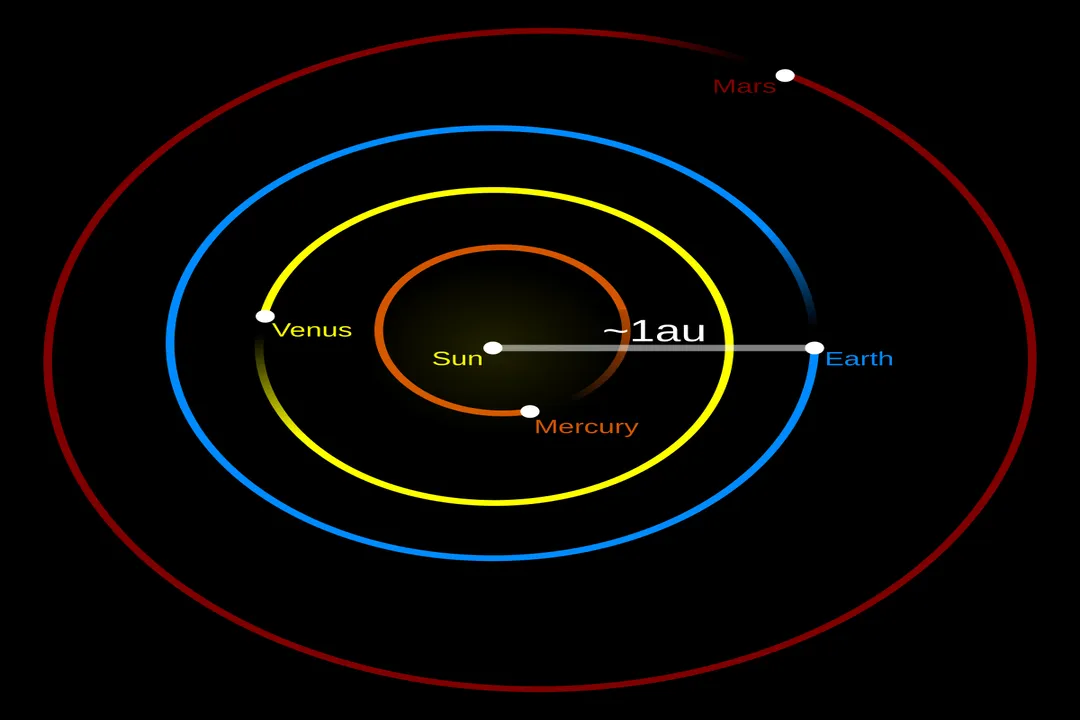
The Astronomical Unit was established as a convenient shortcut based on the average distance between the Earth and the Sun. [8][10] It takes that massive, 150-million-kilometer figure and declares it to be exactly one AU. [4] The value is fundamentally anchored to our home planet's orbit. [10]
Historically, the value was derived through observation and geometry, often using transits of Venus across the Sun's face to calculate the Earth-Sun separation with greater accuracy than previously possible. [8] For centuries, this created an approximation that was 'good enough' for the science of the day. Today, with modern instruments and spacecraft tracking, the precise definition has been solidified. Since 2012, the AU has been fixed as an exact length: 149,597,870.7 kilometers. [4] This fixed definition allows for absolute precision in calculations without needing to constantly reference a changing or slightly imprecise orbital measurement. [4]
Think of it like this: when measuring the height of a standard door, we don't usually say it is 2,133.6 millimeters tall; we say it is about 2.1 meters tall. [2] The AU serves the same purpose for interplanetary travel—it brings the numbers down to a manageable, human-scale comparison relative to our own planetary baseline. [3] If Earth is distance from the Sun, and Mars is , calculating the distance between them is simply in AUs, rather than subtracting two immense kilometer values and losing precision in the process. [2]
When we consider how quickly light travels—about 300,000 kilometers per second—even light itself takes a noticeable time to cross one AU. Light from the Sun reaches Earth in about 8 minutes and 20 seconds. [10] If we state distances in AUs, the time it takes for signals or light to travel across our solar system remains relatively compact when talking about orbital relationships. For example, Jupiter orbits at roughly . [9] If we were to express Jupiter's distance purely in light travel time, we'd say light takes about 43 minutes to get there. Expressing it as is concise, and the conversion to a time unit (like minutes) is straightforward for those familiar with the base unit. [10]
# Solar Context
The primary utility of the AU is overwhelmingly restricted to the realm of our Solar System. [9] It is the perfect ruler for measuring distances between the Sun and planets, or between the planets themselves. [2]
To illustrate the sheer reduction in numerical complexity, consider the approximate distances of a few major bodies from the Sun:
| Celestial Body | Distance (Approximate km) | Distance (Approximate AU) |
|---|---|---|
| Earth | 150,000,000 km | |
| Jupiter | 778,000,000 km | |
| Saturn | 1,430,000,000 km | |
| Pluto (dwarf planet) | 5,900,000,000 km | |
| [9][4] |
Notice how the kilometer figures require an increasing number of zeroes, while the AU values remain relatively small integers or simple decimals. This makes comparison intuitive. Moving from Jupiter () to Saturn () means the distance increased by about , which is far easier to conceptualize and calculate than subtracting $778$ billion kilometers from $1.43$ trillion kilometers. [2]
This principle extends to spacecraft navigation as well. Missions sent to the outer solar system, such as the Voyagers or New Horizons, report their position relative to the Sun in AUs because it provides mission control and the public with an immediate, scaled understanding of how far the probe has ventured from the central star. [9] If you read a report stating Voyager 1 is over from the Sun, you instantly know it is far outside Pluto's typical orbit (), placing it deep in the Kuiper Belt or beyond, without needing to recall the precise value of one kilometer in scientific notation. [4][9]
# Scale Boundaries
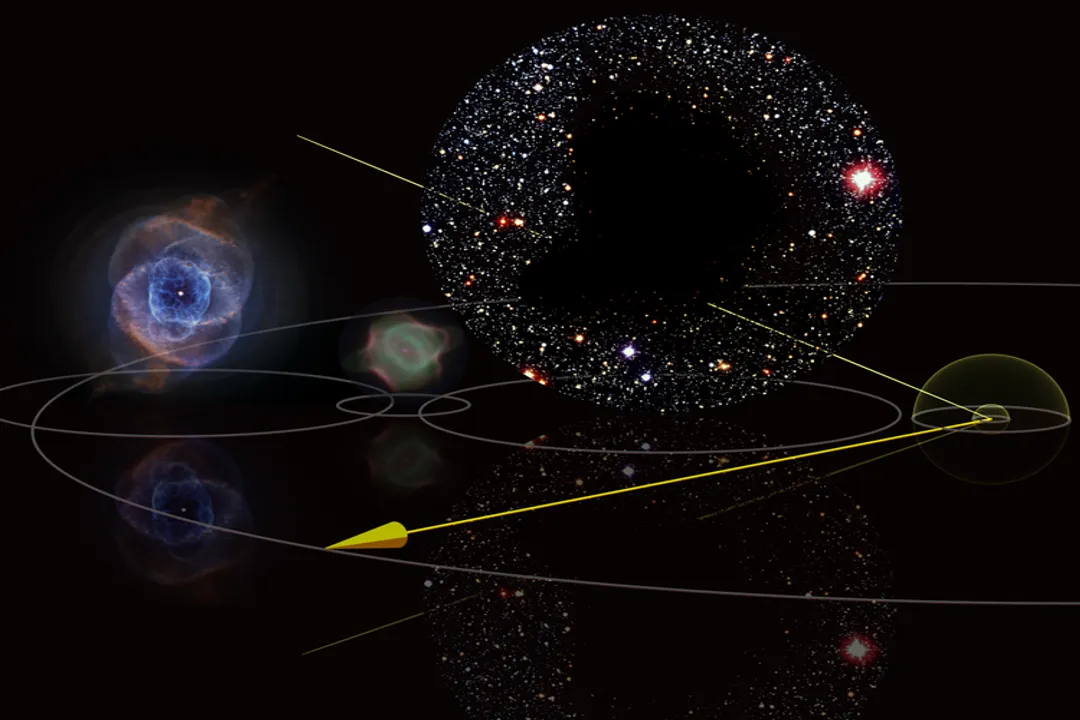
While the AU is superb for local measurements, it quickly fails when we look outside our own planetary neighborhood. Trying to measure the distance to the nearest star, Proxima Centauri, using AUs would yield a number that is once again too large to be convenient. [6] Proxima Centauri lies about $4.24$ light-years away. [6]
This leads to the need for even larger units when discussing interstellar or intergalactic space. [5][6]
- Light-Year: This unit measures the distance light travels in one Earth year. It is an immense distance, roughly . [6] Using a light-year, Proxima Centauri is only $4.24$ units away, a much cleaner expression than its equivalent in AUs or kilometers. [6]
- Parsec: Often used by professional astronomers, a parsec is equivalent to about , or $3.26$ light-years. [6]
For example, measuring the distance to the Andromeda Galaxy in AUs would result in a number so large it would be functionally unusable. Therefore, astronomers choose the unit that best fits the scale of the objects being discussed. [5][7] The AU is the right tool for the solar system job, but it is the wrong tool for galactic neighbors. [6]
If we were to create a universal distance scale based only on kilometers, we would constantly be switching between scientific notation ( for Earth-Sun) and very large whole numbers ( for Proxima Centauri). [7] Using the AU provides a base unit that makes Solar System distances integers, and then switching to the light-year makes nearby stellar distances integers, offering clarity at every level of magnitude. [6]
# Definition Changes
Another subtle complexity that reinforces the use of fixed, defined units rather than observational ones relates to the historical precision of the AU itself. [4] Before space probes and extremely precise radar measurements, the exact value of the Earth-Sun distance relied heavily on optical measurements, which carried inherent, small errors.
Early attempts to determine the distance were good, but not perfect. [8] As technology improved, the accepted value for the AU was refined downward slightly over time. Since the 2012 redefinition, however, the value is no longer determined by observation; it is a defined constant set to exactly. [4] This standardization is critical for modern science. When an orbital maneuver is calculated to bring a probe to a target based on a rendezvous point, that 5.0000 must translate perfectly and identically into kilometers for every space agency involved, regardless of their current observational methods. [4] This shift from a measured quantity to an established standard is a hallmark of mature scientific fields dealing with grand scales. [7]
Related Questions
#Citations
Why do astronomers use astronomical units (AU) instead of ... - Brainly
Why do astronomers use astronomical units (AU) to express ... - Quora
How is an Astronomical Unit (AU), which is equal to the distance ...
Astronomical unit - Wikipedia
Distance - | The Schools' Observatory
Clear, friendly guide to AU vs light-year vs parsec with real ...
Why do scientists use specialized units for distance when metric ...
What is the Astronomical Unit? | Science Guys - Union University
Cosmic Distances - NASA Science
What is an astronomical unit? - EarthSky