How do astronomers measure the size of planets?
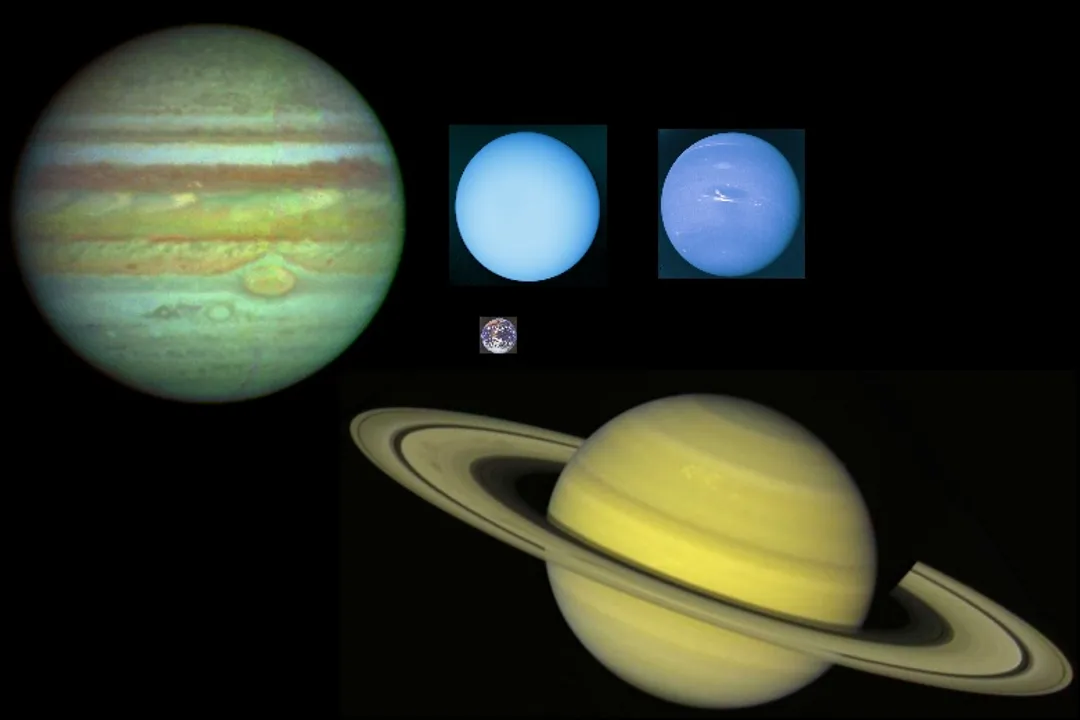
Determining the physical dimensions of a planet, whether it orbits our Sun or a star light-years away, requires more than just seeing it through a telescope. It involves applying fundamental principles of geometry, physics, and a careful progression of distance measurements stretching across the universe. The methods used depend heavily on whether the planet is a familiar neighbor in the Solar System or a distant exoplanet whose light we can only detect indirectly. [5]
# Angular Size
For objects within our own stellar neighborhood, the measurement relies on basic trigonometry. If an astronomer can accurately determine two things—the planet's physical distance from Earth and its angular size (how wide it appears in the sky, usually measured in arcseconds)—the actual diameter can be calculated. [2][5][7] The angular size is a measure of how large an object appears relative to its distance. [5]
This geometric relationship can be expressed using the small-angle formula, which essentially relates the physical diameter of the object to the distance multiplied by its angular diameter expressed in radians. [5] For the outer planets like Jupiter or Saturn, pre-spacecraft methods focused on obtaining the best possible angular measurements using telescopes and specialized instruments like micrometers to gauge the apparent width across the planet's disk. [7] While this approach works well when a planet is resolved as a disk, it becomes impossible for distant exoplanets, which appear merely as pinpricks of light or, more often, only register as a slight change in a star's brightness. [1]
# Distance Prerequisite
The critical component underpinning the angular size method is knowing the distance with extreme accuracy. [6] If the distance measurement is off by a small percentage, the resulting calculated physical size of the planet will be off by the exact same percentage [Original Insight 1]. Because of this sensitivity, establishing planetary distance requires reliable steps along the Cosmic Distance Ladder. [3]
The distance ladder is a series of overlapping techniques used to measure increasingly vast cosmic separations. [3] For relatively nearby objects like the Moon or planets, methods involving radar ranging or parallax provide precise baseline measurements. [6] However, extending this ladder to measure farther stars, whose light carries the signature of orbiting exoplanets, requires careful calibration at every rung. [3] An error in the distance to a nearby star used as a reference point will propagate outward, affecting the size determination for any planets observed transiting it.
# Transit Photometry
When dealing with exoplanets—worlds orbiting other stars—astronomers cannot resolve them as disks; therefore, the angular size method is unavailable. [1][2] Instead, the most common technique for sizing these worlds is the transit method. [1][2][5]
This method involves meticulously monitoring the brightness of a host star over time. [2] If a planet happens to pass directly between its star and Earth (a transit), it blocks a small fraction of the star's light. [5] The amount of light blocked is directly proportional to the ratio of the planet’s cross-sectional area to the star’s cross-sectional area. [1][2]
The result of a transit measurement is not the planet's absolute size, but its size relative to its star. [2] If a planet blocks $1%$ of the star's light, its diameter is approximately th the diameter of the star. [1] To convert this relative measurement into an absolute physical size, such as kilometers or Earth radii, astronomers must independently determine the actual physical size of the host star. [2] Stellar characterization often involves analyzing the star's spectral type, temperature, and luminosity, allowing scientists to estimate its radius using stellar evolution models. [2]
# Comparing Measurement Inputs
The differences between measuring Solar System bodies and exoplanets highlight distinct areas of expertise in observational astronomy. For planets we can see directly, the challenge lies in obtaining exceptionally precise angular measurements and calibrating the distance base points. For exoplanets, the challenge shifts to ultra-precise photometry and the accurate modeling of the host star [Original Insight 2].
| Measurement Scenario | Primary Observable Data | Key Geometric/Physical Requirement | Result Yields |
|---|---|---|---|
| Solar System Planet | Angular Diameter (Arcseconds) | Accurate Distance (via Radar/Parallax) | Physical Diameter (e.g., km) [5][7] |
| Exoplanet | Light Dip Fraction () | Accurate Stellar Radius | Planet Radius relative to Star Radius [2] |
# Mass and Density Relationship
While this focuses on size (radius), it is worth noting that a full characterization of a planet—especially an exoplanet—requires knowing its mass as well. Mass is often determined through the radial velocity method, which measures the star's slight wobble caused by the planet's gravitational tug. [1] Once both the mass (from gravity) and the radius (from transit) are known, astronomers can calculate the planet's density. [1] Density provides crucial insight into the planet's composition; a low-density world is likely a gas giant, whereas a high-density world suggests a rocky composition. [1] A highly accurate radius measurement is thus an essential stepping stone toward understanding what the planet is actually made of, moving beyond just its physical dimensions.
# Scaling the Solar System
For context regarding scale, sometimes the sheer size differences are best understood through analogies. When trying to grasp the scale of our own Solar System, some educational approaches involve creating scale models. [10] Even when scaled down drastically, the relative sizes remain vast. For instance, if Jupiter were scaled to the size of a large beach ball, Earth would only be about the size of a marble or a small grape, illustrating how different the giants are from the terrestrial worlds, even at an accessible scale. [10] This exercise reinforces that the size measurements, whether derived from trigonometry for Jupiter or photometry for a distant 'hot Jupiter,' are dealing with numbers that defy everyday intuition. [10]
#Videos
How Do People Measure Planets & Suns? - YouTube
How do we know the size of the Solar System? - YouTube
Related Questions
#Citations
How do scientists calculate the size of planets and stars only by ...
How do astronomers measure the size of planets?
Cosmic distance ladder - Wikipedia
How Do People Measure Planets & Suns? - YouTube
Determining Planet Properties - Astronomy Notes
How Do You Measure the Distance to the Moon, Planets, Stars and ...
Before spacecraft, how did astronomers study the giant planets?
How is the size of the planets measured? - Quora
Make a Scale Solar System – Math Project | NASA JPL Education