Is Venus the only planet that goes clockwise?

The common narrative circulating about our solar system often singles out Venus as the lone exception, the planet that dares to spin in the opposite direction—clockwise. This assertion is close to the truth, capturing the essence of Venus’s unique rotational behavior, but it overlooks a more dramatic outlier and ignores the specific frame of reference required to even make such a judgment. It is more accurate to say Venus exhibits retrograde rotation, meaning it spins opposite to the vast majority of other major planets in our solar neighborhood. [2][6]
To truly understand this, we must first establish the cosmic convention. When astronomers discuss planetary rotation, they typically adopt a standard perspective: looking down onto the solar system from above the Sun's North Pole. [6] From this vantage point, most planets, including Earth, rotate prograde, which appears as a counter-clockwise spin. [1][5] Venus, however, rotates in the opposite sense, appearing to move clockwise, giving it the distinction of having a retrograde spin. [2][6] This behavior is precisely what sparks the curiosity, suggesting some massive, history-altering event reset its spin long ago. [3][5]
# Rotational Reference Frame
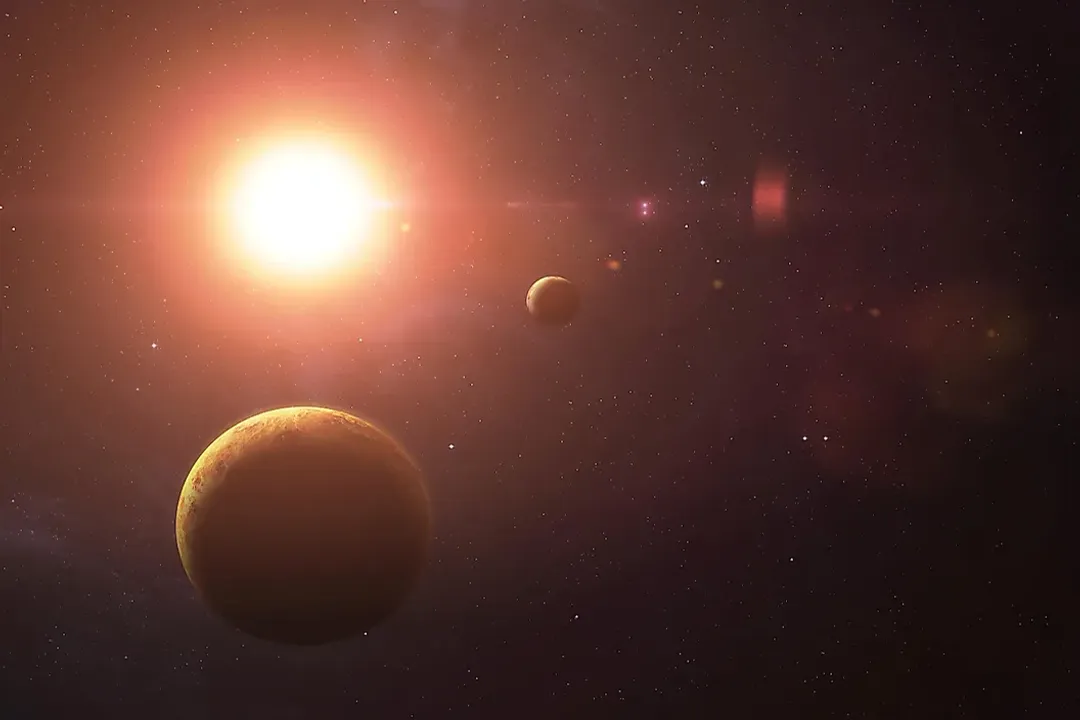
The designation of "clockwise" or "counter-clockwise" isn't an inherent quality of a planet; it is entirely dependent on the observer's angle. [2] If one were magically transported to the "south" pole of the solar system and looked "up," all the planets would appear to reverse their spin direction relative to the standard. [6] Therefore, when we state that Venus spins clockwise, we are applying the standard definition where prograde is counter-clockwise. This places Venus in a minority group, but it is not alone in having an unusual axis or spin relative to the others. [2]
# Venusian Time Warp
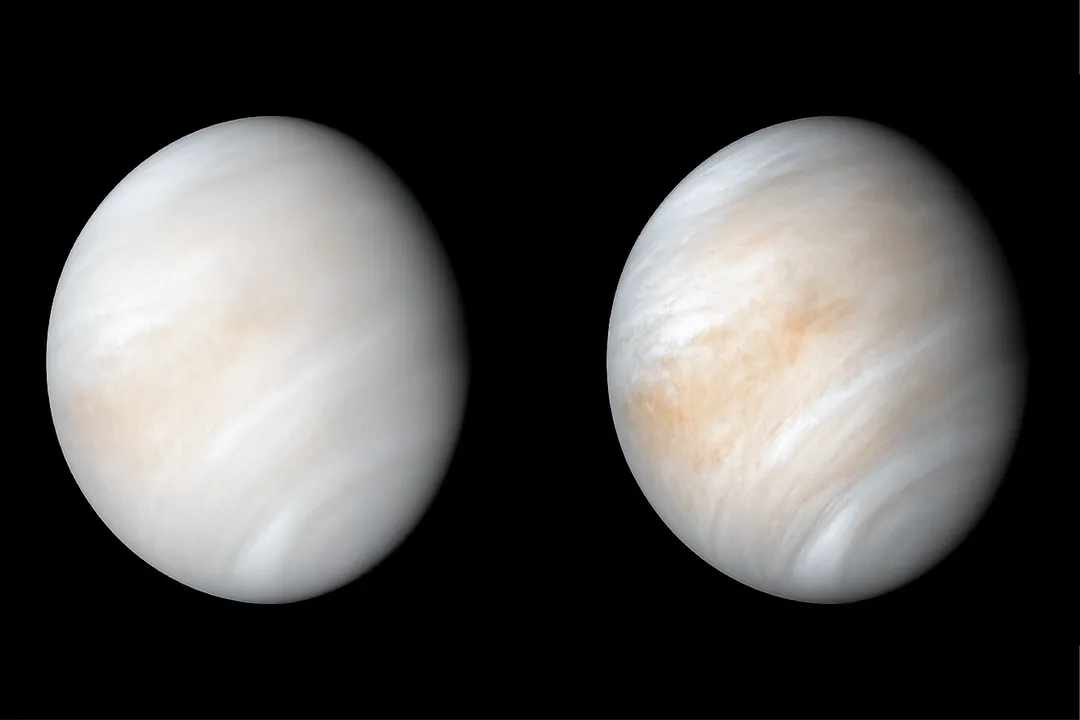
Venus’s retrograde rotation is extreme, not just in direction but also in speed. Its rotation period is remarkably slow. [6] A single rotation on Venus—a Venusian day—takes approximately 243 Earth days to complete. [6][9] Even more surprisingly, this day is longer than its orbital period around the Sun, which takes about 225 Earth days. [6] Imagine living on a world where the sun sets on Monday, and before Tuesday’s sunrise arrives, nearly a full Earth year has passed since the previous sunrise! This temporal disconnect, where a rotation takes longer than an orbit, highlights just how unusually sluggish Venus is in its spin compared to nearly every other planet. [6] This slow spin means that, were you standing on the surface, the Sun would appear to rise in the west and set in the east. [4]
A secondary aspect of Venus's rotation, which adds another layer of complexity, is the behavior of its atmosphere. While the surface turns slowly over 243 Earth days, the upper atmosphere circles the planet in just about four Earth days, a phenomenon known as super-rotation. [7] The surface-level conditions are therefore dominated by this rapid atmospheric flow rather than the planet’s sluggish body rotation. Considering the incredibly slow spin (one rotation in 243 Earth days) combined with the dense, hot atmosphere moving hundreds of times faster, the Coriolis effect on any hypothetical surface winds would be drastically muted in comparison to Earth's influence, potentially leading to weather patterns dictated more by thermal dynamics than by large-scale rotational forces.
# Uranus The True Outlier
If the criterion is simply not spinning prograde like the majority, then Venus is certainly one of the exceptions. However, it is not the only one with a bizarre rotational profile. [2] That honor, in terms of sheer extremity, belongs to Uranus. [5]
While Venus is retrograde (spinning backward), Uranus has an axial tilt of about 98 degrees relative to its orbital plane. [5] This means Uranus is essentially rolling around the Sun on its side. [2][5] Its rotation axis is nearly parallel to the plane in which it orbits. [2] Because of this extreme tilt, Uranus experiences seasons of unparalleled duration, with one pole facing the Sun directly for decades while the other is shrouded in complete darkness. [5] Although Uranus is technically spinning retrograde according to the strict solar system standard, its tilt is so pronounced that its "day" direction is often overshadowed by the near-total axial collapse onto its orbital plane. [2] In popular science discussions, Venus often gets the spotlight because its retrograde spin is a distinct, albeit slower, reversal compared to Earth, Mars, or Jupiter, whereas Uranus is tumbling sideways, which is a fundamentally different kind of rotational anomaly. [2][5]
# Why The Difference?
The reasons for these rotational eccentricities are subjects of intense scientific modeling, largely pointing toward chaotic beginnings for the solar system. [3] For Venus, the prevailing theory suggests a massive, ancient impact—perhaps as large as the one thought to have formed our Moon—struck the planet at just the right angle to reverse its spin. [3][5] This kind of violent collision would be powerful enough to flip a planet’s rotation entirely. [3]
Uranus's situation is similar but more extreme. It is hypothesized that multiple massive collisions knocked it onto its side. [5] These early impacts were not mere nudges; they were planet-shaping, energy-transferring events that dictated the orientation we observe billions of years later. [3]
# Comparing Spin Anomalies
It can be helpful to compare the key characteristics of the planets that deviate from the standard prograde spin:
| Planet | Rotation Direction (Standard View) | Approximate Day Length (Earth Days) | Axial Tilt (Degrees) | Primary Anomaly |
|---|---|---|---|---|
| Venus | Retrograde (Clockwise) | 243 | ~3 | Direction and slow speed [6][9] |
| Uranus | Retrograde (Clockwise) | 17.2 | ~98 | Extreme axial tilt [2][5] |
| Earth | Prograde (Counter-Clockwise) | 1 | ~23.5 | Standard reference |
This table clarifies that while both Venus and Uranus share the distinction of being retrograde when viewed conventionally, Uranus’s tilt is orders of magnitude more unusual than Venus’s direction of spin alone. [2][5]
# On the Surface of a Backward Spinner
If one could withstand the crushing atmosphere and searing heat of Venus—which hovers around () [9]—the visual experience of the sky would be profoundly alien due to the retrograde spin. [4] On Earth, we watch the Sun appear in the east, traverse the sky, and disappear in the west, a cycle dictated by our prograde spin. [6] On Venus, the Sun would perform the reverse ballet: rising in the west and setting in the east. [4] This would not feel like a different direction of motion but rather a total inversion of the familiar celestial mechanics we experience daily. [4]
The perception of time, as already noted, is perhaps the strangest effect. A single solar day on Venus is longer than its year. [6] This implies that if you could somehow stand on the surface and watch the sky transition from noon to midnight, it would take 121.5 Earth days to see the Sun set, and then you would only have about 113 Earth days until the next sunrise, assuming perfect orbital synchronization for simplicity. [6] This slow turnover contrasts sharply with Earth’s 24-hour cycle, which is heavily influenced by its relatively fast, prograde spin.
In summary, while it remains a captivating piece of astronomical trivia, the claim that Venus is the only planet that rotates clockwise is an oversimplification. Venus is the only planet whose retrograde rotation is the most prominent feature of its spin without an accompanying extreme axial tilt, setting it apart from the prograde majority. Yet, Uranus shares its retrograde nature, albeit wrapped up in an almost unbelievable sideways tumble, proving that in the dynamics of the outer solar system, the definition of "normal" is highly relative. [2][5]
Related Questions
#Citations
Venus is the only planet to spin clockwise : r/Damnthatsinteresting
No, Venus not only planet that rotates clockwise - Africa Check
Why Venus Spins the Wrong Way | Scientific American
Is it true that Venus is the only planet to spin clockwise, and ... - Quora
The Only Planet That Rotates Clockwise - World Atlas
Venus - Wikipedia
Venus unique clockwise rotation and planetary development
why do venus and uranus spin counterclockwise? - YouTube
Venus: Facts - NASA Science