Which planet was visible next to the Moon?
The planet appearing closest to the Moon changes frequently, often daily, making any single answer obsolete almost as soon as it is given. This celestial alignment, known formally as a conjunction, is one of the most striking sights in the night sky, drawing the eye to the familiar silver disc paired with a bright, steady beacon of light. [2] Since the Moon orbits the Earth relatively quickly, its path against the backdrop of the stars and planets—known as the ecliptic—means it sweeps past different celestial bodies in short succession. [2]
# Which Planets Align
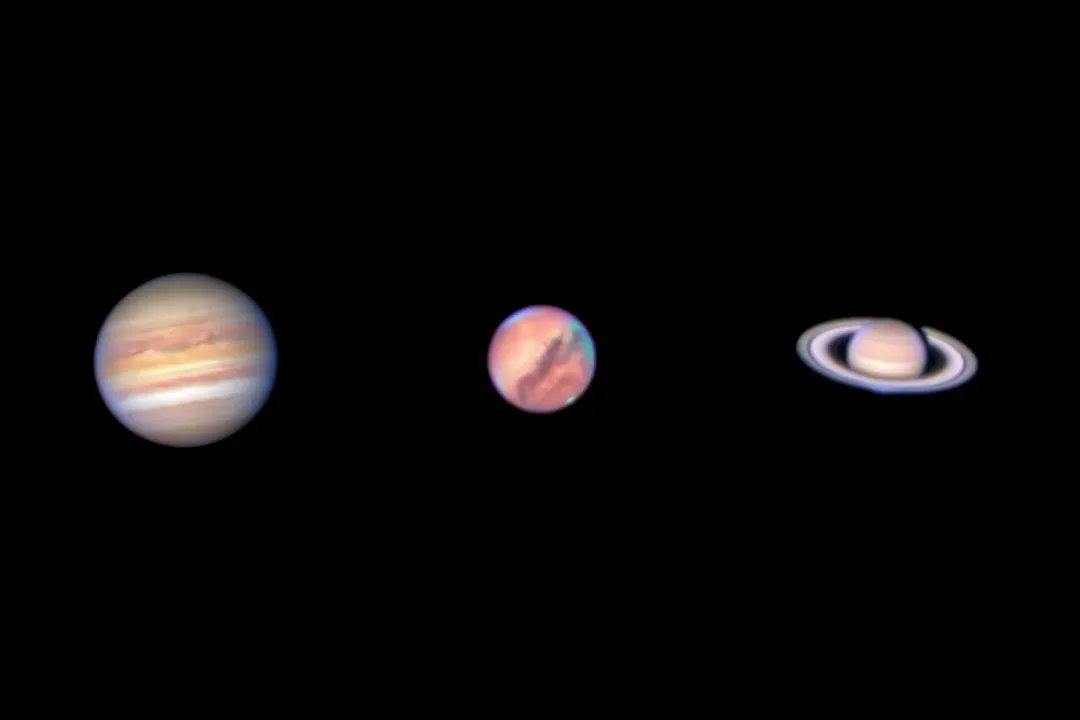
Five major solar system bodies, besides Earth, can regularly be found near the Moon: Mercury, Venus, Mars, Jupiter, and Saturn. [1][8] Venus and Jupiter are often the most dazzling partners for the Moon when they meet, easily visible even from light-polluted areas. [1][5] Venus, in particular, is the brightest object in the sky after the Sun and Moon, often appearing as a brilliant "evening star" or "morning star," depending on its position relative to the sunset or sunrise. [1][8] Mars, famous for its reddish hue, presents a striking color contrast when positioned next to the Moon's grey surface. [2] Saturn, while less brilliant than Venus or Jupiter, offers a pale yellowish glow that can be beautiful in close proximity to our satellite. [2] Mercury, being closest to the Sun, is only visible low in the sky shortly after sunset or before sunrise, making its conjunctions with the Moon often the hardest to catch. [1][8]
# Understanding Alignment
The reason we see these alignments at all stems from the geometry of our solar system. All the major planets orbit the Sun on roughly the same flat plane, called the ecliptic. [2] The Moon's orbit around the Earth is tilted slightly relative to this plane, intersecting it about twice a month. [2] When the Moon crosses the ecliptic near where one of the planets happens to be at that moment, we witness a conjunction. [2] This is why observers are encouraged to check current sky charts, as what was near the Moon yesterday will likely be a different object tonight, or the same object will have moved noticeably further along the ecliptic path. [5][6]
# Checking Tonight’s View
Determining precisely which planet shares the sky with the Moon tonight requires looking at real-time astronomical data, as the visibility is dynamic. [1][5] Several online tools are designed for this purpose, allowing users to input their location for an accurate perspective. [5][6] These resources often provide graphical representations or explicit text stating which planets are visible and their proximity to the Moon. [6] For instance, some platforms will detail when the Moon and a planet will be at their closest angular separation, which is the peak viewing time for that specific pairing. [2] Beginners are often advised to look toward the west shortly after sunset for Venus or toward the east before dawn for a view of Mercury or Saturn, depending on the time of year and the current planetary arrangement. [1][8] If you see a very bright "star" within a few degrees of the Moon, it is most likely Venus or Jupiter. [1]
# Viewing Details
Planets offer a distinct viewing experience compared to stars. Stars twinkle because their light is distorted by Earth's turbulent atmosphere; planets, being much closer and appearing as tiny discs rather than pinpoints, exhibit a much steadier light. [10] When a bright planet like Venus is positioned right next to the crescent Moon, the resulting image is often breathtaking, a sight that has inspired sky-watchers for millennia. [4] If you have access to a small telescope or good binoculars, that steady light allows for incredible detail. For example, you might resolve Jupiter’s four brightest moons appearing as tiny points lined up near the planet, or you might notice the faint gibbous phase of Venus when it is far from the Moon. [9][10]
When observing these close pairings, one practical consideration for the general observer is light pollution. If the Moon is full or close to it, its own brightness can wash out fainter celestial objects nearby. A slender crescent Moon, however, acts as a perfect natural lamp, subtly illuminating the scene without overwhelming the view of a dimmer planet like Saturn that happens to be positioned near its limb. [10] This dynamic interplay between the Moon's phase and the visibility of its planetary neighbors adds an extra layer of complexity to casual sky watching.
# Frequency Mechanics
While the Moon passes through the ecliptic twice per orbit, the frequency with which a specific planet appears in conjunction is governed by its own orbital period and the precise angle between its orbit and the Moon’s orbit. [2] The inner planets—Mercury and Venus—are locked into appearing relatively close to the Sun from our perspective, meaning their conjunctions with the Moon tend to happen near sunrise or sunset. [1] A rough comparison of their orbital paths against the Moon's path reveals something interesting about how often we see them pair up. Because Venus orbits closer to the Sun than Earth, its orbital plane is slightly different from the Moon's relative to the Earth-Sun line, leading to frequent, yet predictable, close passes throughout the year. [2] Conversely, while Mars and Jupiter are often quite bright, the relative geometry of their longer orbits means that a spectacular, naked-eye conjunction might be separated by many months, making those occurrences feel more special when they do happen. [2]
To help track this, it can be useful to know the general visibility windows for the outer planets versus the inner ones.
| Planet | General Visibility Window | Light Intensity Near Moon |
|---|---|---|
| Venus | Evening twilight or Morning twilight | Very bright, steady glow [1] |
| Mercury | Very low on the horizon, shortly after sunset or before sunrise | Faint to moderately bright |
| Mars | Varies widely, often visible for much of the night | Distinct reddish color [2] |
| Jupiter | Varies widely, often visible for much of the night | Very bright, near Venus in intensity [1] |
| Saturn | Varies widely, often visible for much of the night | Pale yellow, less intense than Jupiter [2] |
This table, based on general planetary behavior, illustrates why your chance of spotting a bright Venus or Jupiter near the Moon might feel higher than spotting Mercury, even though the Moon passes the ecliptic twice monthly. [1][2] The planet’s location along that line is the ultimate deciding factor.
# Practical Observation
For anyone wanting to regularly identify the bright object next to the Moon, establishing a consistent viewing schedule is key. [8] If you habitually check the western sky ten minutes after sunset, you will quickly learn which planets—usually Venus or Jupiter—are currently sharing that twilight hour with the Moon. [5] If you miss the conjunction, don't worry; the Moon moves on, and another planet will soon take its turn in the spotlight. [6] Patience is perhaps the most important tool for the casual skywatcher, allowing you to catch these fleeting, beautiful pairings as they occur naturally. [9]
Related Questions
#Citations
Visible planets and night sky guide for December - EarthSky
Bright “Star” Next to Moon: What Planet Is Near the Moon Tonight?
r/moon - What planet is this? - Reddit
Visibility of Planet Venus Beside the Moon - Facebook
Night Sky Tonight: Visible Planets at Your Location - Time and Date
Planets Visible Tonight - TheSkyLive
What planet is currently visible next to the Moon? - Quora
What Planets Are Visible Tonight - Farmers' Almanac
What's up in the night sky: December 2025 | The Planetary Society
Visible planets in the night sky tonight 2025-2026