What planet is very visible in the western sky?
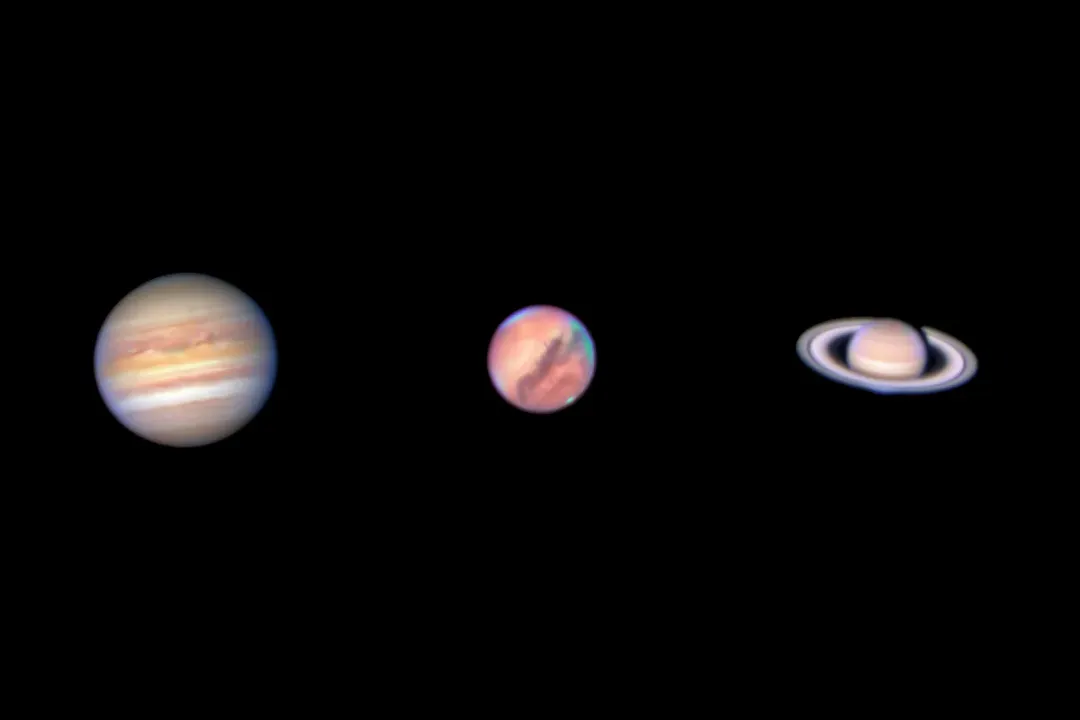
The glow just after sunset or before dawn in the western or eastern sky often draws the eye, promising a glimpse of something beyond the familiar pinpricks of the stars. That bright, steady light is frequently a planet, our solar system neighbors making a brief appearance before dipping below the horizon or waiting for morning twilight. [1][3] Determining precisely which planet is gracing the western sky at any given moment requires understanding the celestial mechanics that govern their orbits, as their visibility is highly dependent on the time of year and your specific location. [2] Generally, the planets visible in the western sky are those that have recently set after the Sun, appearing as "evening stars". [9]
# Setting West
Planets orbit the Sun on a path relatively close to the ecliptic plane, which is the apparent path the Sun takes across our sky throughout the year. [8] Because they orbit inside or outside Earth’s orbit, they follow the Sun across the sky, albeit at different speeds and distances. [3] When a planet is visible in the western sky shortly after sunset, it is called an evening object. [9] This means the planet is moving toward the horizon after the Sun has set, having caught up to or pulled away from the Sun in their respective orbits from our perspective. [1][3] Conversely, if you look east before sunrise, you might catch a planet that is about to rise ahead of the Sun, which is known as a morning object. [9] The position of a planet in the western sky—how high it is and how long it remains visible—is a direct indicator of how far along its orbit it is relative to the Sun at that time of day. [1]
# Evening Star
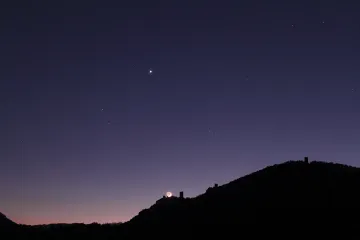
If there is a dazzlingly bright object shining low in the western sky shortly after the Sun disappears, it is almost certainly Venus. [1][6] Venus is the brightest natural object in the night sky after the Moon. [3][6] Its brilliance allows it to be seen easily even when low on the horizon, making it a common fixture in the evening or morning sky, hence its historical moniker, the "Evening Star" or "Morning Star". [1][6] When Venus is in the evening sky, it is catching up to the Sun from our viewpoint or has just passed its greatest elongation on the western side, meaning it is at its maximum apparent distance from the Sun in the evening. [1] The period when Venus is visible is dictated by its orbital cycle relative to Earth; it can dominate the sky for several weeks before eventually becoming too close to the Sun to see, transitioning into its period as a morning star or becoming completely hidden. [3] If you see something shining with a brilliant, steady, slightly yellowish-white light low in the west, start your search there. [1][6]
# Giant's Glow
Jupiter, the largest planet in our solar system, is another frequent visitor to the western sky, though it typically doesn't achieve the blinding glare of Venus. [3] Jupiter shines with a very bright, steady, slightly yellowish-white light. [1][6] Unlike Venus, which is constrained to be close to the Sun in the sky, Jupiter's orbit is much wider, allowing it to appear at various times of the night and in different parts of the sky depending on the season and the year. [3] When Jupiter is visible in the west after sunset, it means it is setting later than the Sun, offering an excellent, easy-to-spot target for novice observers. [1] If you locate a bright non-twinkling light, and you can mentally rule out Venus (perhaps Venus is not visible at all this month), Jupiter is the next best candidate for a prominent bright planet in the west. [8] Its sheer size means that even through modest binoculars, you might be able to spot its four largest moons—Io, Europa, Ganymede, and Callisto—if the sky conditions are dark enough. [8]
# Faint Travelers
The outer planets, Mars and Saturn, tend to be less frequent or less prominent visitors to the post-sunset western sky compared to Venus and Jupiter, primarily because they orbit further from the Sun. [3]
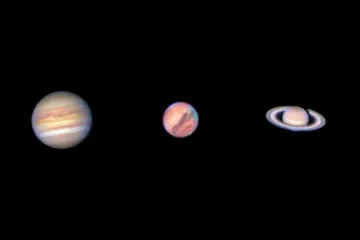
Saturn is noticeably dimmer than both Venus and Jupiter, possessing a steady, pale yellowish-white light. [1][6] Its visibility in the evening depends heavily on the time of year. If Saturn is visible in the west after sunset, it is likely moving toward conjunction (the point where it appears closest to the Sun in the sky, making it unobservable) or has recently emerged from the morning sky phase. [3] Observing Saturn is incredibly rewarding because, even with small telescopes, its famous ring system is distinguishable, which is a feature no other planet in the sky displays. [8]
Mars, the ruddy planet, gains attention during periods of close approach to Earth, when its brightness can rival that of Saturn or even Jupiter, depending on the timing. [1] However, Mars is known for its distinct reddish-orange hue. [6] When it's visible in the western sky, it appears as a distinctively colored star-like object. Its visibility window can be much more erratic in terms of timing than the gas giants because Earth's orbit crosses Mars's orbit in a way that causes its visibility to shift dramatically across years. [3]
If you are looking west and see two bright "stars," one brilliant and white (likely Venus) and one slightly dimmer and distinctly orange (likely Mars), you are getting a genuine planetary show that few observers witness regularly. [1][6]
# Innermost Friend
Mercury presents the greatest challenge for skywatchers hoping to spot a planet in the western sky. [1] As the innermost planet, it never strays far from the Sun's glare. [3][6] Therefore, Mercury is only visible either low in the eastern sky just before sunrise or low in the western sky just after sunset. [1][6] For western viewing, it appears only for a short window after twilight ends before it sets. Its appearance is brief, and it is often obscured by atmospheric haze close to the horizon. [3] Successful spotting of Mercury requires precise timing and a clear, unobstructed view toward the horizon. [1]
This dependency on extreme elongation periods means that Mercury might be completely invisible for many weeks or months at a time, unlike Jupiter or Saturn which can sometimes remain visible for half the night. [3] A fantastic spotting opportunity arises when Mercury reaches its greatest eastern elongation, which is the point where it appears farthest from the setting Sun, maximizing its viewing time immediately after dusk. [1]
# Star Check
Distinguishing a planet from a star is fundamental to enjoying the night sky, and this is especially true when looking toward the bright western horizon. [8] The most reliable indicator is twinkling. [6][8] Stars twinkle significantly because they are incredibly distant point sources of light, meaning their light is easily scattered and distorted by Earth’s turbulent atmosphere. [6] Planets, being much closer, appear as tiny disks rather than points, and their light beams are less affected by the atmosphere, resulting in a steady, unwavering glow. [8] When you see a bright object in the west that does not seem to flicker, you are almost certainly looking at a planet. [6]
Another key differentiator is color, as noted previously: Venus is brilliant white/yellow, Mars is distinctly red/orange, while Jupiter and Saturn are steady pale white/yellow. [1][6] Stars, of course, display a wide range of colors, but the steady light signature remains the primary telltale sign. [8]
To help track these transient visitors, one simple technique to practice is positional comparison. If you find a bright object in the west, check a star chart or a reputable real-time astronomy app that shows the ecliptic path. If the object lies directly on or very near that path, it confirms its planetary status, as stars are scattered randomly across the celestial sphere. [8]
| Planet | Typical Appearance (Western Sky) | Key Identifying Feature |
|---|---|---|
| Venus | Extremely bright, brilliant white/yellow | Brightest object after the Moon; steady light [3][6] |
| Jupiter | Very bright, steady pale yellow-white | Second brightest; steady light; good for binoculars [1][8] |
| Mars | Moderately bright, distinct reddish-orange | Noticeable color contrast against other stars/planets [1][6] |
| Saturn | Dimmer, pale yellowish light | Steady light; rings visible in telescopes [1][8] |
| Mercury | Faint, only visible briefly just after sunset | Always very close to the horizon/Sun's position [1][3] |

# Viewing Strategy
The best way to ensure you catch a glimpse of the western sky visitors is to align your observations with the solar cycle, which means focusing on twilight hours. [4] Since the data on which planet is visible changes daily based on orbital mechanics and your latitude (for instance, a location like Los Angeles will have different precise timings than one further north), [2] establishing a consistent viewing habit works better than trying to catch a specific one-off event. [4]
Here is an actionable tip for maximizing your success: Instead of only looking immediately after the Sun sets, try setting a second viewing window about 45 to 60 minutes later. [1] Venus sets relatively quickly because it is close to the Sun in the sky, so if it was visible right after sunset, it will be gone by the second window. However, Jupiter and Saturn, which are further out, will set much later. This slightly delayed check can catch slower-moving planets that might have been too low or too close to the lingering glare during the initial twilight fade-out. [1] Furthermore, if you are looking for Mercury, you must observe in the very first moments of twilight; if you wait until the sky is fully dark, Mercury will have already set, hidden by the horizon. [3]
Another useful piece of advice, especially when looking low in the west, involves geographical awareness. If you are in the Northern Hemisphere, the western horizon is where the Sun sets, and planets that follow it are often better viewed when the Sun sets far to the northwest (summer months) or slightly to the southwest (winter months). If you are trying to spot a planet that has just risen in the east before dawn, the opposite is true: your view will be best when the sunrise is shifted to the northeast (summer) or southeast (winter), as this keeps the eastern sky darker for longer before the planet itself becomes washed out by morning light. [7] This subtle seasonal shift in where twilight occurs on the horizon directly impacts your observation window for those planets hugging the twilight zone. [2][7] Consulting a local sky chart or almanac for the specific date and location remains the most authoritative source for precise timing, but understanding why they are there—setting after the Sun—will help you predict when they might reappear. [4]
Related Questions
#Citations
Visible planets and night sky guide for December - EarthSky
Night Sky Tonight: Visible Planets in Los Angeles - Time and Date
The brightest planets in December's night sky: How to see them (and ...
Planets Visible Tonight - TheSkyLive
What planets are visible in the night sky? - Facebook
What Planets Are Visible Tonight - Farmers' Almanac
Current Night Sky - Center for Astrophysics | Harvard & Smithsonian
Visible planets in the night sky tonight 2025-2026
What planets are visible in the western sky at night? What ... - Quora