Did Russia have a man on the Moon?
The history of crewed spaceflight is often told through the lens of a singular triumph: the American bootprint on the lunar surface in July 1969. Yet, this narrative frequently overlooks the profound, often secret, efforts mounted by the Soviet Union. The Soviet space program, which had already achieved staggering "firsts"—the first satellite, the first man in orbit—was deeply invested in reaching the Moon with a cosmonaut. Despite this commitment and immense engineering talent, the straightforward answer to whether Russia, meaning the USSR, ever landed a man on the Moon is no.
# Race Beginnings
The competition between the United States and the Soviet Union to achieve lunar supremacy was the defining feature of the Space Race. Following Yuri Gagarin's historic orbit in 1961, the pressure within the Soviet leadership, particularly from figures like Sergei Korolev, was immense to follow up with an even greater achievement: landing a cosmonaut on the Moon. The political stakes were exceptionally high, linking national prestige directly to technological superiority.
The early Soviet efforts included plans for a crewed lunar landing, though their approach diverged significantly from the American strategy. While the U.S. centered its efforts on the singular, massive Saturn V rocket designed to launch the entire Apollo spacecraft assembly in one go, the Soviets initially pursued a modular approach. This plan involved launching components for a lunar module and an orbital module separately using a less powerful rocket, which would then rendezvous in lunar orbit. However, as the American program gained momentum and it became clear that a single-launch super-heavy vehicle would be necessary to compete effectively, the focus shifted dramatically toward developing the super-heavy launch vehicle designated the N1.
# The N1 Challenge
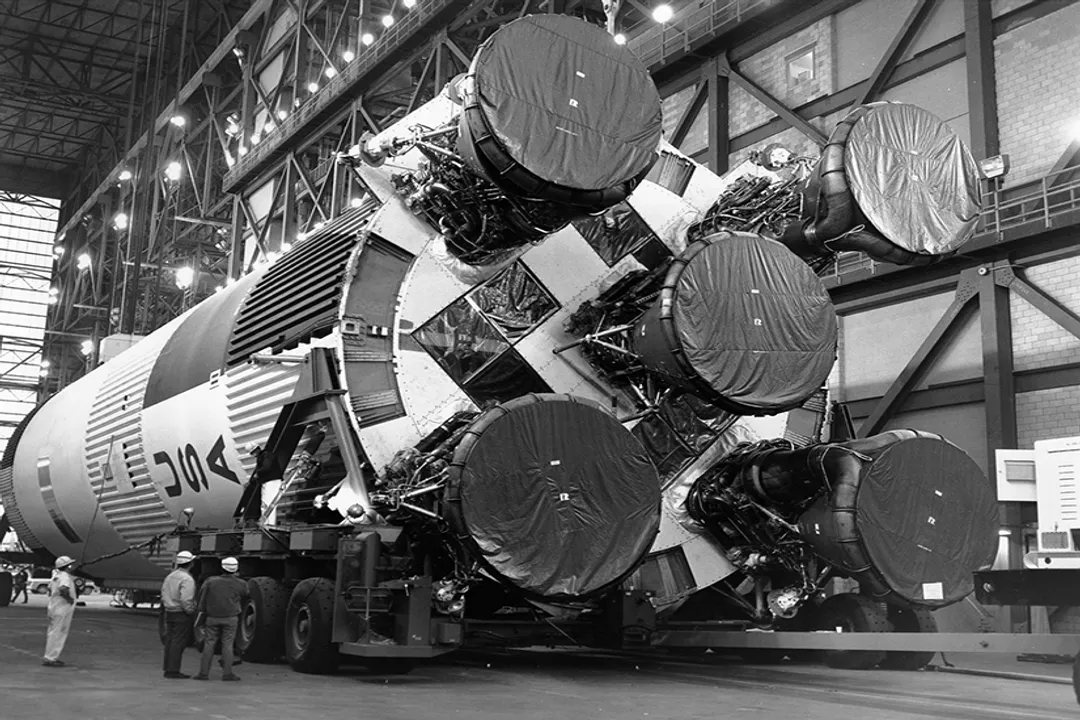
The entire credibility of the Soviet crewed lunar effort rested on the massive N1 rocket. This machine was intended to be the Soviet equivalent of the American Saturn V, a behemoth designed to propel the L3 lunar module and its crew toward the Moon. The sheer scale of the N1 represented an enormous technical undertaking for the Soviet engineers.
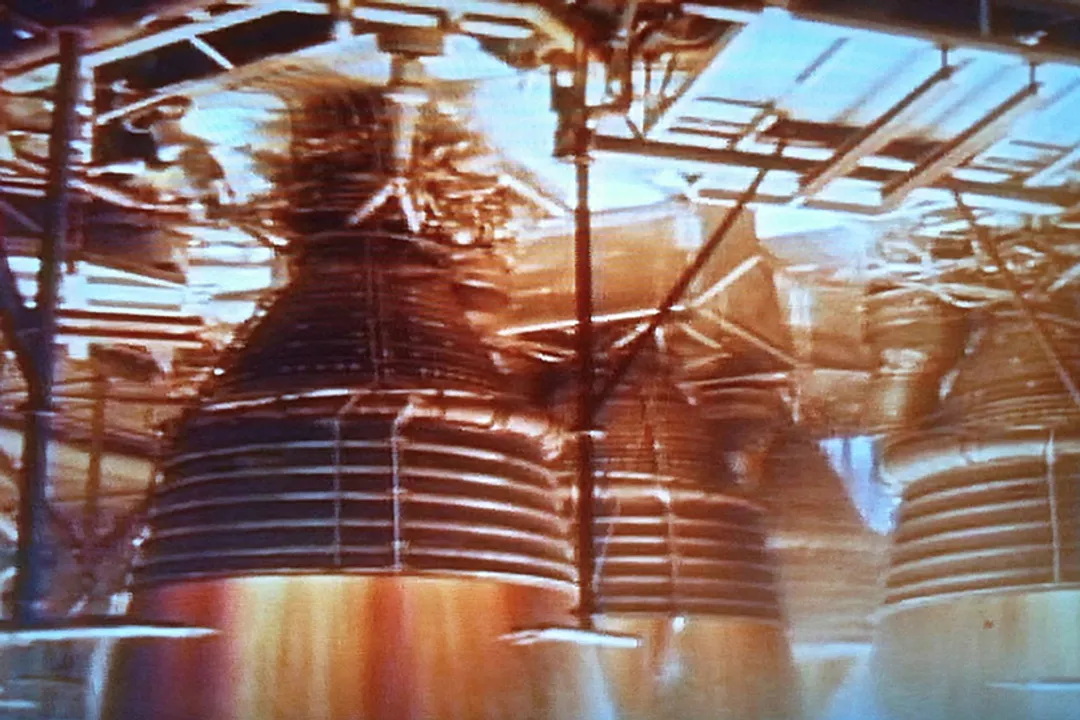
Unlike the Saturn V, which used a cluster of only five powerful F-1 engines on its first stage, the N1 utilized a staggering 30 engines clustered together for its first stage. This design choice stemmed from the technical limitations faced by Soviet engine designers at the time; they had not yet perfected the high-thrust, single-chamber engine technology that the Americans employed successfully. This complexity—coordinating the ignition, operation, and throttling of thirty separate rocket engines simultaneously—introduced an unprecedented level of potential failure points.
The L3 stack, which included the Soyuz 7K-LOK spacecraft and the LK lunar module, was designed to enter lunar orbit, with one cosmonaut descending to the surface while the other remained in orbit. The whole system was incredibly intricate, with the final landing portion requiring the complex assembly and transfer of modules in orbit, similar in principle to Apollo but executed with different hardware.
# Test Flight Failures
The failure to put a man on the Moon is inextricably linked to the catastrophic failures of the N1 rocket during its testing phases. There were four uncrewed test launches between February 1969 and November 1972, and all of them ended in failure.
The very first launch attempt in February 1969 was a spectacular disaster. Shortly after liftoff, the complex engine cluster proved too much for the vehicle to handle. Within seconds, the engines began to fail, leading to severe vibrations and structural breakup. The rocket exploded in flight, a spectacular event that, fortunately, happened shortly after clearing the launchpad. Had the failure occurred closer to the ground, the consequences for the Baikonur Cosmodrome would have been devastating. The subsequent launch in July 1969 also failed due to engine issues.
The third test in June 1971 was even more destructive. This launch ended in the most powerful non-nuclear explosion in Earth’s history up to that point, as the rocket disintegrated over the steppes of Kazakhstan, scattering debris miles wide. The fourth and final test in November 1972 also failed, marking the definitive end of a credible path to a Soviet Moon landing in that decade. Each failure eroded the program’s funding, political support, and engineering confidence.
It is fascinating to consider the engineering philosophies at play here. The Soviet focus on centralization and sheer brute force, manifested in the thirty-engine configuration, placed an almost impossible burden on quality control and synchronous operation. While American engineers were often able to iterate quickly on smaller, more reliable engine designs that eventually coalesced into the five-engine configuration of the Saturn V, the N1’s reliance on massive numbers of engines simultaneously appears to have been a critical point of vulnerability that they could not overcome in time. This suggests that sometimes, simplicity in design, even when requiring higher individual component performance, can prove more reliable under extreme pressure than sheer complexity, a lesson that resonates across heavy engineering disciplines.
# Political Fallout and Secrecy
By the time the N1 had failed its final test in 1972, the United States had already landed three missions on the Moon. The political momentum, which had fueled the Soviet lunar effort, evaporated rapidly. The USSR never publicly admitted the full scope of its crewed lunar aspirations until much later, maintaining for years that the Moon was never a primary goal, or that their efforts were solely focused on robotic exploration. This denial served as a way to save face after investing so much national prestige into the race.
The program was officially terminated following the final N1 failure. The resources that had been poured into the massive N1 project were immense, representing a significant chunk of the Soviet space budget. Once the landing goal became unattainable, the strategic decision was made to pivot away from the Moon and toward long-duration orbital stations, which is where the Soviet Union would ultimately find its enduring success with the Salyut and Mir programs. This redirection highlights another strategic consideration: the opportunity cost of the N1 effort. The massive financial and scientific commitment required to solve the N1's myriad problems meant that those talented engineers and vast resources were unavailable for other, perhaps more achievable, near-Earth space objectives. In hindsight, while the U.S. concentrated on winning one specific prize, the USSR gambled everything on that singular rocket, leaving little infrastructure to fall back on when it failed.
# What Remained?
Even though the crewed landing failed, the Soviet Union did not abandon lunar exploration entirely. They continued to send sophisticated robotic probes, achieving many notable firsts in that domain. For instance, the Luna program successfully brought back soil samples from the Moon using automated landers, which was a remarkable feat of remote engineering. These robotic missions continued long after the American crewed landings ceased, demonstrating a sustained, albeit shifted, commitment to lunar science.
The primary technical achievement of the Soviet lunar program that did see flight, though uncrewed, was the Lunokhod series of rovers. These remote-controlled vehicles operated on the lunar surface, collecting data and providing invaluable experience in robotic remote control—expertise that would prove vital for future planetary missions.
In summary, while the American astronauts were walking on the lunar dust, no Soviet cosmonaut ever followed them. The dream died not from a lack of desire or talent, but seemingly from the insurmountable technical hurdles presented by the N1 rocket and the immense, unforgiving deadline imposed by the Cold War competition. The saga of the Soviet attempt remains a powerful reminder that in engineering, especially at the absolute frontier of capability, complexity can become the greatest enemy of success.
#Videos
Why Russia Did Not Put a Man on the Moon - YouTube
The Russian Who Almost Walked on the Moon - YouTube
Related Questions
#Citations
Why Russia Didn't Put Man on Moon - SpaceSpecialists Ltd
Soviet crewed lunar programs - Wikipedia
Why did the Soviet Union never send men to set foot on the Moon?
Was the first man on the Moon a Russian cosmonaut who landed ...
Why Russia Did Not Put a Man on the Moon - YouTube
Why The Soviets Never Landed A Man On The Moon
The Soviet Response to the Moon Landing? Denial There Was a ...
Why Russia Did Not Put a Man on the Moon – The Secret Soviet ...