What is the glow around the Moon tonight?
Seeing a luminous ring encircling the Moon in the night sky is a captivating, almost magical sight that has inspired folklore and wonder for millennia. For those who stop to look up, the immediate question is often simple: what exactly is that glow? It is not an atmospheric trick of proximity or a new feature of the Moon itself, but rather a beautiful optical demonstration of physics happening high above in the Earth's atmosphere.
# Ice Crystal Optics
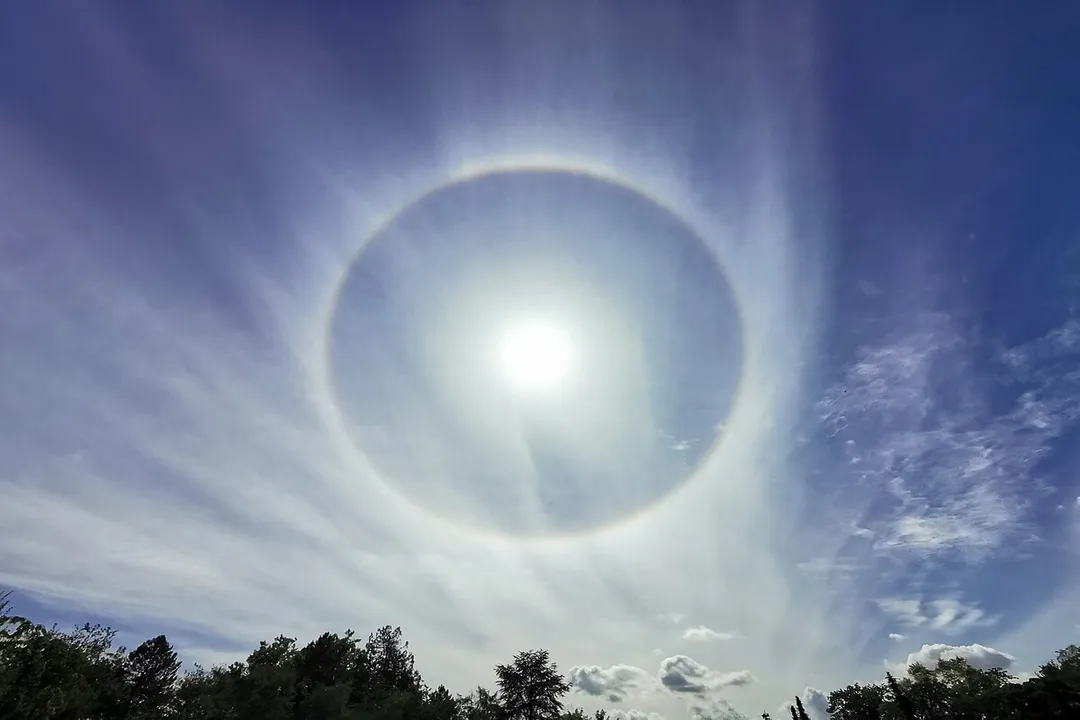
The ring you observe is scientifically known as a halo. While we associate the Moon with the dark, these halos are created through the interaction of moonlight with microscopic particles suspended in the air—specifically, ice crystals. This phenomenon requires the Moon to shine through a specific type of cloud layer that is cold enough for water vapor to freeze into these crystalline structures.
Unlike phenomena caused by light scattering off of water droplets, which often create rainbows or the shimmering of the Moon's surface, a lunar halo is a product of refraction. Think of each tiny, six-sided ice crystal acting like a minuscule prism. As the moonlight enters one face of a crystal and exits another, it is bent, or refracted, to a specific degree. This consistent bending angle is what separates the halo from random atmospheric hazes. If the light bends consistently at the same angle across countless crystals, a distinct, circular ring is projected onto the sky from our perspective here on the ground.
# Twenty Two Degrees
The most common, and certainly the most striking, halo observed around the Moon is the 22-degree halo. This number is not arbitrary; it reflects the precise minimum angle at which light is refracted by those common hexagonal ice crystals. While the precise measurement can range slightly, sometimes cited between and , the figure of is the accepted standard for describing this pervasive optical event. When observers across different regions report seeing an "impressive" ring, they are almost always referring to this phenomenon.
If you are looking at a bright Moon, you can often judge the size of this ring yourself. The apparent width of the Moon is only about half a degree across. Imagine stacking the Moon's diameter across that arc—it would take approximately 44 Moons lined up side-by-side to span the full circle from the Moon outward to the ring itself.
A helpful way to gauge this is by holding your hand out at arm's length. If you stretch your hand out fully, your little finger tip to your thumb tip usually spans roughly to . If the Moon is centered within that span, the ring you are seeing is almost certainly the telltale halo. Knowing the angle helps frame the sheer scale of the atmosphere involved in creating such a large structure visible overhead.
# High Cloud Signs
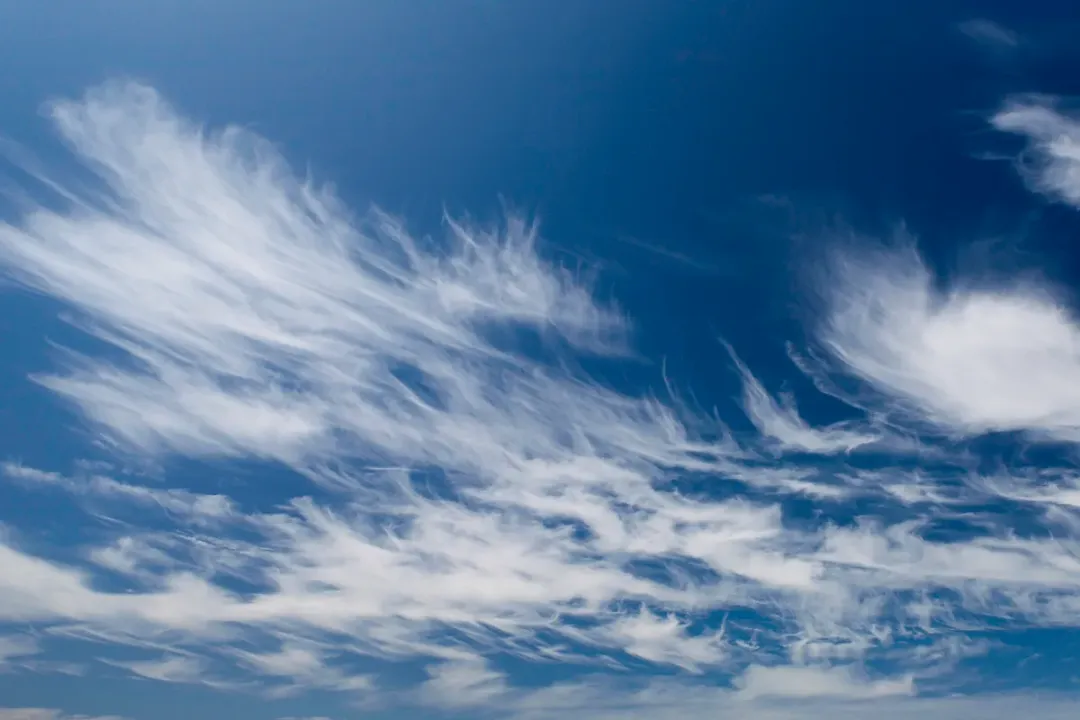
The formation of a lunar halo immediately points to a specific type of meteorological condition: the presence of high-level clouds. These are not the puffy, lower-altitude cumulus clouds that signal fair weather, nor are they the dark, heavy nimbostratus clouds that bring immediate rain or snow. Instead, halos form within cirrus or cirrostratus clouds.
These clouds reside at very high altitudes, typically above $20,000$ feet, where temperatures are well below freezing, ensuring that any water vapor present exists as ice. Cirrostratus clouds are particularly famous for producing halos because they often form a thin, extensive veil across the sky, allowing the moonlight to pass through relatively unimpeded, though still sufficiently diffused to be visible.
The existence of these high ice clouds often precedes a change in the weather pattern. In many mid-latitude areas, the appearance of high-level clouds like cirrostratus can signal an approaching warm front, which carries a deeper layer of moisture that will eventually descend to lower altitudes as rain or snow. Watching for a ring around the Moon, therefore, can act as an ancient, natural barometer, often suggesting that conditions may become wetter within the next day or so. If you notice the halo fading, it might mean the front is passing, or perhaps the high-level ice crystals are being replaced by lower, water-droplet clouds that do not produce the same prismatic effect.
# Crystal Geometry
The physics governing the halo demands a very specific crystal structure. If the ice crystals were randomly oriented blocks or irregular shapes, the light would scatter in all directions, resulting in a general glow rather than a sharp ring. The consistent, predictable angle of is a direct consequence of the hexagonal symmetry inherent to ice.
Ice molecules naturally arrange themselves into a hexagonal lattice. When forming plate-like crystals in the atmosphere, these plates possess six sides and six corners. For the halo to form, the light must enter one side face of the crystal and exit through another side face that is oriented at a angle relative to the first face—this is the geometry that produces the minimum deviation angle of . If the ice crystals are oriented horizontally (like tiny frisbees floating down), they can create other effects, such as parhelia, or "sun dogs," if the Sun is low, but the halo requires random tumbling that favors this specific refractive path.
It is fascinating to consider the sheer number of these microscopic, perfectly formed prisms needed to create a feature so vast it can span many degrees across the sky and be visible over a large geographical area, sometimes across entire states or regions simultaneously. The Moon itself, which serves as the light source, must be relatively high in the sky for the most perfect, circular halo to be visible, as low-hanging Moon angles can distort the view due to the lower atmosphere.
# Sighting Tips
To maximize your chance of seeing this atmospheric wonder tonight, you first need a clear line of sight to the Moon, whether it is full or gibbous. Halos are most spectacular when the background sky is dark, but the Moon needs to be bright enough to illuminate those high-altitude ice crystals effectively. If the sky looks hazy or uniformly milky rather than deep black, the halo might be washed out, although technically present.
If you see a ring, try to observe whether it changes shape or brightness over the span of an hour. A stable, bright halo that slowly moves with the Moon suggests the ice crystals are relatively uniform in their orientation and the atmospheric layer is stable. Conversely, if the ring appears patchy, distorted, or seems to flicker, it often indicates turbulence within the high cloud layer, with crystals tumbling irregularly, scattering the moonlight inconsistently.
Furthermore, while the halo is the star, other, rarer rings exist, though they are much harder to distinguish, especially from the Moon's diffuse light. For instance, the halo is sometimes produced, but it requires the light to pass through the ends of the hexagonal prisms, and it is often too faint to notice against the general sky background when the Moon is the source. Pay attention to any fainter, larger circles; if you spot one, you are witnessing an even rarer feat of atmospheric optics! The ring, however, remains the defining signature of moonlight interacting with high-altitude hexagonal ice.
#Videos
What is a lunar halo? - YouTube
Related Questions
#Citations
the presence of those high ice-crystal clouds often does precede ...
What's it called when there's a ring around the moon? Took ... - Reddit
Halo spotted around the moon: What it means for snow chances
Today's Moon Phase | Current moon cycle for today and tonight
Have you ever noticed a halo around the moon? Here's why that ...
What is a lunar halo? - YouTube
Moon Phase Today: Waxing Crescent - TheSkyLive
What causes a ring or halo around the Moon?
22° halo - Wikipedia