How long would it take a plane to fly around UY Scuti?

UY Scuti captures the imagination like few other celestial objects, primarily because its sheer scale defies easy comprehension. When thinking about traversing such a body, the mind naturally turns to familiar benchmarks—how long would it take to circle it in the fastest vehicle we commonly use, an airplane? The answer involves scaling up the dimensions of this colossal red supergiant to a speed comparable to a modern commercial jetliner, yielding a figure that dwarfs human experience.[1][5]
# Star Dimensions
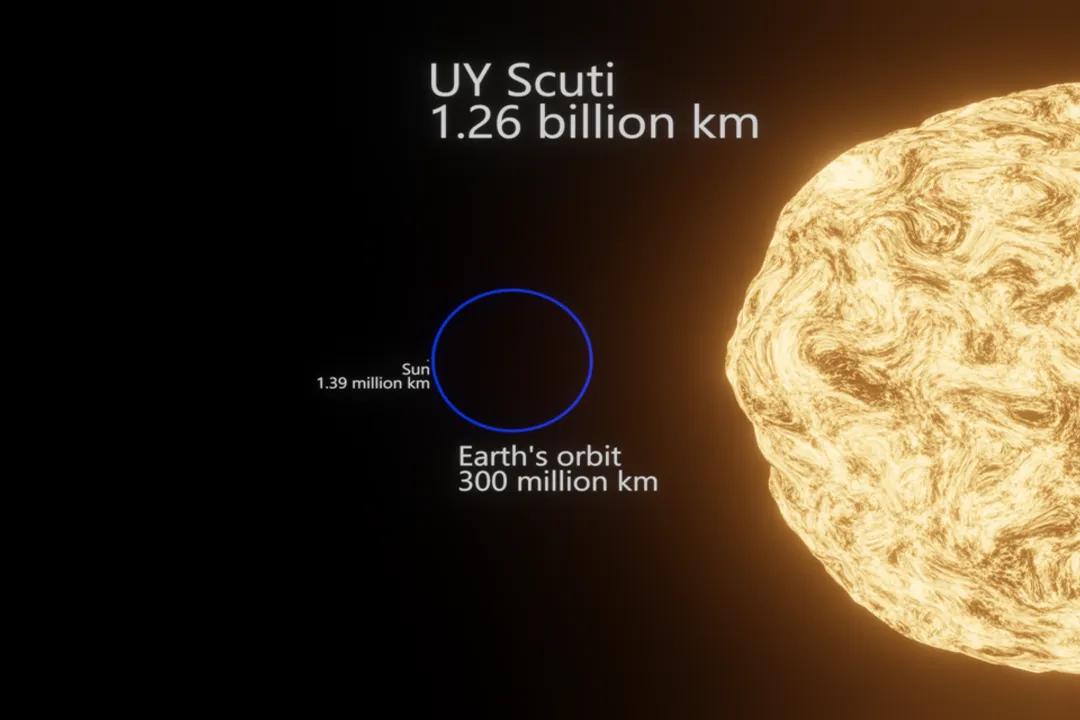
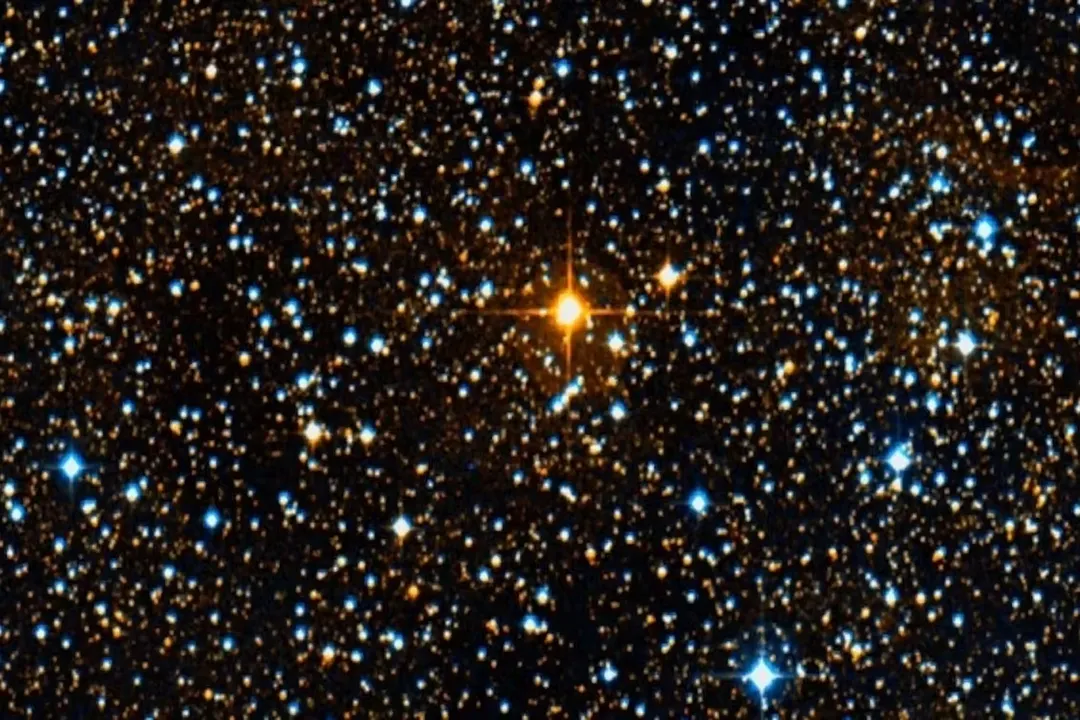
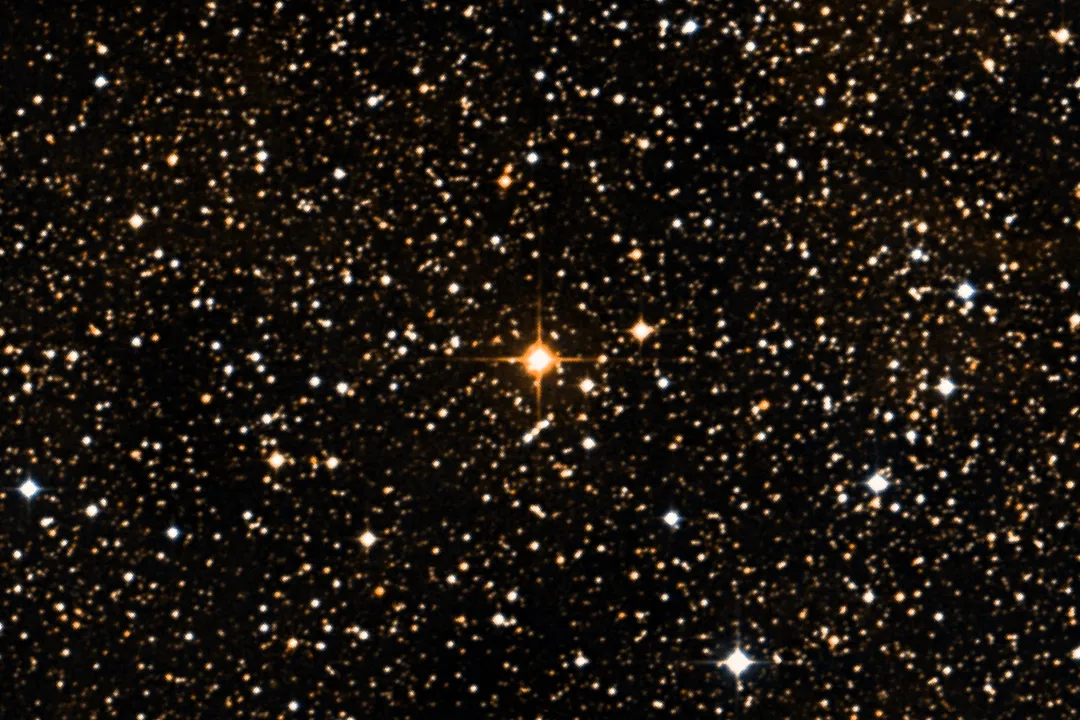
UY Scuti is officially categorized as a red supergiant, making it one of the most massive and luminous stars known to humankind, though its exact status as the absolute largest can shift as measurement techniques improve and other candidates are confirmed. [4][5][9] It is situated in the constellation Scutum, residing approximately 9,500 light-years away from Earth. [1][5] To truly grasp its size, comparisons to our own Sun are indispensable. Reports suggest that UY Scuti’s radius could be around 1,700 times that of the Sun. [1]
This comparison is crucial because the Sun itself is already immense; its diameter is about 1.4 million kilometers. [1] Multiplying that scale by 1,700 gives a diameter for UY Scuti in the neighborhood of kilometers, or nearly $2.4$ billion kilometers. This places its equatorial diameter close to $1,500$ million miles. [5]
If we were to substitute the Sun with UY Scuti at the center of our Solar System, its surface would extend far past the orbit of Jupiter, potentially reaching out past the orbit of Saturn, completely engulfing the orbits of Mercury, Venus, Earth, and Mars. [1][8] This visualization helps anchor the otherwise abstract numbers to familiar solar system geography.
# Circumference Estimate
To calculate the time required to fly around the star, we need its circumference rather than just its diameter. The formula for the circumference () of a sphere is , where is the radius. Using the estimated radius of 1,700 solar radii (), and knowing the Sun’s radius is approximately 695,700 kilometers, we can calculate an approximate circumference for UY Scuti in kilometers.
Plugging this into the circumference formula yields:
This equates to roughly $7.43$ billion kilometers that would need to be traversed in this thought experiment. [5] The sheer magnitude of this figure highlights that even a star 1,700 times the size of the Sun requires a circumference measurement in the billions of kilometers. While the exact radius measurement of UY Scuti has uncertainties, often cited as having an error margin of about 190 solar radii, this calculated circumference provides a solid basis for the hypothetical flight calculation. [1][5]

# Plane Traversal Time
With the distance established, the next component for this hypothetical journey is the speed of the traveler. Commercial airliners typically cruise at speeds averaging around $925$ kilometers per hour (), or about 575 miles per hour (). [1] For this calculation, we will adopt the metric speed for consistency.
To find the time (), we divide the total distance (circumference, ) by the speed (): .
Converting this massive number of hours into years helps put the duration into a slightly more manageable context. There are 8,760 hours in a standard year ().
Thus, flying non-stop around UY Scuti at the cruising speed of a modern jet would take approximately 917 years. [1] If one were to use the distance provided by another source, suggesting a circumference closer to 5.3 billion miles (about 8.5 billion km), the time extends even further, nearing 1,050 years based on the same airspeed. This means that even with our fastest conventional air travel, circling this star is a project spanning nearly a millennium.
# Cosmic Context
The resulting time frame is staggering, illustrating the true separation between terrestrial speeds and stellar dimensions. To put this 917-year journey into perspective, consider the span of recorded human history. The city of Rome, for example, has existed for roughly 2,775 years since its traditional founding. [2] The flight around UY Scuti would consume over one-third of the entire known history of that ancient city.
Furthermore, the mass of UY Scuti is estimated to be between 7 and 10 times the mass of the Sun. [4] This extreme mass means that any object approaching it would be subject to immense gravitational forces, rendering the simple, constant-velocity calculation irrelevant in reality. The plane would be immediately torn apart or consumed long before it covered any meaningful fraction of the circumference. The calculation is purely a mathematical exercise in scaling physical parameters against one another.
Another way to appreciate the scale is through light speed. Light, the fastest thing in the universe, covers approximately 300,000 kilometers per second. A trip around UY Scuti at the speed of light would take about , resulting in approximately 24,767 seconds, or roughly 6.88 hours. [5] The comparison between the time it takes light (under 7 hours) and the time it takes a jet (917 years) dramatically underscores the vast difference between terrestrial speed and the speed of light, which is essential for crossing interstellar distances.
# Orbital Comparison
While flying around the star is a hypothetical endeavor, considering an orbit—if such a thing were possible without being incinerated—provides another layer of insight into its size. Some thought experiments involve imagining Earth orbiting UY Scuti instead of the Sun. [8] If Earth orbited at the distance of its current orbit from the Sun (1 Astronomical Unit, or ), UY Scuti’s massive size would cause the star to swallow Earth entirely. [8]
If we consider a hypothetical orbit where the planet just skirts the star's surface without touching it, based on the 1.5 billion mile radius estimate, the orbital period would be drastically shorter than Earth’s year. For an object orbiting at a radius from a central mass , the orbital period is related by Kepler's Third Law. Since UY Scuti is far less massive than its vast size might suggest (it is far less dense than the Sun), its gravity at its surface is relatively weak compared to the Sun's gravity at its surface. [4] However, if an object were to orbit at a radius where Earth orbits the Sun, the orbital period would be governed by the mass difference, which suggests a period much shorter than a year, provided the star's mass was comparable to the Sun's, which it is not. Since UY Scuti is likely several times the mass of the Sun, any stable orbit near its photosphere would complete its circuit in a relatively short time compared to an Earth year, though the intense radiation would instantly sterilize any orbiting body. [4]
The plane flight scenario, though impossible, remains a useful metric because it relates the incomprehensible scale of a red supergiant back to a physical, human-observable speed, revealing that even at our fastest, traversing such a boundary takes not just days or months, but multiple lifetimes dedicated solely to the circuit.[1][2]
Related Questions
#Citations
Meet the Largest Star Ever Discovered
TIL about UY Scuti, the largest-known star by radius. It is 1700 times ...
The star of uway UY scuti This star is among the billions of stars in ...
How long does it take to get to UY Scuti? - Quora
What is the biggest star in the Universe? - The Conversation
UY Scuti - Wikipedia
What If Earth Orbited UY Scuti? - What If Show
What is UY Scuti — one of the largest stars known to humankind?