How long does it take for a nebula to become a star?
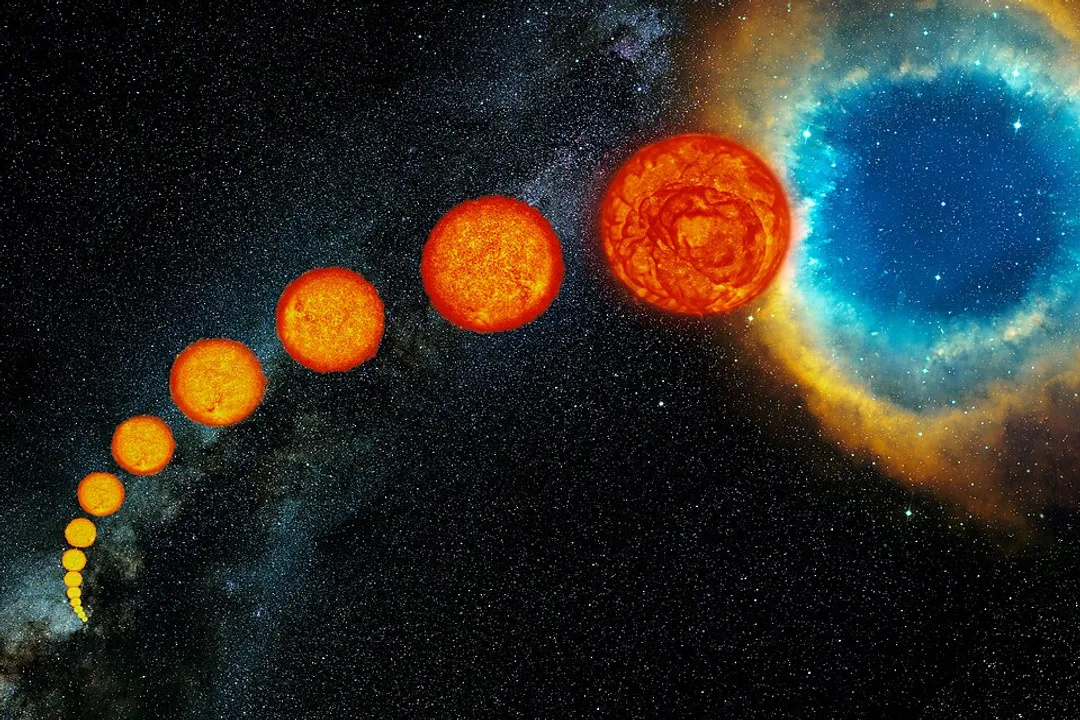
The genesis of a star, that magnificent furnace lighting up the cosmos, begins in the cold, dark recesses of space, within what we call a nebula. These immense clouds of gas and dust are the stellar nurseries of the universe, and the journey from diffuse cloud to blazing main-sequence star is a protracted one, measured in timescales that dwarf human experience. It is not an instantaneous event; rather, it is a slow, inexorable gravitational collapse spanning millions of years.
# Cosmic Dust
A nebula, or molecular cloud, is essentially the raw material for star formation. These regions are vast, composed primarily of molecular hydrogen, but they also contain crucial heavier elements and dust grains. While the overall process is universal, the duration of this cosmic incubation period is critically dependent on one factor: mass. A small, less massive cloud destined to form a star like our Sun follows a very different timetable than a gargantuan cloud destined for a blue giant. The first requirement for any star's birth is that a portion of this cloud must become gravitationally unstable, overcoming the internal pressure resisting collapse.
# Collapse Trigger
The initial collapse of a dense core within the nebula is governed by physics, often requiring a push from the external environment to get things started. While some regions may simply be dense enough to collapse under their own gravity, events like the shockwave from a nearby supernova explosion or the gravitational compression from passing spiral arms in a galaxy can trigger the initial fragmentation and implosion. Once triggered, the material begins to fall inward toward a central point. This process is surprisingly inefficient at the largest scales; often, only a small fraction of the gas in a giant molecular cloud ever actually ends up forming a star, with much of the rest being blown away or remaining as unformed diffuse gas. Think of it like trying to collect water vapor in a massive, chaotic windstorm; most of the moisture escapes the catcher's mitt. [1]
# Core Formation
As the cloud material rushes inward, the gravitational potential energy of the infalling gas is converted into thermal energy—it heats up. This early, contracting object is known as a protostar. The key distinction between a contracting cloud and a true star is the temperature and pressure at the core. A true star, one that will shine steadily for billions of years, must achieve the necessary conditions to initiate sustained hydrogen fusion.
The timescale to reach this state varies dramatically based on the final mass of the object being formed. For a star of about one solar mass, like our Sun, the journey from the initial dense core phase in the molecular cloud to when it stabilizes on the main sequence is surprisingly long, estimated to be around 50 million years. This represents the bulk of the time spent in the various pre-main-sequence stages, including the protostar phase and the subsequent T Tauri phase.
Consider the relative scales here for a moment. If you took the entire 50-million-year history of our Sun's formation and growth—from the moment the cloud first started collapsing noticeably to the moment it began burning hydrogen like it does today—and compared it to the Sun's current lifespan of about 10 billion years, the formation period accounts for only about th of its entire active life. This highlights that the fiery, stable part of a star's existence is vastly longer than its birth process. [2]
# Mass Differences
The crucial differentiator in the timeline is the mass acquired by the protostar. High-mass stars—those eight times the mass of the Sun or more—experience a much more violent and rapid birth. Because their gravitational pull is so much stronger, they can accrete mass much faster, and the core pressures rise to fusion levels far more quickly.
For these massive objects, the time it takes to go from the initial collapse phase to achieving nuclear ignition on the main sequence can be staggeringly short, potentially on the order of just a few hundred thousand years, or $10^5$ years. This is a stark contrast to the 50 million years required for solar-mass stars. The universe is very impatient when it comes to forming its biggest stars. [3]
This difference in formation time has profound implications for stellar populations. In a dense star-forming region, you will have lower-mass stars still slowly contracting over tens of millions of years, while the high-mass stars born from the same initial cloud complex might have already ignited, lived out a very brief existence of a few million years, and died in a supernova, seeding the nebula with heavy elements that future generations of stars will incorporate.

# Protostar Stages
The protostar phase itself is complex, involving various substages of contraction before the core gets hot enough for full fusion. Initially, the core heats up due to gravitational contraction, forming a first hydrostatic core. This object continues to contract, and as it shrinks, the temperature and density increase further. For solar-mass stars, the time spent contracting through these initial hydrostatic core phases into the more recognizable T Tauri star stage—a phase marked by strong stellar winds and bipolar outflows—can take several million years. These stellar winds are vital, as they help blow away the remaining gas envelope that cocooned the protostar, allowing visible light to finally escape.
When we look at a star-forming region today, say the Orion Nebula, we are seeing objects in various stages of this timeline. Some are still dark, dense cores; others are visible T Tauri stars shining via gravitational contraction, and still others have already reached the long-term stability of the main sequence. The time it takes to get from that very first sign of gravitational overdensity in the nebula to the ignition point is the critical window we are trying to measure.
| Star Type (Approx. Mass) | Formation Time (Nebula to Main Sequence) | Relative Lifespan (Active) |
|---|---|---|
| Low Mass (, like the Sun) | years | Billion Years |
| High Mass () | years | Million Years |
| [5][3][6] |
It's worth noting that for the least massive objects, those that never quite reach the critical temperature for sustained hydrogen fusion (brown dwarfs), the collapse process itself might proceed differently, often slowing down as electron degeneracy pressure begins to resist gravity, though they still originate from the same nebular material. They represent a failure to fully become a star, a cosmic near-miss that still takes time to settle into its final state. [4]
# Ignition Threshold
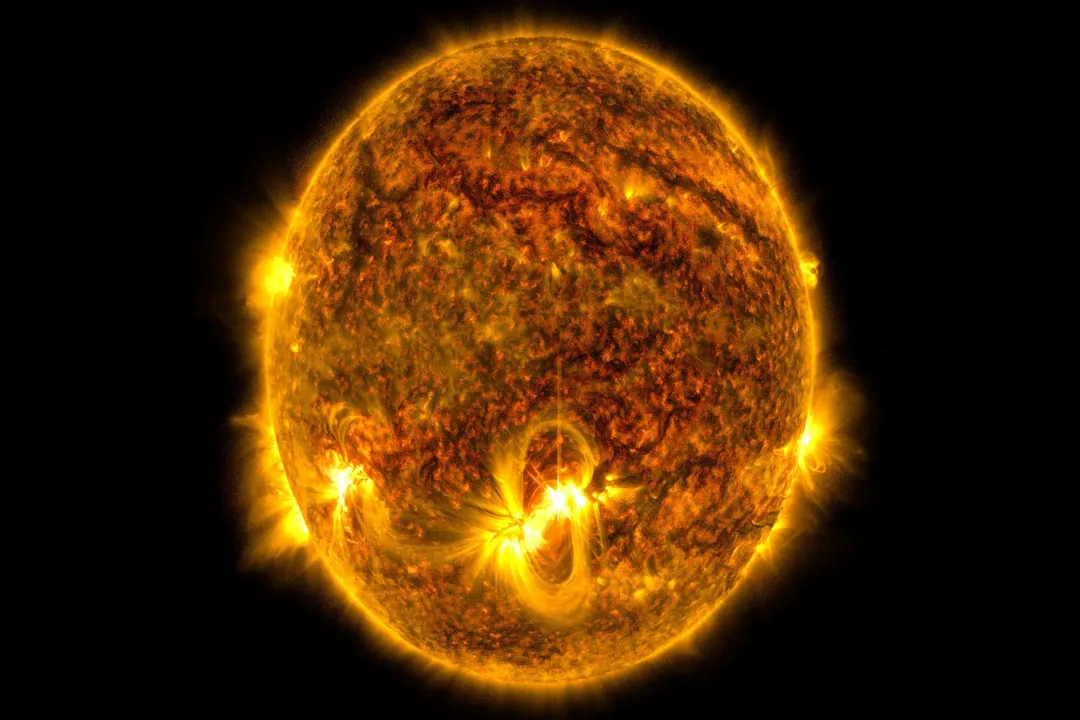
The final moment in this long transition is ignition: when the core temperature reaches about million Kelvin, allowing for the fusion of hydrogen into helium to begin in earnest. This process releases massive amounts of energy, which creates an outward pressure that perfectly counteracts the inward pull of gravity, achieving hydrostatic equilibrium. This state is the definition of a main-sequence star, and it is the phase where a star spends about 90% of its entire life.
The entire process, from the initial collapse of a relatively cool, diffuse cloud of gas and dust until this equilibrium is reached, solidifies the answer: it is not a fixed duration, but a sliding scale of millions to tens of millions of years, heavily skewed by the resulting star's mass. For stars like our Sun, the duration is fixed around years. For the galaxy's heaviestweights, that long wait is drastically shortened to just a few hundred thousand years. While the collapse phase might be the most dynamic part of the star's birth, the vast majority of the timeline is spent managing the infalling material and heating the core until that crucial threshold for nuclear fire is crossed.
Related Questions
#Citations
How long does it take a nebula to start the fusion process ...
Star Basics
Stellar Evolution
The Life Cycle of a Star
Stellar evolution
Control Telescope :: Stars & Nebulae
The Life Cycle of Stars: From Birth to Stellar ...
A Star is Born: The Life Cycle of Stars | Wisconsin Space Grant ...
What is the average time between a nebula formation and ...
The Life Cycle of Stars