Why do some stars become supernova?
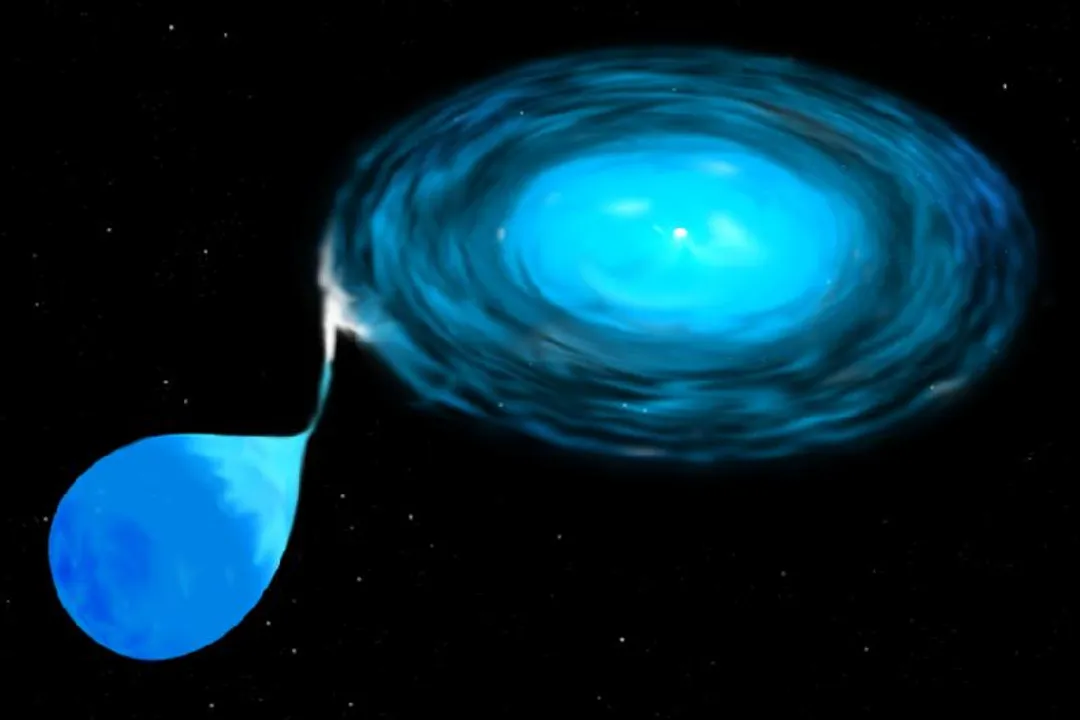
The spectacular death of a massive star, a supernova, is one of the most energetic events in the universe, briefly outshining entire galaxies. [3] These explosions represent the final, dramatic curtain call for certain stars, scattering the material they spent billions of years forging back into the cosmos. Understanding why this happens requires looking closely at the star's mass and its internal nuclear engine, as not all stars meet this explosive fate; many simply fade away quietly. [5]
# Mass Threshold
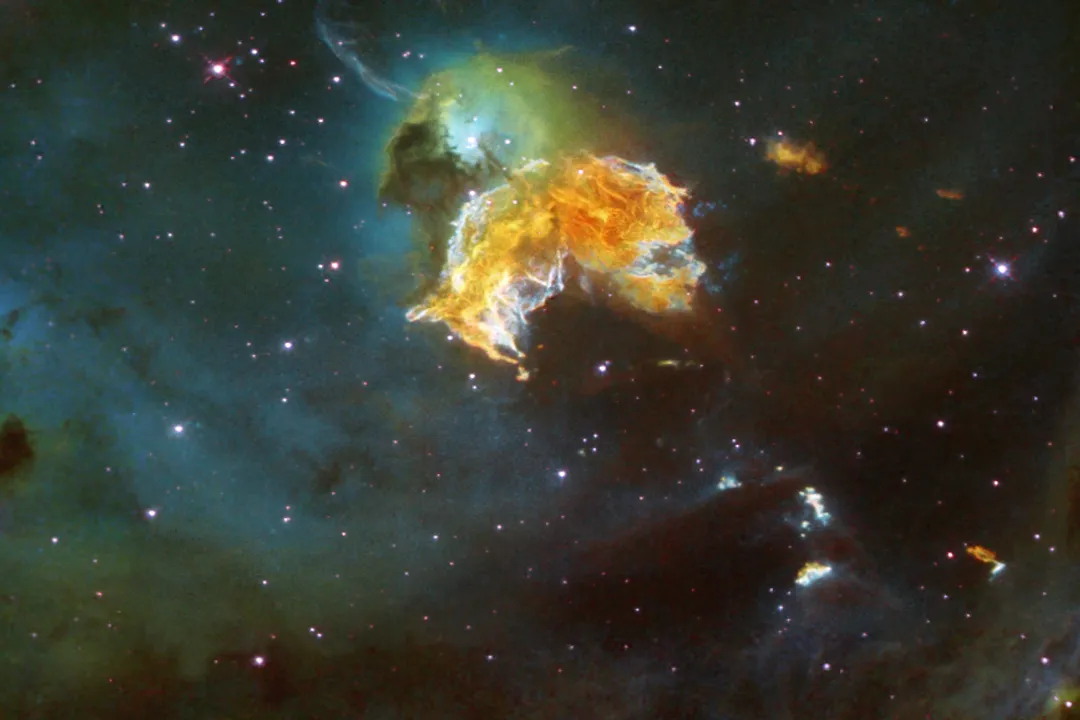
The primary determinant for whether a star will end its life in a brilliant supernova explosion is its initial mass. [5] Stars are categorized based on this factor, and the dividing line is quite significant. [4] Stars that are relatively low-mass, such as our own Sun, are destined for a much gentler end. [5][4] These smaller stars will exhaust their fuel, swell into red giants, shed their outer layers to form beautiful, expanding shells of gas known as planetary nebulae, and finally contract into a dense stellar remnant called a white dwarf. [5]
Conversely, stars born with masses significantly greater than the Sun—generally considered to be at least eight times the mass of the Sun () or more—possess the internal gravitational pressure needed to continue their fusion processes to the extreme. [1][5] These heavier stars have enough fuel and gravity to sustain reactions much longer, but this very longevity leads to a catastrophic end, not a gentle cooling off.
| Star Fate | Initial Mass (Approx.) | Final Stellar State | Mechanism |
|---|---|---|---|
| Gentle Death | (like the Sun) | White Dwarf | Planetary Nebula Ejection [5] |
| Violent Death | Neutron Star or Black Hole | Core Collapse Supernova [1] | |
| Catastrophic Death | (White Dwarf) | Complete Destruction | Thermonuclear (Type Ia) [1] |
This concept of a mass threshold is key. If a star is too small, the pressure generated by fusion in its core is sufficient to indefinitely counteract the relentless inward crush of its own gravity, leading to stability until the fuel runs out. [4] For the massive stars, the crushing pressure eventually wins the long battle, leading to collapse.
# Iron Core
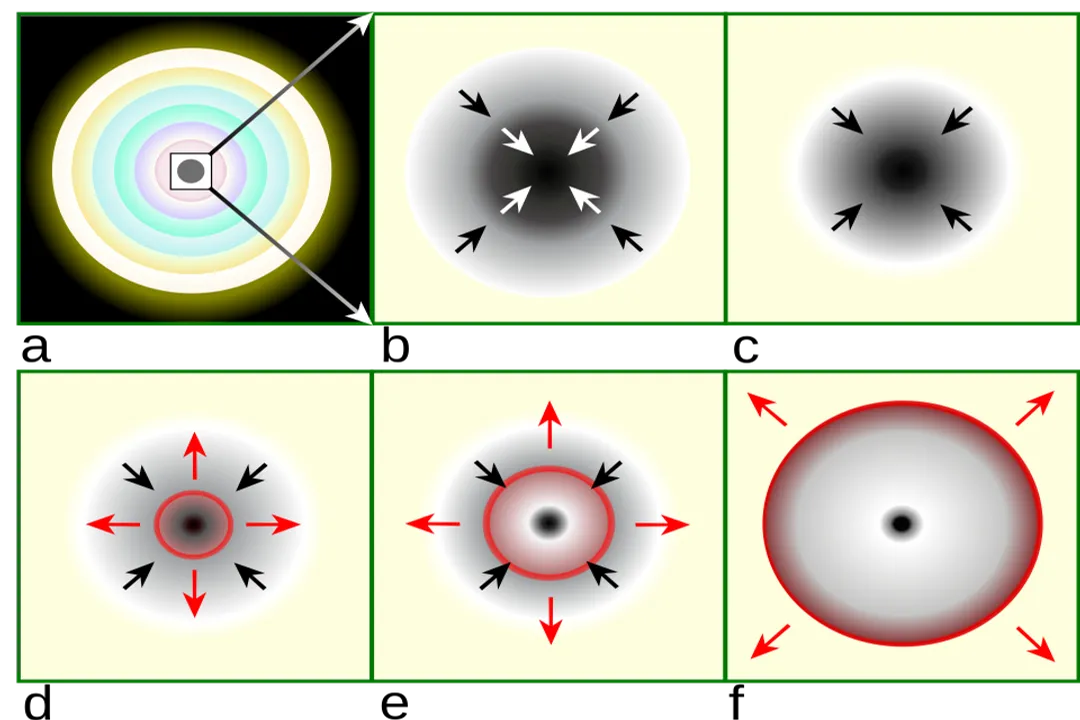
For the massive stars heading toward a core-collapse supernova (Types II, Ib, Ic), the process involves a dramatic, layered structure of nuclear fusion occurring in the core. [1] Hydrogen fuses to helium, helium fuses to carbon, and so on, up the periodic table, creating heavier and heavier elements within concentric shells. [1] This process releases the energy that supports the star against gravity.
The problem arises when the core eventually manages to fuse elements all the way up to iron (). Unlike the fusion of lighter elements, fusing iron does not release energy; instead, it consumes energy. [1] When the star’s core becomes iron, it is essentially unable to generate the thermal pressure required to support the immense weight of the star's outer layers. [5][1] The energy source has switched off instantaneously.
Imagine the star’s structure as a carefully balanced support system where every layer is holding up the one above it through outward heat pressure. When the central iron core can no longer push out, the entire structure above it collapses inward with unimaginable speed, often reaching speeds of up to 70,000 kilometers per second. [1] This collapse compresses the core until it becomes extraordinarily dense, often forming a neutron star. The infalling outer material slams into this rigid, newly formed core and violently rebounds outward, creating the shockwave we observe as a supernova explosion. [3]
A helpful way to think about this structural failure is through the lens of fuel efficiency. Lighter elements are like efficient fuel, providing a strong outward push for billions of years. [1] Iron, however, is the cosmic equivalent of hitting a sudden, rigid concrete wall in the middle of a high-speed race; the momentum carries the matter forward, but the energy source that was supposed to sustain the outward push has vanished, leading to an immediate, catastrophic reversal of fortune.
# Binary Paths
Not all supernovae are the result of a single, massive star running out of fuel. A different type, known as a Type Ia supernova, involves a binary star system where a white dwarf is present. [1] A white dwarf is the dense, leftover core of a medium-sized star that has already died.
In these scenarios, the white dwarf orbits another star, perhaps a red giant. If the two stars are close enough, the white dwarf can begin to siphon, or steal, matter—primarily hydrogen and helium—from its companion star. [1] This accretion process continuously adds mass to the white dwarf.
There is an absolute upper mass limit for a stable white dwarf, known as the Chandrasekhar Limit, which is about $1.4$ times the mass of the Sun. [1] As the white dwarf gains mass from its partner, it approaches this critical limit. Once it crosses , the internal pressure can no longer support the star’s weight against gravity, leading to a runaway thermonuclear reaction in the carbon and oxygen core. This ignites the star entirely in a massive thermonuclear explosion that utterly obliterates the white dwarf, leaving no remnant behind. Because these explosions always happen at nearly the same mass, Type Ia supernovae are remarkably consistent in their peak brightness, making them invaluable standard candles for measuring cosmic distances.
# Cosmic Impact
The explosive energy of a supernova is not just a transient flash; it is fundamental to the existence of everything around us, including ourselves. While a star can fuse elements up to iron on its own, the creation of elements heavier than iron—like gold, silver, uranium, and iodine—requires far more energy than standard core fusion can provide. [1]
It is the extreme conditions during the collapse and rebound shockwave of a core-collapse supernova that generate the intense neutron flux necessary to rapidly build these heavy nuclei through processes like the r-process (rapid neutron capture). [1] The supernova then violently disperses these newly synthesized elements, along with the lighter elements already present, across the galaxy.
This dispersal mechanism is why we call supernovae the "element factories" of the universe. Every atom of carbon in our bodies, the iron in our blood, and the calcium in our bones was once forged inside a star and subsequently blasted into space by an event like a supernova. [1] The sheer violence of the explosion ensures that this enriched material is flung out at high velocity, mixing efficiently with the existing interstellar gas clouds, providing the raw ingredients for the next generation of stars, planets, and life. If the explosion had been slower or less energetic, these heavy elements might have remained localized or clumped, making their incorporation into future stellar systems far less efficient. The speed of the blast is therefore crucial to enriching the galactic medium quickly. [1]
Related Questions
#Citations
Supernova - Wikipedia
Why do some stars go supernova while others become black holes?
What Is a Supernova? | NASA Space Place – NASA Science for Kids
Why do medium stars collapse to form supernovae while big stars ...
Why do only stars above a certain mass threshold go supernova ...
Supernovae
Supernova explosions - Las Cumbres Observatory
What causes a supernova to occur? - Physics Forums
Supernovae Information and Facts | National Geographic