What happens to a star's core during a supernova?
The final moments for a truly massive star are less a slow fading and more an abrupt, catastrophic implosion, the prelude to a universe-shaking explosion known as a supernova. [3] When we talk about what happens to the star’s core, we are focusing on the engine room of this immense cosmic event, specifically when that star has exhausted its ability to generate outward pressure through thermonuclear fusion. [2] This process is overwhelmingly characterized by core-collapse supernovae, reserved for stars many times the mass of our Sun. [4]
# Stellar Fusion Limits
A star spends the majority of its existence in a state of hydrostatic equilibrium, a perfect, delicate balance where the relentless inward pull of gravity is perfectly counteracted by the outward pressure generated by nuclear fusion in its core. [2] Hydrogen fuses into helium, then helium into carbon, and so on, building up heavier and heavier elements in successive shells, much like an onion, until the star creates a core composed of iron. [1] Iron is the cosmic dead end for fusion. Fusing iron atoms consumes energy rather than releasing it, meaning the star can no longer tap into nuclear energy to support its staggering weight. [2][4]
The weight pressing down on this iron core is immense, corresponding to a mass likely greater than $1.4$ solar masses—the Chandrasekhar limit, though for a core-collapse event, the collapsing mass is often much higher, perhaps $8$ to $10$ solar masses or more. [3] Once the temperature and density become sufficient to start fusing silicon into iron, the star has perhaps only a day left before total collapse begins. [1] The fusion chain effectively stops, and the star loses its last internal source of pressure support.
# Inward Fall
With fusion halted, gravity wins the long battle instantly. The iron core, which can be roughly the size of Earth but contain more mass than the Sun, begins to collapse in on itself in a matter of milliseconds. [2][4] This collapse is incredibly rapid, a free-fall event where matter accelerates to a significant fraction of the speed of light. [2] The density escalates dramatically. To appreciate this rate of compression, consider that a volume of material that might start at the size of Earth is squeezed down until its constituent particles are almost touching. [1]
As the core implodes, the gravitational pressure becomes so extreme that it overcomes the electron degeneracy pressure that was previously holding the core up. [2] Electron degeneracy pressure is a quantum mechanical effect where electrons resist being squeezed into the same space, providing a significant stabilizing force in smaller stars or the outer layers of giants. However, the crushing gravity of a massive star's iron core simply overwhelms this resistance. [2]
This is where a fascinating transformation, often called neutronization, begins. [2] The electrons, no longer able to resist compression, are forced into the atomic nuclei, combining with protons to form neutrons and releasing a flood of nearly massless particles called neutrinos. [2][5]
This process removes the last resistive force (the electrons) and transforms the core's composition almost entirely into neutrons. [2] The core shrinks from the size of Earth to something perhaps only $20$ kilometers across, reaching astonishing densities—the density of an atomic nucleus. [2] If you could scoop up a teaspoon of this material, it would weigh billions of tons. [4]
# Core Stiffening and Rebound
The collapse does not continue indefinitely toward a singularity, at least not immediately. Once the density reaches the nuclear saturation density—the point where neutrons begin to fill available quantum states—a new, incredibly stiff pressure emerges: neutron degeneracy pressure. [5] This pressure, akin to the electron degeneracy pressure but vastly stronger, suddenly halts the inward rush of matter. [2][5]
This sudden stop is like hitting an impossibly dense, unyielding wall. The infalling material, still rushing inward at tremendous speeds, crashes into this newly formed, ultra-dense proto-neutron core. [2] The core effectively stiffens and rebounds, sending a powerful outward-propagating shockwave through the star's outer layers. [2][4]
Interestingly, the energy carried away by the neutrinos produced during neutronization is huge—they can carry away more than $99%$ of the total energy released in the entire supernova event. [4] While the initial bounce of the shockwave is crucial for initiating the visible explosion, the shock often stalls as it plows through the dense layers of infalling matter above the core. [2] This is where the action of the neutrinos becomes critical. The tremendous flux of neutrinos streaming out of the hot, dense core helps re-energize the stalled shock, driving it outward and initiating the catastrophic explosion that blows the rest of the star into space. [2] This entire sequence, from the iron core igniting collapse to the shock wave propagating outward, takes mere seconds. [2]
If we were to analyze the stability of the remaining core material, it's a battle between gravity and the neutron degeneracy pressure. For stars whose initial mass, after shedding outer layers, still leaves a remnant core mass below a certain threshold (usually estimated to be around $2$ to $3$ solar masses, though the exact limit is complex), the neutron degeneracy pressure will be sufficient to maintain stability, resulting in a neutron star. [5] The escape velocity from the surface of such an object is immense, often exceeding half the speed of light, a truly mind-boggling consequence of compressing solar masses into a small sphere. [4]
# Remnant Formation
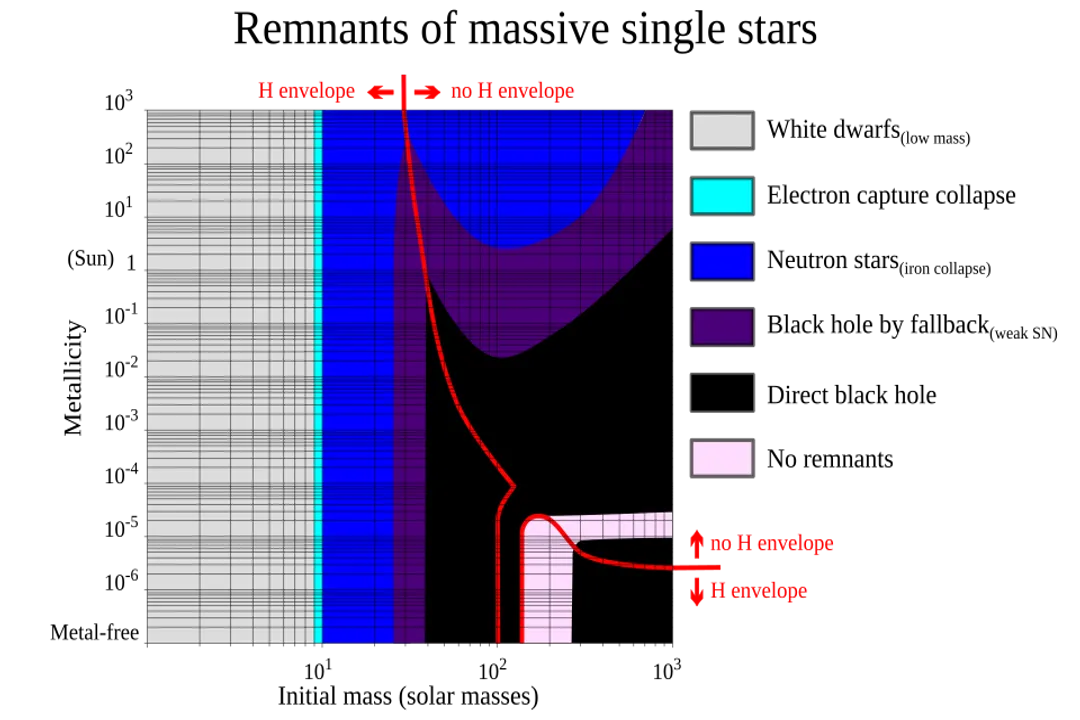
What remains after the core has settled depends entirely on the initial mass of the star that collapsed. [6] If the remnant mass falls below the maximum stable mass for a neutron star, the result is that compact object, spinning rapidly and possessing an incredibly strong magnetic field. [3] These neutron stars are the seeds of pulsars if their magnetic poles are aligned correctly to sweep beams of radiation across our line of sight. [8]
However, if the mass of the progenitor star was significantly higher, or if the remnant core exceeds the maximum stable limit for neutron degeneracy pressure (the Tolman-Oppenheimer-Volkoff limit, which is still a subject of refinement), the fight against gravity is lost again. [5] In this scenario, nothing known in physics can halt the collapse. The core continues to compress past the point of no return, collapsing into a black hole. [3][5] The gravitational field becomes so intense that even light cannot escape its boundary, the event horizon. [3]
The material ejected in the supernova explosion forms a supernova remnant. [8] These glowing clouds of expanding gas are rich in heavy elements—the very iron, gold, and uranium synthesized in the star’s dying furnace—which are then scattered throughout the galaxy, providing the raw material for the next generation of stars, planets, and life itself. [4]
Here is a comparison showing the dependency on the initial stellar mass, which dictates the final core fate:
| Progenitor Star Mass (Approx.) | Core Fate Post-Collapse | Resulting Object |
|---|---|---|
| $8$ to $25$ Solar Masses | Collapse halts via neutron degeneracy | Neutron Star |
| $> 25$ Solar Masses | Collapse overcomes all pressure | Black Hole |
| $< 8$ Solar Masses | Fusion ceases, core contracts slowly | White Dwarf (potential Type Ia) |
| [3][5][6] |
It's fascinating to consider the sheer energetic difference between the initial collapse and the light we actually observe. The energy released in neutrinos is so vast that even a tiny fraction interacting with the outer layers is enough to power the visible explosion. [4] This highlights that the visible light of a supernova, though briefly outshining an entire galaxy, is merely the energetic aftermath, the splash caused by the deeper, invisible collapse of the core. [7]
Understanding these immediate post-collapse processes is crucial for astronomers. Efforts are underway to catch these events before the visible light arrives, by monitoring neutrinos or gravitational waves that signal the core's implosion moment. [9] Detecting these precursors gives us a few precious hours or days to prepare telescopes before the electromagnetic radiation washes over us, providing an unparalleled look into the mechanics that govern the universe's most dramatic events. [9] The core's transformation is not just the death of a star; it is the cosmic forge for the universe's heavy elements, making the seconds of its implosion the most significant for galactic chemical evolution.
#Videos
A Detailed Breakdown of Core Collapse Supernovae - YouTube
Related Questions
#Citations
What happens to a massive star's iron core before it collapses?
Core-collapse | COSMOS
Supernova - Wikipedia
DOE Explains...Supernovae - Department of Energy
Why does matter stay collapsed in the core, following a supernova ...
What happens to the core of a super massive star after it ... - Quora
A Detailed Breakdown of Core Collapse Supernovae - YouTube
Supernovas & Remnants | Center for Astrophysics
Catching Core-Collapse Supernovae Before They Happen