What happens when a blue star dies?
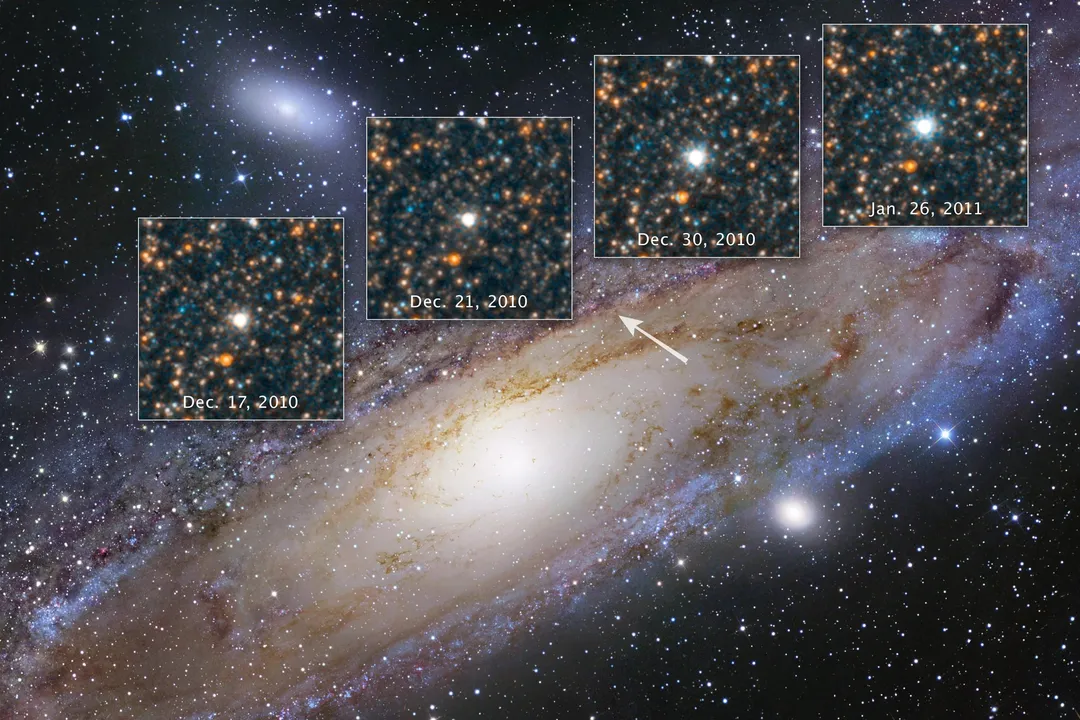
The demise of a massive, brilliant blue star is one of the most spectacular and consequential events in the cosmos. These stellar giants burn through their nuclear fuel reserves at an astonishing rate, leading to a dramatic and swift end compared to their smaller, dimmer counterparts. [7] Unlike the slow, gentle fade of a star like our Sun, the death of a blue star often involves explosions that fundamentally reshape the interstellar medium around them. [7]
# Hot and Fast

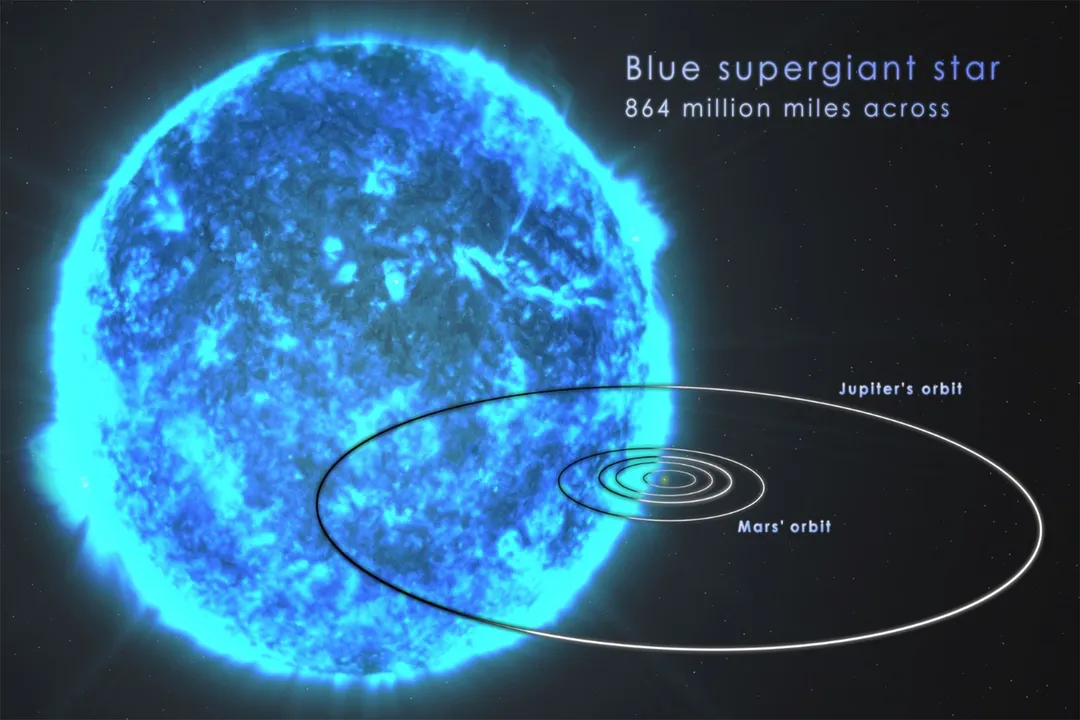
Blue stars are defined by their extreme mass and corresponding high surface temperatures, often exceeding $10,000$ Kelvin. [7] Because of this intense heat, their rate of nuclear fusion is exponentially higher than that of middle-aged, yellow stars. In essence, a blue supergiant operates with the pedal constantly pressed to the floor; it shines blindingly bright for a relatively short period, perhaps only a few million years, before it exhausts the hydrogen fuel in its core. [7] While a star like the Sun has a lifespan measured in billions of years, a blue giant lives fast and dies young, spending its brief existence radiating enormous amounts of energy into space. [6][7]
The life cycle progression for these heavyweights is marked by sequential fusion stages. Once hydrogen is consumed, the star begins fusing heavier elements in its core, progressing from helium fusion to carbon, neon, oxygen, and silicon. [5] Each successive burning stage lasts for an increasingly shorter duration. [6] The final stage of this internal layering process sees the core transforming silicon into iron. [5]
# Core Collapse
This iron-producing stage signals the inevitable end because fusing iron consumes energy rather than releasing it. [5] When the iron core grows too massive—reaching roughly the Chandrasekhar limit for massive stars, though the exact threshold is complex—it loses the outward thermal pressure supporting it against its own immense gravity. [6] Gravity takes over completely, and the core begins a catastrophic inward collapse over a matter of milliseconds. [5][6]
For the most massive blue supergiants, the core collapse can be so swift and complete that the outer layers don't have time to produce a visible rebound explosion in the conventional sense. [1] Instead, the crushing gravity overcomes all known forces, squeezing matter down past the point where neutrons can resist, leading directly to the formation of a black hole. [1] This scenario represents the most extreme possible stellar endpoint.

# Explosive Finale
When the stellar core collapses down to nuclear densities—where protons and electrons are squeezed together to form neutrons—it suddenly becomes incredibly rigid. [5] This "stiffening" causes the infalling outer layers of the star to hit this newly formed, incompressible neutron core and rebound violently. [5] This rebound generates a massive shockwave that races outward through the star, causing the outer layers to be ejected into space in a cataclysmic supernova. [5]
The energy released during this event is staggering, briefly outshining entire galaxies. [5] The process of stellar death for these blue behemoths is often categorized as a Type II supernova, characterized by the core collapse that follows hydrogen exhaustion. [5][7] The initial state of the star—whether it was a blue supergiant or a slightly less massive blue giant—dictates whether a visible explosion or a direct implosion occurs. [1] When an explosion does happen, the resulting debris flies outward at high velocities, creating shockwaves that heat and ionize surrounding interstellar gas. [3] Astronomers can sometimes observe the glowing, expanding blue bubble or nebula left behind in the aftermath of such a powerful event. [3]
# Stellar Remnants
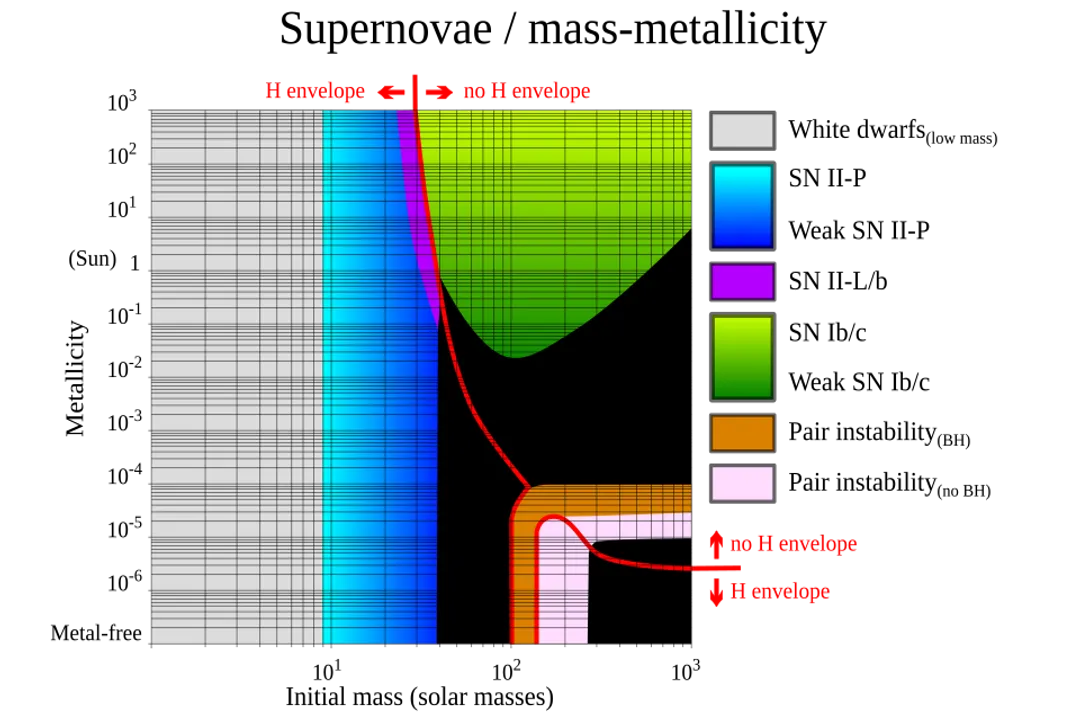
What remains after the supernova shockwave dissipates depends entirely on the mass of the compact core left behind after the outer material has been blown away. [5]
There are two primary outcomes for the remnant object:
Neutron Star: If the core mass falls into a specific intermediate range, typically between about $1.4$ and $3$ solar masses, the intense gravitational pressure results in a neutron star. [5] These objects are incredibly dense; a teaspoonful of neutron star material would weigh billions of tons. [5] The collapse halts just shy of forming a black hole. [5]
Black Hole: If the original star was massive enough, or if the core remnant exceeds the maximum stable mass for a neutron star, gravity overwhelms even the neutron degeneracy pressure. [1][5] In this instance, the core collapses indefinitely, forming a singularity wrapped by an event horizon—a black hole. [1][5]
It is fascinating to consider that the very elements required to build rocky planets and support life as we know it are synthesized and distributed during this process. [6] The extreme temperatures and pressures within the supernova shockwave are responsible for creating many elements heavier than iron, which are then seeded back into the galaxy to eventually form new generations of stars, planets, and perhaps even biological structures. [6]
# Context Comparison
Observing the final stages of a blue supergiant provides a sharp contrast to the fate awaiting our own Sun. Stars similar in mass to the Sun will swell into red giants, gently puffing off their outer layers to form a planetary nebula, leaving behind a white dwarf that slowly cools over eons. [7] The blue star, however, undergoes a process involving core implosion and powerful shockwaves, resulting in either a hyper-dense neutron star or a spacetime singularity. [5] The difference in final outcome is entirely dictated by the initial mass—a factor of perhaps ten or more times the Sun's mass separates a quiet stellar retirement from a spectacular, universe-altering explosion. [7]
The sheer scale of energy involved suggests that even in a relatively quiet stellar remnant, like a neutron star, the physics at play are far removed from standard stellar behavior. Imagine a city-sized object packed with more mass than the Sun, spinning hundreds of times per second—such a remnant represents a permanent, exotic imprint left on the universe from a star that was, for a moment, the brightest thing in its galactic neighborhood. [5] The observable evidence of these deaths, from the expanding nebulae to the resulting collapsed objects, forms a critical part of our understanding of stellar evolution and galactic chemical enrichment. [3][6]
Related Questions
#Citations
The Violent Deaths of Giant Blue Stars May Spawn Exotic Matter
What is the death of a blue star like? - Quora
Astronomers observe blue bubble left behind by star shedding its ...
The Death of Stars - Wonderdome: Planetarium Shows for Schools
Supernova - Wikipedia
[PDF] Death of Stars
Stellar Evolution - | The Schools' Observatory
The Death Throes of Stars - NASA Science
Inner Workings: A massive star dies without a bang, revealing the ...