What happens to a large star when it dies?
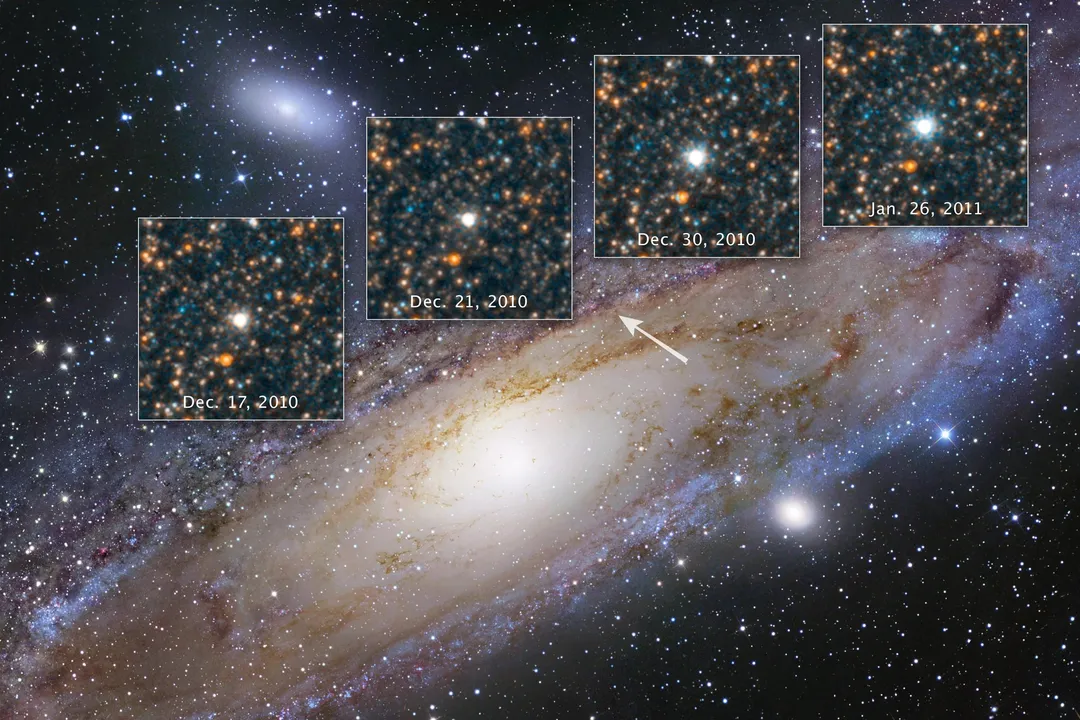
The death of a star is not a gentle fading away, especially when that star is counted among the heavyweights of the cosmos. While a star like our Sun will eventually puff up, shed its outer layers, and leave behind a cooling cinder called a white dwarf, the demise of a truly massive star—one significantly larger than the Sun—is one of the most violent and energetic events in the universe. These stellar giants live fast and die dramatically, fundamentally reshaping the space around them through spectacular explosions.
# Fuel Crisis
A star spends the majority of its life in a delicate balancing act: the outward pressure generated by nuclear fusion in its core perfectly counters the inward crush of its own gravity. This is the main sequence phase, where hydrogen is fused into helium. For a massive star, this stage is relatively short-lived compared to smaller stars because its immense gravity demands a much higher rate of energy production to maintain equilibrium.
When the core runs out of hydrogen fuel, the immediate support mechanism disappears, and gravity begins to win the struggle, causing the core to contract and heat up significantly. This heating allows fusion to continue, but now with heavier elements. Unlike smaller stars that might stall after helium fusion, massive stars have the necessary temperature and pressure to ignite subsequent fusion cycles.
# Layered Fusion
As the core contracts and heats further, it begins fusing the helium into carbon and oxygen. Once the helium is exhausted, the core contracts again until it gets hot enough to fuse carbon, and so on. This process creates an internal structure resembling an onion, with different elements burning in concentric shells around the core. Hydrogen might be fusing in the outermost shell, followed by helium, then carbon, neon, oxygen, and silicon in deeper layers.
While a typical main-sequence star only has one primary engine running—hydrogen fusion—these behemoths create a chain reaction, like a multi-stage rocket firing sequentially, each stage briefer and hotter than the last, until the final, unsustainable stage is reached. Each subsequent stage of fusion generates less energy relative to the amount of fuel consumed, meaning the star spends less and less time on that new stage before exhaustion forces the next contraction.
# Iron Core
This process of building up heavier elements continues until the core is composed almost entirely of iron. Iron represents the cosmic dead end for stellar fusion. Fusing elements lighter than iron releases energy, which supports the star against collapse. However, fusing iron absorbs energy rather than releasing it.
Once a substantial iron core forms, the star loses its primary energy source instantaneously. There is no further fusion available to push back against the relentless inward pull of gravity. Because of the enormous mass involved, this catastrophic failure happens in mere milliseconds.
# Collapse Supernova
With the outward pressure gone, gravity causes the iron core to collapse inward violently. The speed of this infall is staggering, reaching up to $70,000$ kilometers per second, or about $23%$ of the speed of light. This implosion compresses the core to densities greater than that of an atomic nucleus.
When the core material is squeezed past this critical nuclear density, it becomes incredibly stiff and effectively "bounces." This sudden halt of infalling matter generates a tremendous outward-moving shock wave. This shock wave rips through the star's outer layers, heating them to billions of degrees and triggering an unimaginably powerful explosion known as a Type II Supernova. For a brief period, this single event can radiate more energy than the entire rest of its host galaxy combined.
# Stellar Remnants
What remains after the supernova depends entirely on the mass of the collapsed core. The explosion blasts the star's outer layers—which are now enriched with elements heavier than iron, created during the explosion itself—out into space.
# Neutron Stars
If the remaining core mass is between about $1.4$ and $3$ times the mass of our Sun, the collapse halts, leaving behind a neutron star. Gravity is so intense here that it forces electrons and protons to combine, creating a sea of almost pure neutrons held up by neutron degeneracy pressure. These objects are incredibly compact; a typical neutron star packs more mass than the Sun into a sphere only about $10$ to $20$ kilometers across. To put that density into context, a single teaspoon of neutron star material would weigh roughly a billion metric tons.
# Black Holes
If the original star was exceptionally massive, leading to a core remnant exceeding roughly $3$ solar masses, even the incredible resistance of neutron degeneracy pressure cannot withstand the crushing gravity. The collapse continues without stopping. The core shrinks to an infinitely dense point called a singularity, surrounded by a boundary of no return known as the event horizon. This object is a black hole, an area of spacetime from which nothing, not even light, can escape.
# Cosmic Seeding
The materials ejected by a supernova—including the gold, uranium, and other heavy elements created in the final moments of the explosion—are vital for cosmic evolution. The expanding cloud of gas and dust, the supernova remnant, sweeps up surrounding interstellar material and mixes these freshly forged elements into the galactic medium.
The speed at which this ejected material disperses is breathtaking. A large supernova remnant can expand outwards at tens of thousands of kilometers per second, meaning the necessary building blocks for the next generation of stars, planets, and, eventually, life, are distributed across light-years in mere millennia—a geological blink of an eye in cosmic terms. Thus, the violent death of a massive star ensures that the raw materials for future complexity are generously supplied across the galaxy.
#Videos
How Stars Die - YouTube
Related Questions
#Citations
The Death Throes of Stars - NASA Science
The Death of a Star - How Stars Work - Science | HowStuffWorks
ELI5: What is a dying star? : r/explainlikeimfive - Reddit
Death of a Star: What Happens When Things Go Dark
[PDF] Death of Stars
How Stars Die - YouTube
What happens when all the stars die? | Royal Museums Greenwich
[PDF] Death of a star - University of Western Australia
When a star dies, what remains: a rock, nothing, or something else?
What happens when the most massive stars die? - Facebook