What happens to a star before it explodes?
The final moments of a massive star are arguably the most energetic and consequential events in the cosmos, culminating in a spectacular outburst known as a supernova. [1] These explosions briefly outshine entire galaxies, scattering the processed material forged in the star's core across interstellar space. [8] Before this cataclysm, however, the star undergoes a profound, rapid internal reorganization driven by the inexorable pull of gravity meeting the limits of nuclear physics. Understanding this prelude reveals a cosmic drama playing out over mere seconds or minutes after eons of quiet burning.
# Fuel Exhaustion
A star spends the vast majority of its existence in a stable phase, fusing hydrogen into helium in its core. [1] This sustained nuclear fusion generates an outward pressure that perfectly balances the inward crush of the star's own gravity, maintaining hydrostatic equilibrium. [4] This balancing act is the definition of a healthy, main-sequence star.
However, this stable life is finite, and the duration depends critically on the star's initial mass. [6] Stars significantly more massive than our Sun—those starting with at least eight times the Sun's mass—burn through their fuel supply at an astonishing rate compared to smaller stars. [6] While a Sun-like star might take billions of years to exhaust its core hydrogen, a heavyweight star can blaze for only a few million years before demanding more extreme measures to maintain its fight against gravity. [6]
# Layered Burning
Once hydrogen is depleted in the center, the star doesn't simply wink out. Instead, it begins fusing heavier and heavier elements in concentric shells around the core, like an onion being built from the inside out. [1][4] The star contracts slightly, heats up, and begins fusing helium into carbon. When the helium is spent, it moves on to fuse carbon into neon, and so on, through oxygen, silicon, and eventually reaches the element iron in the innermost layer. [1][4] This progression is an incredible feat of physics, demanding progressively higher temperatures and pressures for each subsequent reaction. [4]
| Fusing Element | Product | Approximate Core Temperature (Billion K) |
|---|---|---|
| Hydrogen | Helium | 0.015 |
| Helium | Carbon | 0.1 |
| Carbon | Neon, Magnesium | 0.6 |
| Neon | Oxygen, Magnesium | 1.2 |
| Oxygen | Silicon, Sulfur | 2.0 |
| Silicon | Iron | 3.5 |
This table illustrates the escalating temperature required to initiate successive fusion stages in a massive star's final years [1][4].
# The Iron Core
The chain of fusion stops dead at iron. Fusing elements lighter than iron releases energy, which provides the necessary outward pressure to counteract gravity. However, iron is the most stable atomic nucleus; fusing iron consumes energy rather than releasing it. [1] When the star's core becomes pure iron, it has reached a terminal roadblock. There is no longer any internal energy source capable of pushing back against the star's immense gravitational weight. [1][7]
This transition marks the true beginning of the end. While the outer layers might continue burning lighter elements in shells around the inert iron core, this activity only hastens the inevitable, as the iron core continues to grow in mass. [7] As the core grows, the pressure mounts until it reaches a critical limit, often cited around $1.4$ to $2.8$ solar masses, depending on the star's exact nature. [1]
# Implosion Onset
Once the iron core surpasses this stability threshold, gravity wins, and the core collapses with terrifying speed. [7] This implosion is incredibly fast. In a matter of milliseconds, the core shrinks from the size of the Earth to a sphere only about 20 kilometers across. [2][7] For a star that has existed for millions of years, this final act happens in the blink of an eye. It is a physical reality that the final death throes of a giant star can occur faster than you can register the thought—a collapse measured in fractions of a second. [7]
# Core Bounce and Shockwave
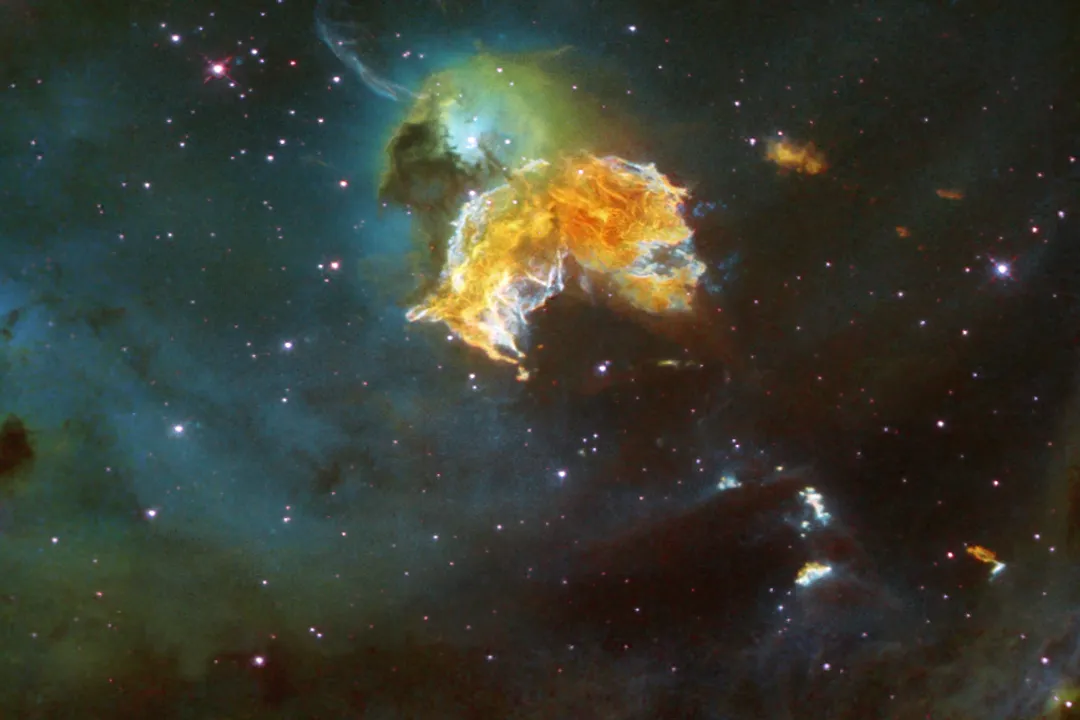
The core’s descent is abruptly halted when it reaches nuclear densities, where the repulsive forces between neutrons become strong enough to resist further compression. [2][7] At this point, the core effectively becomes rigid. The material that was rushing inward, having traveled nearly the entire radius of the star, suddenly slams into this impossibly hard, newly formed neutron core. [2]
This impact causes the infalling material to rebound, generating a tremendous outward-moving shockwave. [2][7] This is the key mechanism that powers the visible supernova explosion. However, the simple rebound alone is often not enough to fully eject the star's outer layers, especially for the most massive progenitors. The shockwave can stall just outside the core, choked by the overlying stellar material. [2]
# Stellar Internal Conflict
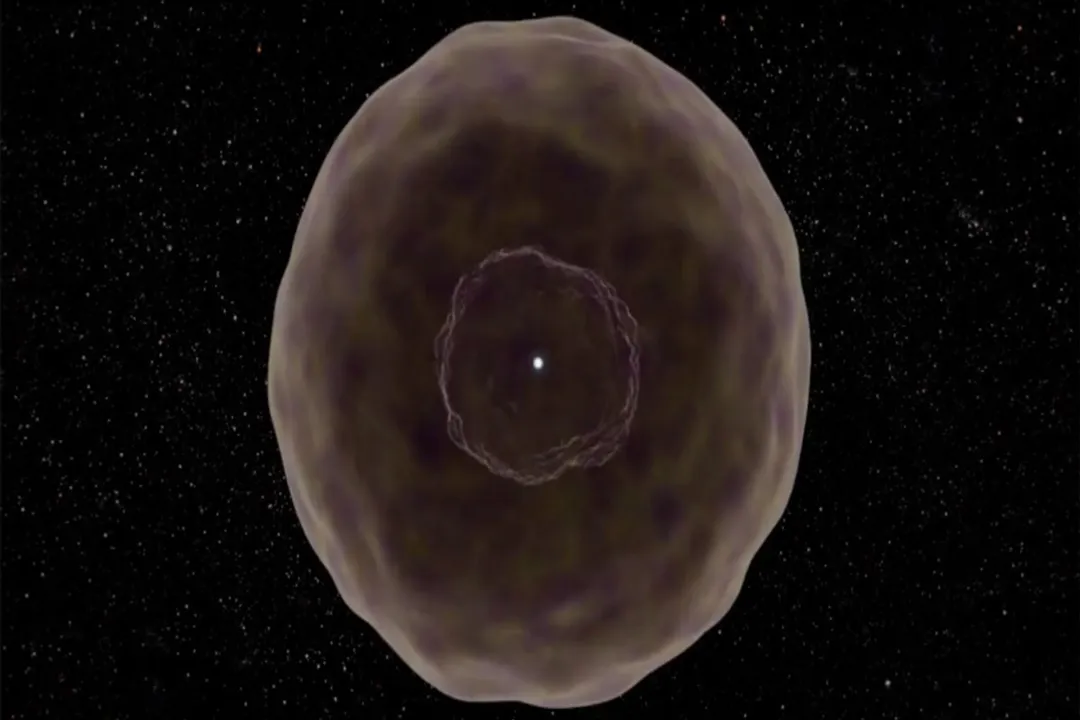
Recent astronomical observations have provided unprecedented insights into the complex physics immediately preceding the blast. For some supernovae, data collected by X-ray telescopes like NASA’s Chandra have revealed evidence of an "inner conflict" in the star’s final days. [3] This refers to a period where the star sheds some of its outer material through powerful winds, only to have that material fall back onto the star before the final collapse. [3]
One groundbreaking observation of a Type II supernova, captured remarkably early, allowed scientists to see the star's internal workings just as it was beginning to die. [5] These detailed views confirm that the structure and mass loss history of the star are crucial factors in how the eventual shockwave will propagate. This observed behavior—ejecting material, then drawing it back in—suggests a highly unstable, dynamic environment as the star struggles against the impending core collapse. [3] It’s a late-stage battle where the star is simultaneously pushing material away and having that same material settle back onto its collapsing structure, complicating the release of energy.
If we consider the typical mass of a progenitor star for a core-collapse supernova (Type II), which can range from about 8 to 50 solar masses, the sheer inertia of the outer layers presents a monumental challenge to the nascent shockwave. [1] The more massive the star, the more material must be pushed outward, and the more likely the shock is to stall near the core, requiring additional energy input—often through the explosion of neutrinos—to succeed. [2]
# The Supernova Event
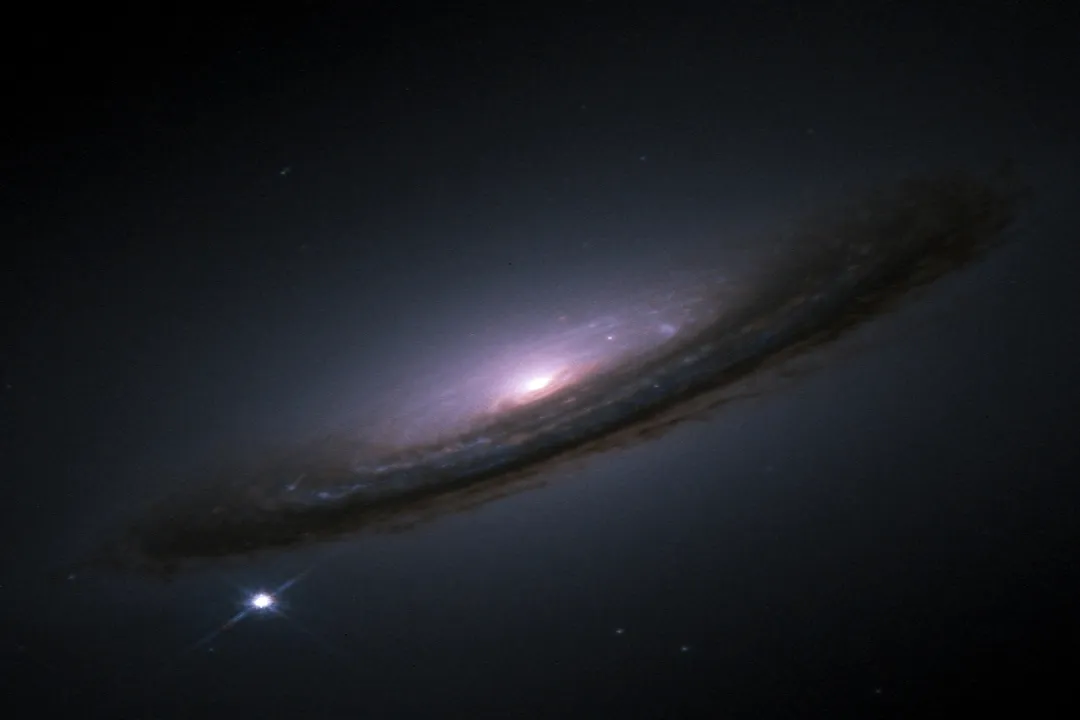
When the shockwave successfully breaks through the stellar surface, the result is the supernova explosion itself. [7] This explosion is responsible for synthesizing and ejecting virtually all elements heavier than iron, such as gold, uranium, and platinum. [8] The initial explosion releases such a massive burst of energy that the expanding cloud of debris—the supernova remnant—shines brightly for weeks or months. [1]
Following the explosion, the remnant core settles into one of two possible fates, determined by its mass:
- Neutron Star: If the remaining core mass is between about $1.4$ and $3$ solar masses, the remnant stabilizes as an incredibly dense neutron star. [1]
- Black Hole: If the remaining core mass exceeds the maximum stable limit for a neutron star (often estimated around $2$ to $3$ solar masses, though precise limits are complex), gravity overcomes even the neutron degeneracy pressure, and the core collapses into a black hole. [1]

# Legacy and Rebirth
The material ejected by the supernova is not just wasted energy; it is the cosmic recipe book for the next generation of stars and planets. [9] This ejected gas, enriched with heavy elements created during the explosion and within the star's lifetime, mixes with existing interstellar gas clouds. [9] When new stars eventually form from this enriched medium, they inherit the building blocks for rocky planets, water, and, eventually, life. [9]
This connection highlights a profound cycle: the death of one generation of massive stars directly seeds the birth of the next. [9] While the star's life before the explosion was an act of creation through fusion, the explosion itself is an act of creation through dispersal, ensuring the continuation of cosmic chemical evolution. [8] If one were to trace the atoms in their own body, many would find their ultimate origin within the fiery, compressed interior of a star that met its spectacular end long ago. Observing these pre-explosion phases, as astronomers recently have, gives us a tangible link to the physics that governed those ancient, distant stellar deaths.
# Timescales and Stellar Mass
It is helpful to distinguish the final, rapid collapse from the long, steady burn that precedes it. The entire lifespan of a massive star, say one starting at $20$ times the Sun’s mass, might only be around $10$ million years. [6] In contrast, the final sequence—from exhausting the last fuel (silicon) to the core turning to iron, and the subsequent collapse—happens incredibly fast. [7] The time between the iron core forming and the core reaching neutron degeneracy density is often measured in the time it takes for light to travel a few kilometers, meaning the entire collapse is over in less than a second. [7]
This speed is a crucial takeaway. While the star may appear stable for millions of years, the final, fatal process is nearly instantaneous on astronomical timescales. This compression of time explains why observing the immediate precursor events is so difficult, requiring extremely sensitive, broad-field monitoring, as the star gives virtually no warning before the final implosion. [3][5] The observational achievement of witnessing the "death throes" before the explosion implies catching the star right at the moment the stabilizing pressure failed, a phenomenon that lasts mere hours or days before the final light show begins. [7]
#Videos
INSIDE A SUPERNOVA - What Happens Before a Star Explodes
Related Questions
#Citations
Supernova - Wikipedia
(Super)novas - what is actually happening during the explosion?
NASA's Chandra Reveals Star's Inner Conflict Before Explosion
INSIDE A SUPERNOVA - What Happens Before a Star Explodes
First-of-its-kind supernova reveals inner workings of a dying star
What is the lifetime of a star before it goes supernova? - Quora
Astronomers See Death Throes of Giant Star Before Violent Explosion
Unique Shape of Star's Explosion Revealed Just a Day After Detection
When stars explode after running out of fuel, why are new stars born ...