What happens in the convective zone of a star?
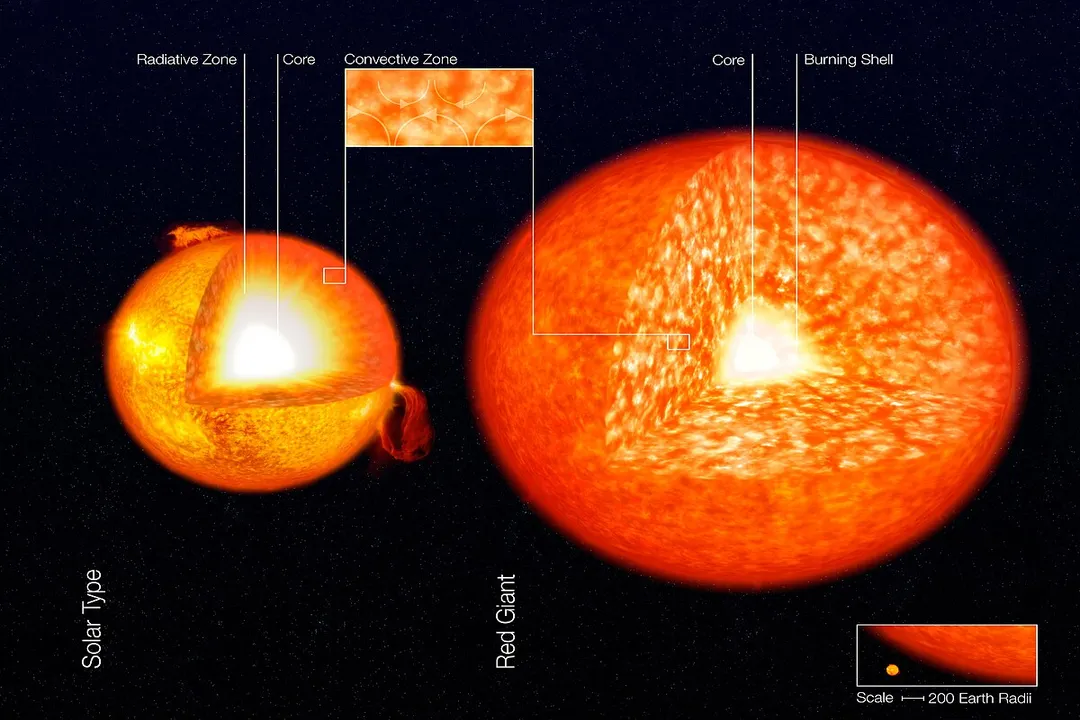
The internal structure of any star, from our modest Sun to the most massive giants, is stratified into distinct layers, each handling the immense energy generated in the core through different physical processes. Deep beneath the visible surface, outside of the central furnace and often outside the tightly packed inner region, lies the convective zone. This region is defined not by what is being made—the nuclear fusion happens much deeper—but by how the resulting energy is transported outward to the surface, the photosphere, where it finally radiates into space. [1][4]
# Zone Location
In stars similar to the Sun, which are classified as low to intermediate mass, the interior is generally divided into three main sections: the core, where hydrogen fuses into helium; the radiative zone surrounding the core; and the outermost layer, the convective zone. [4][7] This structure is a result of how efficiently energy can move through the stellar material at different temperatures and densities. [7]
For the Sun specifically, the core extends about 25 percent of the way to the surface, followed by the radiative zone, which stretches out to roughly 70 percent of the solar radius. [4] Consequently, the convective zone occupies the outer third of the Sun's interior, beginning around 400,000 kilometers beneath the visible surface and extending all the way up to it. [4] This configuration—radiative interior, convective exterior—is typical for stars in the Sun's mass range, often referred to as G-type stars or similar main-sequence objects. [1]
However, this layering is not universal across all stellar types. A key differentiation arises when comparing low-mass stars to their more massive counterparts. [1][3] Stars significantly more massive than the Sun, perhaps ten times its mass or more, often exhibit an inverted structure. [1] In these high-mass stars, the central region dominated by core fusion is surrounded by a large convective core, which then gives way to an extensive radiative envelope that reaches the surface. [1][3] This structural difference dictates fundamental aspects of the star's life cycle and eventual fate. [3]
# Energy Transport
The distinction between the radiative zone and the convective zone hinges entirely on the efficiency of energy propagation. [7] In the radiative zone, energy moves primarily through the process of radiation: photons, created in the core, travel outward by being repeatedly absorbed and re-emitted by the plasma particles. [7] This process is incredibly slow because the path of any individual photon is a tortuous, random walk, resulting in a net outward energy flow that can take hundreds of thousands of years. [7][4]
The convective zone operates under a completely different, and much more dynamic, physical principle: convection. [7][5] Convection is the transfer of heat through the physical movement of the fluid material itself, much like boiling water on a stove. [7] This process only becomes dominant when the temperature gradient—the change in temperature over a given distance—becomes too steep for radiation alone to handle efficiently. [5][7] When the plasma becomes opaque or the temperature difference between adjacent layers becomes large enough, the material becomes unstable, initiating bulk motion. [7]
To conceptualize this, consider the Sun's outer third: the gas here is cooler and less dense than the material deeper inside the radiative zone. [4] When pockets of gas from the bottom of this zone get hot enough, they become buoyant and rise toward the surface, much like bubbles in a boiling liquid. [7] As these plasma "parcels" reach the cooler outer layers, they transfer their heat to the surrounding material, cool down, increase in density, and then sink back down to be reheated by the plasma arriving from below. [7][5] This constant churning is what defines the convective zone, effectively moving energy outward on the timescale of days or weeks, rather than millennia. [4] If we analyze the transit time, we can estimate that a parcel of energy leaving the base of the solar convection zone might reach the surface in perhaps a few weeks, an astonishing acceleration compared to the years estimated for the photon's passage through the radiative zone in the Sun. [4][7] This significant difference in transport speed is the physical reason for the zone's existence.
# Plasma Movement
The mechanism driving this motion is governed by thermal instability. [5] In the context of stellar physics, convection is categorized as MHD convection, meaning the plasma motion is influenced by magnetic fields, although the primary driver is buoyancy. [5] The material rising and falling creates powerful currents within the star's outer layer. [1]
These moving currents are not uniform; they form distinct cells or "bubbles" of circulation. [5] At the bottom of the zone, the rising plumes of hot gas push against the cooler, denser gas sinking from above. [7] This continuous cycle leads to complex fluid dynamics. [5]
One fascinating outcome of this churning is what we observe at the stellar surface: granulation. [4] The Sun's photosphere is not a smooth, unchanging shell. Instead, it is covered in granular structures—bright centers where hot plasma is rising, surrounded by darker lanes where the cooler, denser plasma is descending back into the interior. [4] Each granule is essentially the visible top of a convective cell, offering a direct, albeit fleeting, glimpse into the violent mixing happening hundreds of thousands of kilometers below. [4] While the scale of these surface features is typically on the order of a few thousand kilometers, the underlying convection cells can be much larger and more complex in their three-dimensional structure. [5]
If we were to place a simplified probe into the very bottom layer of this zone in the Sun, we would measure temperatures around $2$ million Kelvin, and the plasma would be highly ionized. [4] By the time that same parcel reaches the visible surface, having shed its heat, the temperature drops dramatically to about $5,778$ Kelvin. [4] This temperature differential is the engine of the convection process.
# Mass Dependence
The location and extent of the convective zone are critically linked to the star's initial mass. [1][3] This is because mass dictates the core temperature and pressure, which in turn determine the opacity (how easily photons can pass through the material) in the outer layers. [3]
In very low-mass stars—red dwarfs, for example, with masses less than about $0.3$ solar masses—the temperature gradient is steep throughout the entire star. [1] Here, the entire stellar interior, from the core out to the surface, is convective. [1] This means that the helium ash produced in the core is constantly mixed throughout the star, preventing a dense, inert core from forming until the hydrogen fuel is exhausted. [1] This thorough mixing grants low-mass stars an incredibly long main-sequence lifetime, far longer than the Sun's projected 10 billion years. [1]
Contrast this with the Sun's structure (intermediate mass) where the radiation zone dominates the interior, and convection is confined to the outer layer. [1][4]
For the high-mass stars (greater than $1$ to $2$ solar masses), the core temperatures are so high that fusion proceeds much faster, and the plasma is significantly more ionized and less opaque than in the Sun's interior. [3] This increased transparency allows radiation to be an extremely effective means of energy transfer near the core. [3] Therefore, these stars develop a large convective core surrounded by a thick radiative envelope that reaches the surface. [1][3] In these massive stars, the surface layers are not churning vigorously; the energy transport mechanism transitions from convection (inside the core) to radiation (outside the core) and remains radiative until the very edge. [1] The physical boundary where this switch occurs is an important parameter for stellar modeling, often calculated based on the local opacity and temperature gradient. [5]
This distinction between the solar-type structure (convective outside) and the massive-star structure (convective inside) is one of the most important dividing lines in the study of stellar evolution. [1][3] It directly affects how long the star spends on the main sequence and what kind of giant star it becomes later in its life. [1] For instance, when our Sun exhausts its core hydrogen, it will transition into a red giant, and its entire structure is expected to become fully convective during that phase, a significant structural change driven by changes in opacity as the star expands and cools in its envelope. [1]
# Surface Effects
The energy transfer in the convective zone has observable consequences far beyond the internal physics. The churning plasma acts as a massive heat engine, and the constant rising and falling of magnetized gas creates the star's magnetic field through a process often termed the stellar dynamo. [5]
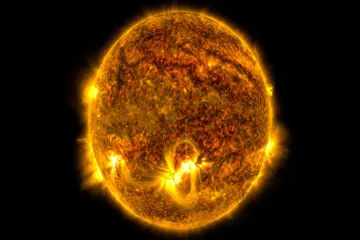
The organized motion within the convective zone stretches and twists the magnetic field lines, leading to the creation of sunspots, flares, and coronal mass ejections on the surface. [4][5] The magnetic fields are generated and maintained by the differential rotation—the equator rotating faster than the poles—combined with the vigorous motions of the conductive plasma. [5]
If we observe the Sun, we see features like supergranulation, which involves larger-scale flows than the fine-grained granules mentioned earlier, further demonstrating the complexity of the flow patterns within this outer layer. [4] The entire mechanism is a prime example of magneto-hydrodynamics in action.
To look at the scale involved in the Sun's convection zone, one can summarize the key characteristics:
| Property | Location | Approximate Value (Sun) | Transport Mechanism |
|---|---|---|---|
| Core | Center | Fusion/Radiation | |
| Radiative Zone | Middle Layer | to | Photon Diffusion (Slow) |
| Convective Zone | Outer Layer | to | Bulk Plasma Motion (Fast) |
| Temperature at Base | Bottom of CZ | N/A | |
| Temperature at Surface | Photosphere | Radiation | |
| [4][7] |
This comparison table starkly illustrates the steep thermal gradient that must exist in that final third of the star to necessitate the shift from the slow, orderly photon dance of radiation to the chaotic, energetic bubbling of convection. The physics demands that once the temperature gradient exceeds a certain critical value, dictated by the local thermal conductivity, the material must convect, or the star simply could not shed its energy fast enough to maintain hydrostatic equilibrium. [5][7]
The depth of this zone dictates how much of the stellar material is fully mixed over its lifetime. For stars like the Sun, only the outer third is mixed during the main sequence phase. [4] This means that the interior, where the fusion products (helium) accumulate, remains chemically distinct from the outer layers that still contain fresh hydrogen fuel. In contrast, the completely convective low-mass stars mix everything, allowing them to consume virtually all their fuel supply before evolving off the main sequence. [1] Understanding the precise boundary of the convective zone is therefore not just a structural curiosity; it is a critical input for any stellar evolution code aiming to accurately predict a star's lifespan and evolutionary track. [3][5] A slight miscalculation of the opacity or adiabatic temperature gradient at the radiative-convective boundary can throw off the predicted age of a star by billions of years in simulations.
Finally, one might consider the sheer energy involved. While the photons in the radiative zone carry the energy as discrete packets, the energy in the convective zone moves as mass itself. This mass movement, carrying thermal energy, creates powerful acoustic waves and turbulence that propagate outward, contributing to the heating of the star's atmosphere, the corona, to millions of degrees—a phenomenon far hotter than the surface below it. [4] This process shows that the convective zone is not merely a passive plumbing layer but an active intermediary that converts heat into mechanical and magnetic energy, which then dominates the visible and high-energy activity of the star. [5]
Related Questions
#Citations
Convection zone
Glossary term: Convective Zone
Convective Zones - an overview
NASA: The Solar Interior
Convection in A Stars
Convective Zone Definition - Astrophysics II Key Term
star_convection.html
convection zone