When does the physical principle of convection become dominant over radiation for energy transport?
Answer
When the temperature gradient becomes too steep for radiation efficiency
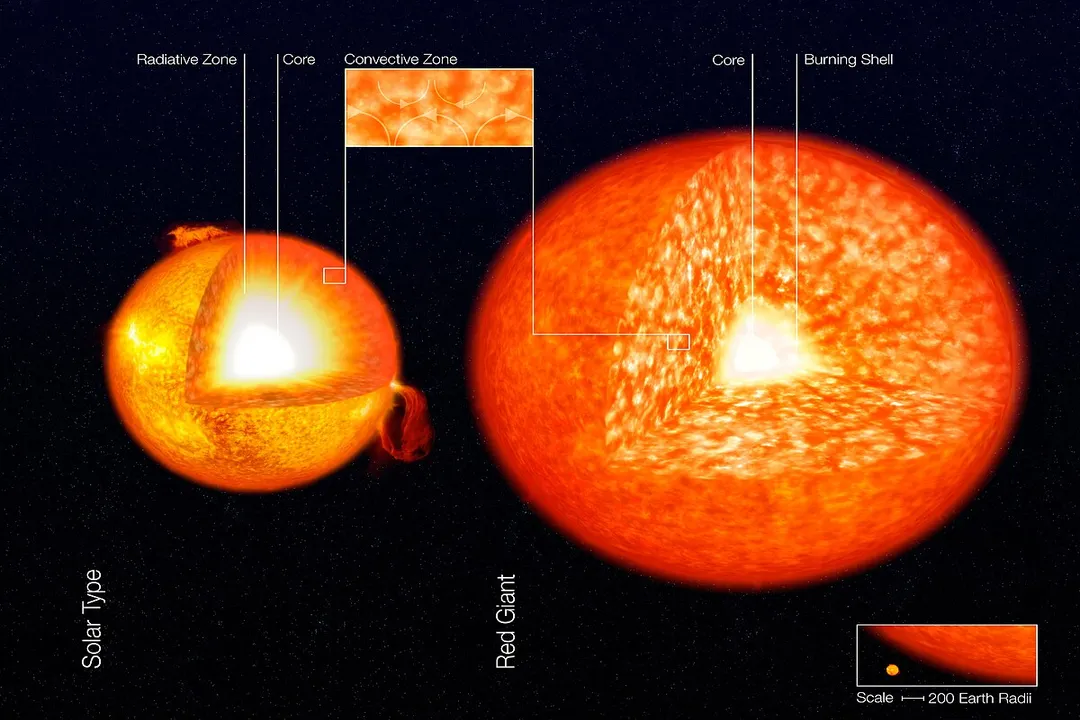
Convection is initiated as a thermal regulation mechanism when the internal temperature gradient—the rate at which temperature changes over distance—increases beyond a critical threshold. If radiation alone were relied upon under such steep gradients, the star could not efficiently move the necessary amount of energy outward to maintain hydrostatic equilibrium. When the plasma effectively becomes opaque due to high density or steep thermal variations, the material becomes unstable, triggering bulk fluid motion (convection) to rapidly transfer heat through the physical movement of the plasma itself.
Related Questions
What is the approximate starting depth of the Sun's convective zone?How is energy primarily transported in the radiative zone?What structural feature characterizes stars significantly more massive than the Sun?What observable feature on the Sun's photosphere is the visible top of a convective cell?How does energy transit time compare between the convective zone and the radiative zone in the Sun?What structural feature is true for very low-mass stars like red dwarfs?When does the physical principle of convection become dominant over radiation for energy transport?What is the approximate temperature difference between the base and the surface of the Sun's convective zone?What process generates the star's magnetic field due to motions within the convective zone?Why is the precise boundary of the convective zone critical input for stellar evolution codes?What physical principle defines the energy transfer in the convective zone?