What happens when a massive star runs out of elements to fuse?
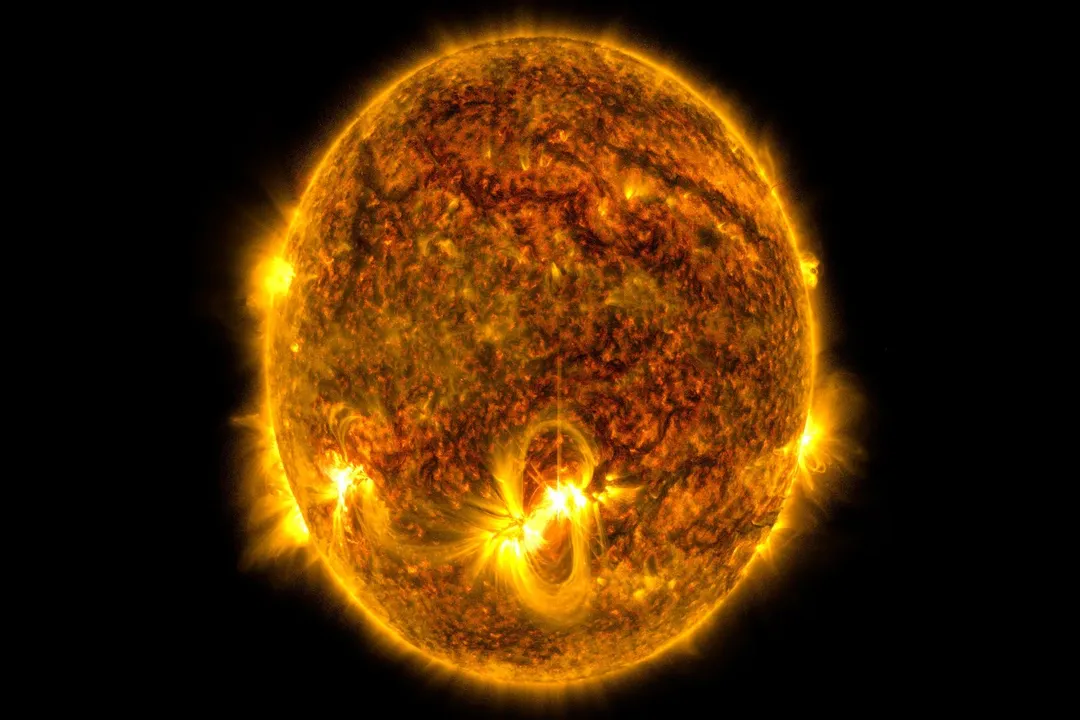
The stellar engine, the process that keeps a star shining across billions of years, is essentially a gigantic, self-sustaining thermonuclear furnace. This process, known scientifically as stellar nucleosynthesis, is the continuous creation of heavier elements from lighter ones, starting with the universe's most abundant ingredients: hydrogen and helium. [2] For stars like our own Sun, this fuel lasts for an immense duration, but for their much larger, more luminous cousins—the massive stars—the consumption rate is staggeringly high. When that primary fuel finally runs out in the core, the star doesn't simply switch off; it transitions into a series of increasingly desperate, energy-intensive burning phases until it reaches the absolute end of the nuclear road.[3][5]
# Stellar Fueling
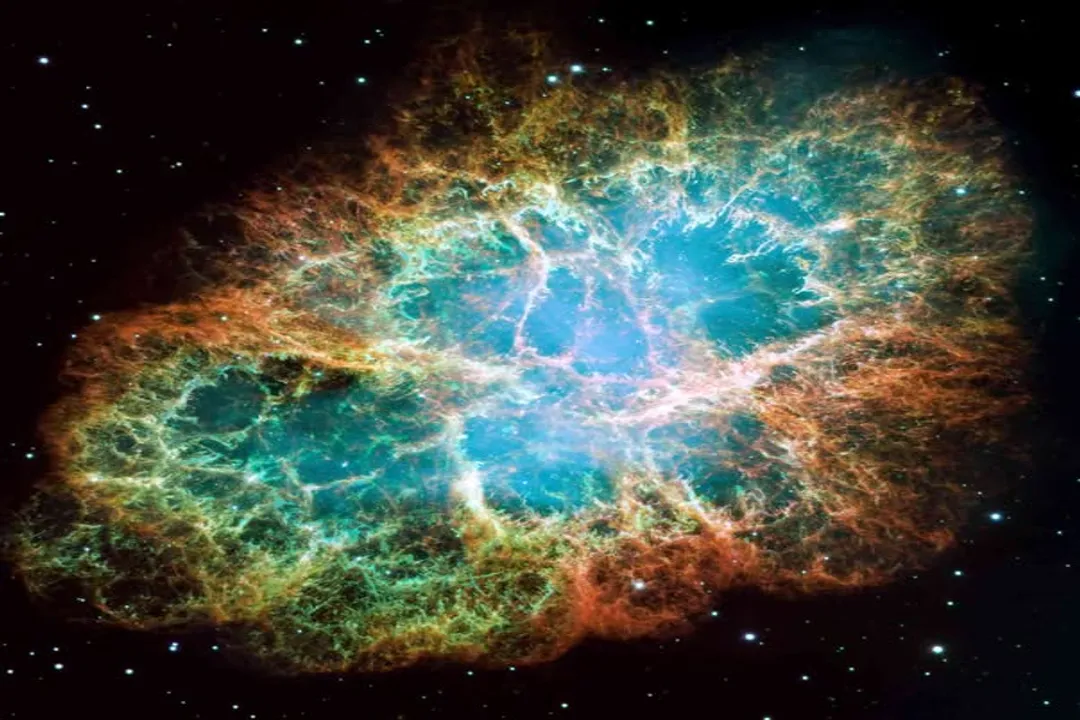
A star spends the majority of its life on the "main sequence," quietly fusing hydrogen into helium in its core. [8] This fusion releases an enormous amount of energy, creating an outward thermal pressure that perfectly balances the inward crush of the star’s own immense gravity. This equilibrium keeps the star stable. When the hydrogen supply in the very center is depleted, the core contracts under gravity, causing the temperature to rise significantly. [3][5] This contraction heats the surrounding shell of still-unburnt hydrogen, igniting it in a shell around the now-inert helium core. This added energy often causes the star's outer layers to swell dramatically, turning it into a giant phase, like the path our Sun will eventually take, though the fate of truly massive stars diverges sharply from that course. [6]
# Layered Burning
The path taken by a star several times the mass of the Sun is far more dramatic and complex. Once hydrogen is exhausted, the increased core temperature allows the helium to ignite, fusing into carbon and oxygen. [5] But for a massive star, that's just the beginning of a rapid sequence of shell burning. The star doesn't stop there because the gravitational forces squeezing the core are so much greater than in a smaller star. These colossal stars achieve the necessary temperatures and pressures to fuse carbon, then neon, then oxygen, and finally silicon. [7]
Think of it like an astronomical onion, where each layer is a different fusion process occurring simultaneously around the central core. As one element burns out in a specific shell, the core contracts again, heats up, ignites the next heavier element, and the shell structure shifts outward. [1][7] This entire process, from hydrogen burning to silicon burning, can take a massive star only a few million years, a mere blink compared to the billions of years it spent on the main sequence. The heavier the element being fused, the less time that stage lasts, a direct consequence of the increasing energy required to overcome the electrical repulsion between larger atomic nuclei.
| Fuel (Core/Shell) | Product | Duration (Relative) |
|---|---|---|
| Hydrogen | Helium | Longest (Billions of Years) |
| Helium | Carbon, Oxygen | Medium (Millions of Years) |
| Carbon | Neon, Magnesium | Short (Thousands of Years) |
| Silicon | Iron, Nickel | Shortest (Days or Less) |
The table above illustrates how the stellar life cycle shortens dramatically with each step up the fusion ladder. For instance, the silicon-burning stage, which precedes the final crisis, can last for less than a single day in the most massive stars, a truly frantic rush toward the end. [7]
# The Iron Wall
This layered process continues until the core is composed primarily of iron () and nickel. [1][7] This arrival at iron is the absolute critical turning point in the star’s life because iron represents the peak of nuclear binding energy. Every element lighter than iron is formed through fusion reactions that release net energy, which is what sustains the star against gravity. [2] However, fusing iron atoms together actually consumes energy rather than releasing it. [1][7] The reaction requires an input of energy from the surrounding stellar material to proceed.
Once the core is iron, the star has effectively run out of usable fuel. There is no nuclear process left that can generate the sustained outward pressure needed to support the star's colossal weight against the relentless pull of gravity. [7] This is where the paths of all stars—even the largest ones—diverge from a sustainable path.
# Core Implosion
The moment the iron core reaches a critical mass, often called the Chandrasekhar limit, the balancing act ends with catastrophic speed. Without the continuous energy generation, gravity wins instantly. The iron core, which might be about the size of Earth, begins to collapse in on itself at nearly a quarter of the speed of light. [1] This implosion is one of the fastest and most violent events in the universe.
As the core collapses, the density and temperature skyrocket to incomprehensible levels. Protons and electrons are squeezed together by the sheer force, overcoming their mutual repulsion and merging to form neutrons and vast numbers of neutrinos—subatomic particles that barely interact with normal matter. [1] In a fraction of a second, the massive core shrinks from Earth-size down to a ball only a few miles across, consisting almost entirely of neutrons packed together as tightly as atomic nuclei allow. The sheer speed and density of this collapse is a phenomenal demonstration of physics taking over when thermal energy fails; it’s a gravitational collapse so complete that it momentarily seems to defy the known limits of matter itself.[1]
# Supernova Eruption
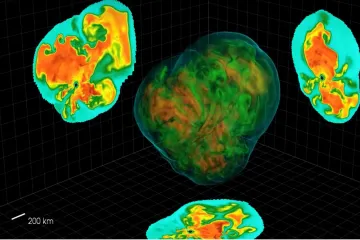
When the inner core reaches this maximum density—the density of an atomic nucleus—it abruptly becomes incredibly stiff, halting its implosion. The outer layers of the star, still rushing inward at tremendous speed, slam into this newly formed, incompressible neutron core. This impact creates a massive shockwave that rebounds outward. [1]
The rebound, aided by a massive burst of energy carried by the flood of neutrinos released during the collapse, drives the rest of the star’s material outward in a spectacular explosion known as a Type II supernova. [1] This explosion briefly outshines entire galaxies and is the mechanism by which all the elements heavier than iron—like gold, silver, and uranium—are forged and scattered across the cosmos, seeding the next generations of stars and planets. [2]
The final remnant left behind depends entirely on the mass of the original star. If the remaining core mass is between about 1.4 and 3 solar masses, the immense pressure holds it together as a neutron star. [1] If the initial star was so massive that its remnant core exceeds this limit (often cited around 3 solar masses), no known force, not even neutron degeneracy pressure, can stop gravity. The collapse continues past the point of no return, creating a black hole, a region of spacetime where gravity is so strong that nothing, not even light, can escape. [1] Thus, the failure to find the next viable fuel source after iron leads directly to either the universe’s densest known objects or a singularity in spacetime.[8]
Related Questions
#Citations
What happens when a very massive star runs out of elements to fuse?
Stellar nucleosynthesis - Wikipedia
When a star runs out of hydrogen, it begins using helium as fuel. Is ...
The energy released from nuclear fusion in the massive star's core ...
What happens when a star runs out of hydrogen? How does it turn ...
Red Giant - ESA/Hubble
Fusion of elements inside heavy stars - Astronomy Stack Exchange
Star Basics - NASA Science
The Evolution of Massive Stars and Type II Supernovae | ASTRO 801