What elements are created in a giant star?
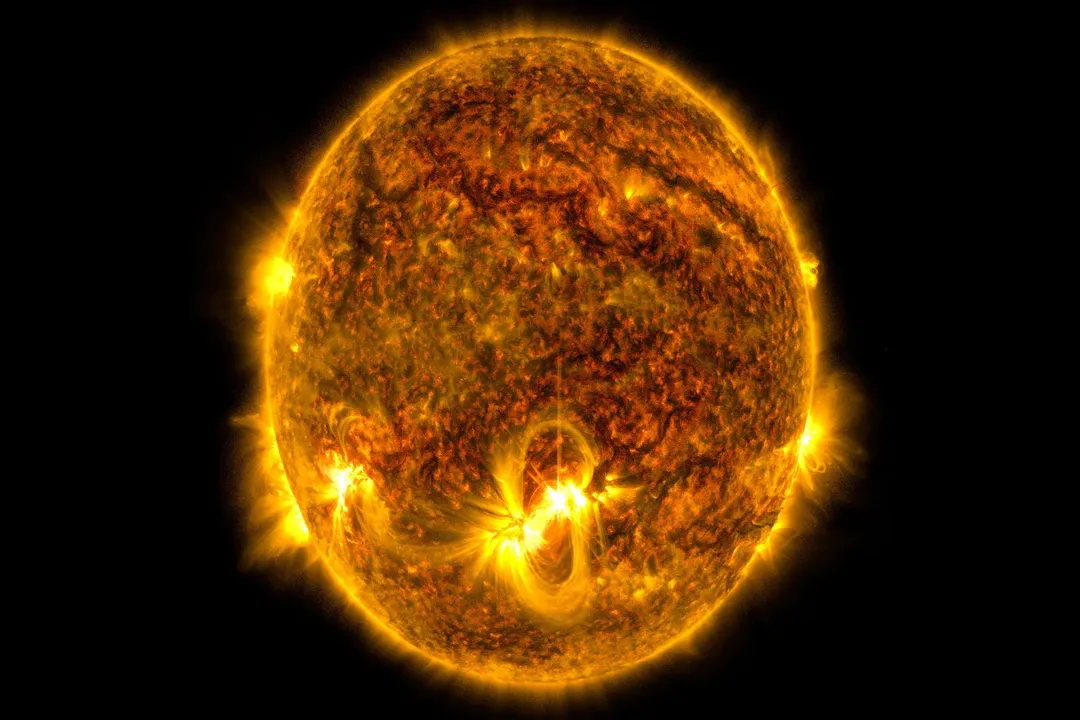
Stars are more than just distant points of light; they are the universe’s alchemists, the colossal engines responsible for forging nearly every element found on Earth and within our own bodies. [2][8] While our Sun is currently in its prime, fusing hydrogen into helium, the real fireworks—the creation of heavier elements—happen spectacularly within the giant and supergiant stars, whose lifespans are vastly different from our solar neighborhood's average inhabitant. [1][7] Understanding what elements these behemoths create requires tracing the fiery path from their initial hydrogen fuel to their dramatic, element-scattering demise.
# Initial Ingredients
Every star begins its life with the same basic recipe, drawn from the interstellar clouds from which it condensed. [5] This primordial mix, largely unchanged since the Big Bang, consists overwhelmingly of the lightest elements: roughly $75%$ hydrogen and about $24%$ helium, with only trace amounts of everything else. [9] Massive stars, destined to become giants, start with this same foundation, but their sheer mass dictates a much hotter and faster internal engine. [2] Because of this immense gravitational pressure, the processes that follow begin sooner and proceed far more rapidly than in a star like the Sun. [1]
# Main Sequence Fusion
For the majority of a star’s life, it maintains a stable equilibrium by fusing hydrogen nuclei into helium nuclei in its core. [2][5] This process, known as the proton-proton chain or the CNO cycle (more dominant in massive stars), releases the energy that counteracts the inward crush of gravity. [1][8] Once the core hydrogen is depleted—a swift affair in a massive star, perhaps lasting only a few million years—the star enters a new, dramatic phase, swelling into a red giant or supergiant. [7]
# Layered Element Creation
When the core runs out of hydrogen, gravity wins the temporary battle, compressing the core until the temperature is high enough to ignite the remaining hydrogen in a shell surrounding the inert helium core. [1] In truly massive stars, the gravitational squeeze is so intense that once the core reaches about $100$ million Kelvin, the helium itself ignites, starting the triple-alpha process. [4] This is where the element creation really accelerates and diversifies.
The triple-alpha process fuses three helium nuclei (alpha particles) into one carbon nucleus. [1][4] Following carbon production, subsequent fusion reactions begin to build up heavier elements sequentially, layer by layer, much like peeling an onion. [1][7] As each fuel source is exhausted in the center, the core shrinks and heats up, igniting the next element fusion in the core while the previous fusion product burns in an outer shell. [1][8]
For these massive stars, the sequence is astonishingly quick:
- Helium fuses into Carbon and Oxygen. [4]
- Carbon fuses into Neon, Sodium, and Magnesium. [1]
- Neon fuses into Oxygen and Magnesium. [4]
- Oxygen fuses into Silicon, Sulfur, and Phosphorus. [1]
- Silicon fuses into elements up to Iron () and Nickel (). [1][4]
This process builds up the periodic table from the lighter side, adding nuclei one by one or two by two through successive captures and fissions. [8] The sheer temperature and pressure inside a supergiant's core allow this process to occur at a blistering pace, often with each stage lasting only a few years, months, or even days for the final stages, unlike the billions of years the Sun spends on hydrogen burning. [1]
Here is a snapshot illustrating the rapid turnover in the final stages of a very massive star's life, contrasting it with the Sun's long-term energy production:
| Element Burning Stage (Core) | Approximate Duration (Massive Star) | Primary Products |
|---|---|---|
| Hydrogen Fusion | years | Helium |
| Helium Fusion | years | Carbon, Oxygen |
| Carbon Fusion | years | Neon, Magnesium |
| Neon Fusion | year | Oxygen, Magnesium |
| Oxygen Fusion | days | Silicon, Sulfur |
| Silicon Fusion | day | Iron, Nickel |
This escalating timescale highlights the intense internal conditions driving the elemental creation in these giants. [1] It's fascinating to consider that every atom of silicon in your garden soil or every speck of oxygen in the air you breathe in this instant was forged in a star that lived and died millions of years ago, experiencing the transition from hydrogen burning to silicon burning in less time than it takes to watch a feature film. [2]
# The Iron Ceiling
The production line grinds to a halt dramatically at iron (, atomic number $26$) and nickel. [3][6] Fusion reactions that create elements lighter than iron release energy, which is what supports the star against gravity. [1][8] However, iron sits at a unique point on the binding energy curve; it possesses the most tightly bound nucleus of all elements. [1][3] Fusing iron nuclei together consumes energy rather than releasing it. [3][6] When the core becomes dominated by iron, the star has no remaining thermonuclear source of outward pressure to counteract its crushing weight, leading to an immediate and catastrophic collapse. [1][3]
This universal limit on fusion energy explains why, even in the hottest, most massive stars, the elements up to iron are created through gradual burning processes, while everything heavier requires a more extreme event. [3][6] The composition of the star's interior just before collapse is a highly stratified, layered structure, with the densest, heaviest elements concentrated at the center, surrounded by shells of lighter material. [7]
# Post-Iron Nucleosynthesis
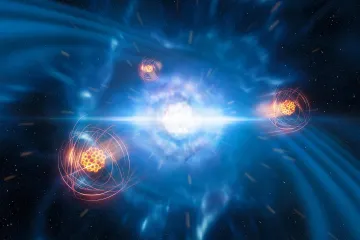
The creation of elements heavier than iron—gold, uranium, lead, and others—cannot occur via the standard fusion process within the star’s core because it is energetically unfavorable. [6] These elements require an influx of massive amounts of energy and an overwhelming flood of neutrons, which only happens during the star's spectacular death: a Type II supernova. [6][1]
When the iron core collapses, it bounces off an incompressible proto-neutron star, triggering a shockwave that rips the star apart. [1] During this explosion, conditions become so extreme that rapid neutron capture, known as the r-process, occurs. [6] In the r-process, atomic nuclei are bombarded with neutrons faster than they can decay, allowing them to rapidly build up massive, neutron-rich isotopes that eventually settle into stable heavy elements before being ejected into space. [6][8] Elements like gold, silver, and uranium are essentially the direct products of these supernova explosions. [6]
Some sources suggest that elements slightly heavier than iron can also be formed in the slower neutron capture process, the s-process, which occurs in asymptotic giant branch (AGB) stars (less massive than the giants leading to core-collapse supernovae). [1] This s-process contributes elements like barium and lead. [1] However, the heaviest elements absolutely require the violent conditions of a supernova's r-process. [6]
If we were to look at the final elemental inventory of a star that went supernova, the outer layers would be enriched with products from all earlier fusion stages (H, He, C, O, Ne, Si), while the newly formed iron core would be surrounded by a halo of the super-heavy elements forged in the explosion itself. [7] The incredible contrast between the slow, steady building of light elements and the instantaneous, violent creation of the heaviest ones demonstrates two fundamentally different physical mechanisms operating within the same stellar lifecycle. [1]
# Dissemination and Legacy
The elements created in these giant stars are not confined to their remnants; they are scattered across the galaxy when the star dies. [2] The resulting supernova explosion disperses the newly synthesized materials—hydrogen processed into carbon, oxygen turned into silicon, and iron converted into gold—into the interstellar medium. [1][8] This enriched gas then mixes with existing clouds, eventually forming the raw material for the next generation of stars, planets, and life. [2] Without the life and death of these massive, giant stars, the universe would remain a rather simple place, consisting almost entirely of hydrogen and helium. [5] The elements that make up our bodies, from the calcium in our bones to the iron in our blood, are a direct inheritance from these stellar furnaces. [4]
Related Questions
#Citations
Stellar nucleosynthesis - Wikipedia
Star Basics - NASA Science
Honest question: if Iron is the heaviest element created in stars, how ...
The Elements: Forged in Stars | PBS LearningMedia
Why are stars made from hydrogen and helium and not other ...
Ask Astro: How do stars make elements heavier than iron?
What's the elemental composition of supergiant stars? - Quora
DOE Explains...Nucleosynthesis - Department of Energy
Universal element formation - Science Learning Hub