What process fuels the majority of a stable star's life by counteracting gravity?
Answer
Fusing hydrogen nuclei into helium nuclei
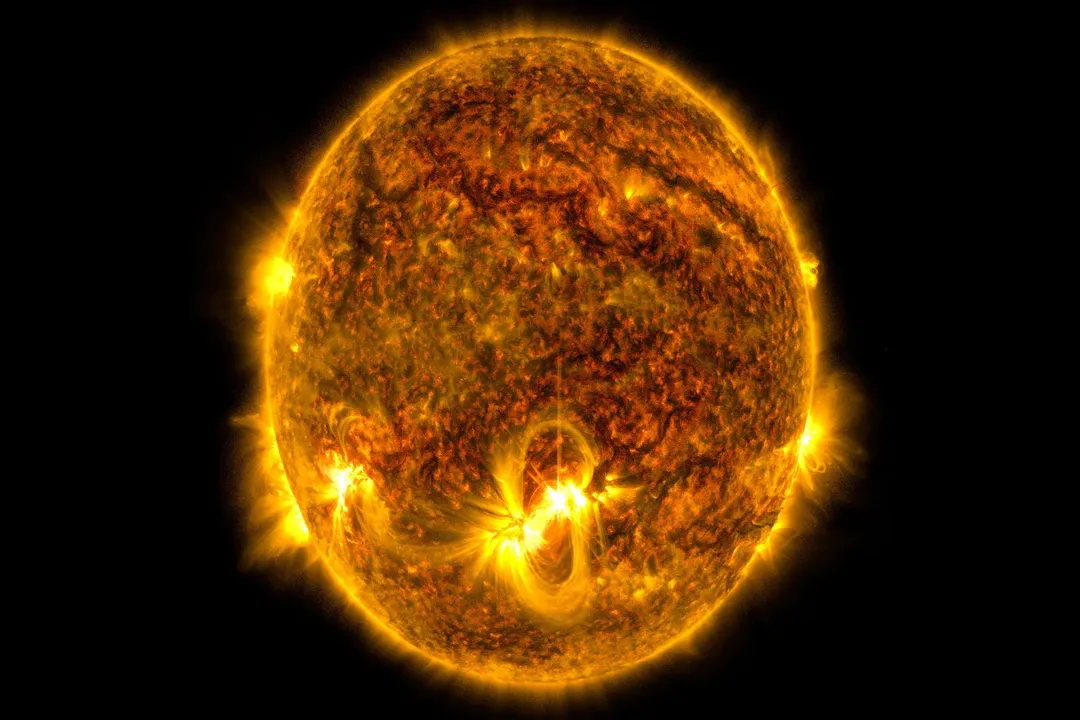
For the vast majority of its existence, a star maintains hydrostatic equilibrium, meaning the outward pressure generated by nuclear reactions perfectly balances the inward crush of gravity caused by its immense mass. This stable state is achieved by fusing hydrogen nuclei into helium nuclei within the star's core. This reaction pathway follows either the proton-proton chain or, more prominently in massive stars, the CNO cycle. The energy released during this fundamental conversion process provides the necessary thermal pressure to prevent the star from collapsing under its own weight until the core hydrogen fuel is completely exhausted.
Related Questions
What is the approximate primordial percentage of Hydrogen in interstellar clouds?What process fuels the majority of a stable star's life by counteracting gravity?Which specific fusion process creates Carbon from Helium nuclei in massive stars?In massive stars, what elements primarily result from the fusion of Carbon nuclei?Why does fusion halt when the core becomes dominated by Iron ($ ext{Fe}$)?What extreme event is necessary to create elements heavier than Iron, such as gold and uranium?What is the mechanism known as rapid neutron capture occurring during stellar death?When core hydrogen is depleted, what ignites in a shell surrounding the inert helium core?How does Hydrogen burning duration in a massive star compare to the Sun's?Which elements are specifically mentioned as being contributed by the s-process in AGB stars?What is the fate of elements synthesized in giant stars after the star dies?